Rewiring Qubit Connections Accelerates Quantum Error Correction By Orders Of Magnitude
Physics

Rewiring Qubit Connections Accelerates Quantum Error Correction By Orders Of Magnitude

Adding sparse long-range shortcuts to quantum circuits allows error-correcting codes to form in logarithmic depth and withstand twice the measurement rate.
By Aisha Ahmed
Published:
Email this Article
Rewiring Qubit Connections Accelerates Quantum Error Correction By Orders Of Magnitude
Photo by Brecht Corbeel on Unsplash

Physicists have discovered that rerouting just a few connections in a quantum circuit dramatically accelerates how quickly quantum error-correcting codes form. The new approach uses sparse networks where qubits enjoy short shortcuts across the system, much like how a few international flights can link distant cities on a globe.

Quantum computers are notoriously sensitive to noise, requiring robust error-correcting codes to protect fragile data. Traditional architectures often rely on rigid, grid-like layouts that struggle to balance code rates and distances without massive overhead. To tackle this bottleneck, researchers Samuel Bevins and Gregory Bentsen from William & Mary investigated what happens when quantum gates are distributed across Watts and Strogatz small-world networks. Their findings are available on the arXiv preprint server.

How Do Small-World Networks Alter Quantum Circuits?

In a standard one-dimensional ring of qubits, connections are strictly local, meaning each unit talks only to its immediate neighbors. The authors simulated monitored random Clifford circuits, which interleave entangling gates with frequent projective measurements. While these local circuits can generate protective codes, they typically require circuit depths that grow as a polynomial of the system size, making them slow to form.
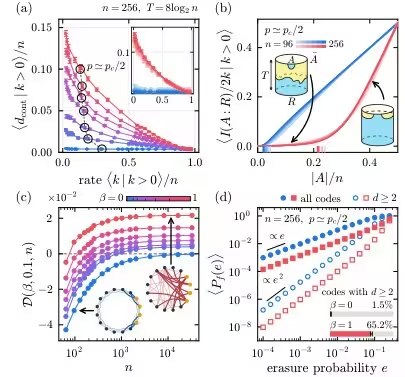
Figure 2: Small-world code properties. (a) Rate–distance trade-off, one point per pp, for β\beta from 0 (blue) to 1 (red); circles: p≃pc/2p\simeq p_{c}/2; inset: β=0\beta=0 and 1, n=96n=96–256. (b) Share of the encoded information held by the first |A||A| qubits; ticks: mean decoupling size A∗A^{*}. Cartoons: the circuit between RR (bottom) and A∪A¯A\cup\bar{A} (top), its domain wall bound to the top (AA exposed) or free in the bulk (AA protected). (c) Tension difference 𝒟⁡(β,0.1,n)\mathcal{D}(\beta,0.1,n) [41]; insets: a pinned arc AA (gold) and its bonds to the rest of the graph at β=0\beta=0 and 1. (d) Mean failure probability ⟨Pf​(e)⟩\langle P_{f}(e)\rangle under i.i.d. erasure, for all codes and those with d≥2d\geq 2; bars: the share with d≥2d\geq 2. Error bars: one standard error over graphs.
Small-world code properties. (a) Rate–distance trade-off, one point per pp, for β\beta from 0 (blue) to 1 (red); circles: p≃pc/2p\simeq p_{c}/2; inset: β=0\beta=0 and 1, n=96n=96–256. (b) Share of the encoded information held by the first |A||A| qubits; ticks: mean decoupling size A∗A^{*}. Cartoons: the circuit between RR (bottom) and A∪A¯A\cup\bar{A} (top), its domain wall bound to the top (AA exposed) or free in the bulk (AA protected). (c) Tension difference 𝒟⁡(β,0.1,n)\mathcal{D}(\beta,0.1,n) [41]; insets: a pinned arc AA (gold) and its bonds to the rest of the graph at β=0\beta=0 and 1. (d) Mean failure probability ⟨Pf​(e)⟩\langle P_{f}(e)\rangle under i.i.d. erasure, for all codes and those with d≥2d\geq 2; bars: the share with d≥2d\geq 2. Error bars: one standard error over graphs. Credit: Samuel Bevins et al. / arXiv

By introducing a rewiring probability denoted as beta, the team added random long-range connections while keeping the total number of edges constant. Even when only a small fraction of the bonds were rewired, creating the classic small-world property where the average path length scales logarithmically rather than linearly, the behavior of the quantum states shifted profoundly.

Why Does Logarithmic Depth Change Everything?

The simulations reveal that fully rewired small-world networks generate quantum codes in a circuit depth that grows only as the logarithm of system size, written as five times the natural logarithm of $n$. On a system of about two thousand qubits, this logarithmic scaling allows codes to form in roughly fifty layers of gates, compared to hundreds or thousands of layers required on a standard local ring.

Furthermore, these small-world codes achieve a finite rate and an extensive mean contiguous distance while failing significantly less often under random erasure. When tested against simulated qubit erasures, the fully rewired network codes showed failure rates more than six times lower than their local ring counterparts at equivalent operating points.
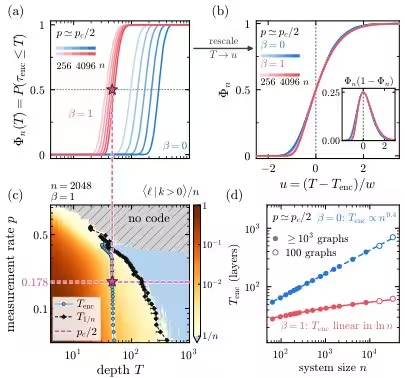
Figure 3: Short-depth coding transition. Colors as in Fig. 2. (a) Encoding fronts Φn​(T)=P⁡(τenc≤T)\Phi_{n}(T)=P(\tau_{\mathrm{enc}}\leq T), the share of circuits encoded by depth TT, at p≃pc/2p\simeq p_{c}/2, on the depth axis of (c); dashed: Φn=1/2\Phi_{n}=1/2, reached at TencT_{\mathrm{enc}}. (b) The same fronts against u=(T−Tenc)/wu=(T-T_{\mathrm{enc}})/w (arrow), with ww their interquartile width; inset: their variance Φn​(1−Φn)\Phi_{n}(1-\Phi_{n}) over circuits. (c) Mean fraction ⟨ℓ|k>0⟩/n{\langle\ell\,|\,k>0\rangle}/n of exposed qubits at n=2048n=2048 and β=1\beta=1, with TencT_{\mathrm{enc}} and T1/nT_{1/n}, past which ⟨ℓ|k>0⟩<1{\langle\ell\,|\,k>0\rangle}<1 (light blue); dashed: p≃pc/2p\simeq p_{c}/2 and the TencT_{\mathrm{enc}} of (a) at this nn and β\beta, which meet on the TencT_{\mathrm{enc}} front (stars). (d) TencT_{\mathrm{enc}} against nn at the rates of (b); lines: fits over n≥512n\geq 512, ∝n0.402\propto n^{0.402} on the ring and a+5.01​ln⁡na+5.01\ln n at β=1\beta=1. Bands in
Short-depth coding transition. Colors as in Fig. 2. (a) Encoding fronts Φn​(T)=P⁡(τenc≤T)\Phi_{n}(T)=P(\tau_{\mathrm{enc}}\leq T), the share of circuits encoded by depth TT, at p≃pc/2p\simeq p_{c}/2, on the depth axis of (c); dashed: Φn=1/2\Phi_{n}=1/2, reached at TencT_{\mathrm{enc}}. (b) The same fronts against u=(T−Tenc)/wu=(T-T_{\mathrm{enc}})/w (arrow), with ww their interquartile width; inset: their variance Φn​(1−Φn)\Phi_{n}(1-\Phi_{n}) over circuits. (c) Mean fraction ⟨ℓ|k>0⟩/n{\langle\ell\,|\,k>0\rangle}/n of exposed qubits at n=2048n=2048 and β=1\beta=1, with TencT_{\mathrm{enc}} and T1/nT_{1/n}, past which ⟨ℓ|k>0⟩<1{\langle\ell\,|\,k>0\rangle}<1 (light blue); dashed: p≃pc/2p\simeq p_{c}/2 and the TencT_{\mathrm{enc}} of (a) at this nn and β\beta, which meet on the TencT_{\mathrm{enc}} front (stars). (d) TencT_{\mathrm{enc}} against nn at the rates of (b); lines: fits over n≥512n\geq 512, ∝n0.402\propto n^{0.402} on the ring and a+5.01​ln⁡na+5.01\ln n at β=1\beta=1. Bands in Credit: Samuel Bevins et al. / arXiv

What Role Do Domain Walls Play in Protection?

To explain why long-range connectivity enhances error protection, the authors analyzed the system using an statistical mechanics picture based on entanglement domain walls. In this framework, competing forces between entangling gates and projective measurements determine whether quantum information remains secure or gets exposed to the environment.

On a local ring, domain walls fluctuate with limited freedom, keeping the tension uniform. In contrast, the team’s phenomenological Gaussian interface model indicates that long-range connectivity makes the bulk entropy sensitive to boundary pinning. Pinning an interface causes an extensive loss of entropy, creating a large energy difference between pinned and depinned domain walls that protects subregions scaling with the system size.
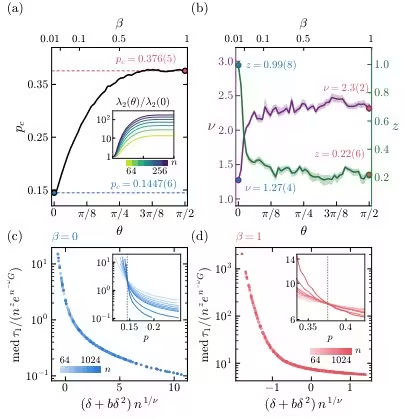
Figure 4: Measurement-induced purification from the ring to fully rewired graphs, from Eq. (1) fitted at each angle to y=ln⁡med​τ1y=\ln\mathrm{med}\,\tau_{1} over n=64n=64–1024; top axes: β=sin2⁡θ\beta=\sin^{2}\theta; blue and red: the ring and β=1\beta=1; their values, with statistical and systematic errors combined, as dashes in (a) and beside the end points in (b). (a) The critical rate pcp_{c}. Inset: the mean algebraic connectivity λ2\lambda_{2} relative to the ring’s, for n=64n=64–256 (key). (b) The correlation-length exponent ν\nu (plum, left) and the dynamical exponent zz (green, right). (c), (d) Collapses med​τ1/(nz​en−ω​G​(x))=eF⁡(x)\mathrm{med}\,\tau_{1}/\bigl(n^{z}e^{n^{-\omega}G(x)}\bigr)=e^{F(x)} against xx at β=0\beta=0 and 1, lighter for smaller nn (keys); insets: the same against pp, crossing at pcp_{c} (dashed). Bands in (a) and (b) (in (a) narrower than the line): 16–84% over 2000 graph resamples, statistical only.
Measurement-induced purification from the ring to fully rewired graphs, from Eq. (1) fitted at each angle to y=ln⁡med​τ1y=\ln\mathrm{med}\,\tau_{1} over n=64n=64–1024; top axes: β=sin2⁡θ\beta=\sin^{2}\theta; blue and red: the ring and β=1\beta=1; their values, with statistical and systematic errors combined, as dashes in (a) and beside the end points in (b). (a) The critical rate pcp_{c}. Inset: the mean algebraic connectivity λ2\lambda_{2} relative to the ring’s, for n=64n=64–256 (key). (b) The correlation-length exponent ν\nu (plum, left) and the dynamical exponent zz (green, right). (c), (d) Collapses med​τ1/(nz​en−ω​G​(x))=eF⁡(x)\mathrm{med}\,\tau_{1}/\bigl(n^{z}e^{n^{-\omega}G(x)}\bigr)=e^{F(x)} against xx at β=0\beta=0 and 1, lighter for smaller nn (keys); insets: the same against pp, crossing at pcp_{c} (dashed). Bands in (a) and (b) (in (a) narrower than the line): 16–84% over 2000 graph resamples, statistical only. Credit: Samuel Bevins et al. / arXiv

How Does Rewiring Shift the Purification Transition?

The transition where a quantum circuit loses its capacity to store information, known as the purification transition, also changes under network rewiring. The critical measurement rate, designated as $pc$, marks the threshold where measurements overwhelm scrambling and destroy the code.

The team found that increasing network nonlocality raises the critical measurement rate from zero point one four five on the ring to zero point three seven six on fully rewired graphs. This means small-world circuits can withstand more than twice the measurement rate while still preserving quantum information, altering the critical exponents that govern the phase transition.

The study was posted to the arXiv preprint server on November 23, 2026.

Fact Checked

This article has been fact checked for accuracy, with information verified against reputable sources. Learn more about us and our editorial process.

Last reviewed on .

Article history

  • Latest version

Reference(s)

  1. Bevins, Samuel. “Small-world networks yield tunable quantum codes at short circuit depth.” arXiv.org <http://arxiv.org/abs/2611.31224v1>.

Cite this page:

Ahmed, Aisha. “Rewiring Qubit Connections Accelerates Quantum Error Correction By Orders Of Magnitude.” BioScience. BioScience ISSN 2521-5760, 24 November 2026. <https://www.bioscience.com.pk/en/subject/physics/small-world-networks-yield-tunable-quantum-codes-at-short-circuit-depth>. Ahmed, A. (2026, November 24). “Rewiring Qubit Connections Accelerates Quantum Error Correction By Orders Of Magnitude.” BioScience. ISSN 2521-5760. Retrieved November 24, 2026 from https://www.bioscience.com.pk/en/subject/physics/small-world-networks-yield-tunable-quantum-codes-at-short-circuit-depth Ahmed, Aisha. “Rewiring Qubit Connections Accelerates Quantum Error Correction By Orders Of Magnitude.” BioScience. ISSN 2521-5760. https://www.bioscience.com.pk/en/subject/physics/small-world-networks-yield-tunable-quantum-codes-at-short-circuit-depth (accessed November 24, 2026).
End of the article