One in Ten Hospitalized Spinal Infection Patients Also Faces Hidden Heart Valve Disease
New research reveals that roughly ten percent of adults with vertebral osteomyelitis carry a co-occurring heart valve infection linked to specific bacteria and longer hospital stays.

About one in ten adults hospitalized with spinal infections also suffer from a dangerous co-occurring heart valve infection, according to a large retrospective study. Researchers found that this hidden overlap frequently ties into specific bacterial strains and repeated positive blood tests, pointing to a distinct clinical profile that can severely prolong hospital stays.
Spinal infections, such as vertebral osteomyelitis and discitis involving inflammation of the bones and discs in the spine, carry substantial health risks. They often trigger prolonged hospitalizations and severe pain. For years, clinicians have known that these spinal issues can sometimes coincide with published in the Journal of Bone and Joint Infection, a serious endovascular condition where bacteria or fungi colonize the inner heart lining or valves. Until now, routine-care estimates and exact microbiological descriptions of how often these two conditions strike together remained surprisingly limited across large patient populations.
How Many Patients Face Both Conditions in Routine Care?
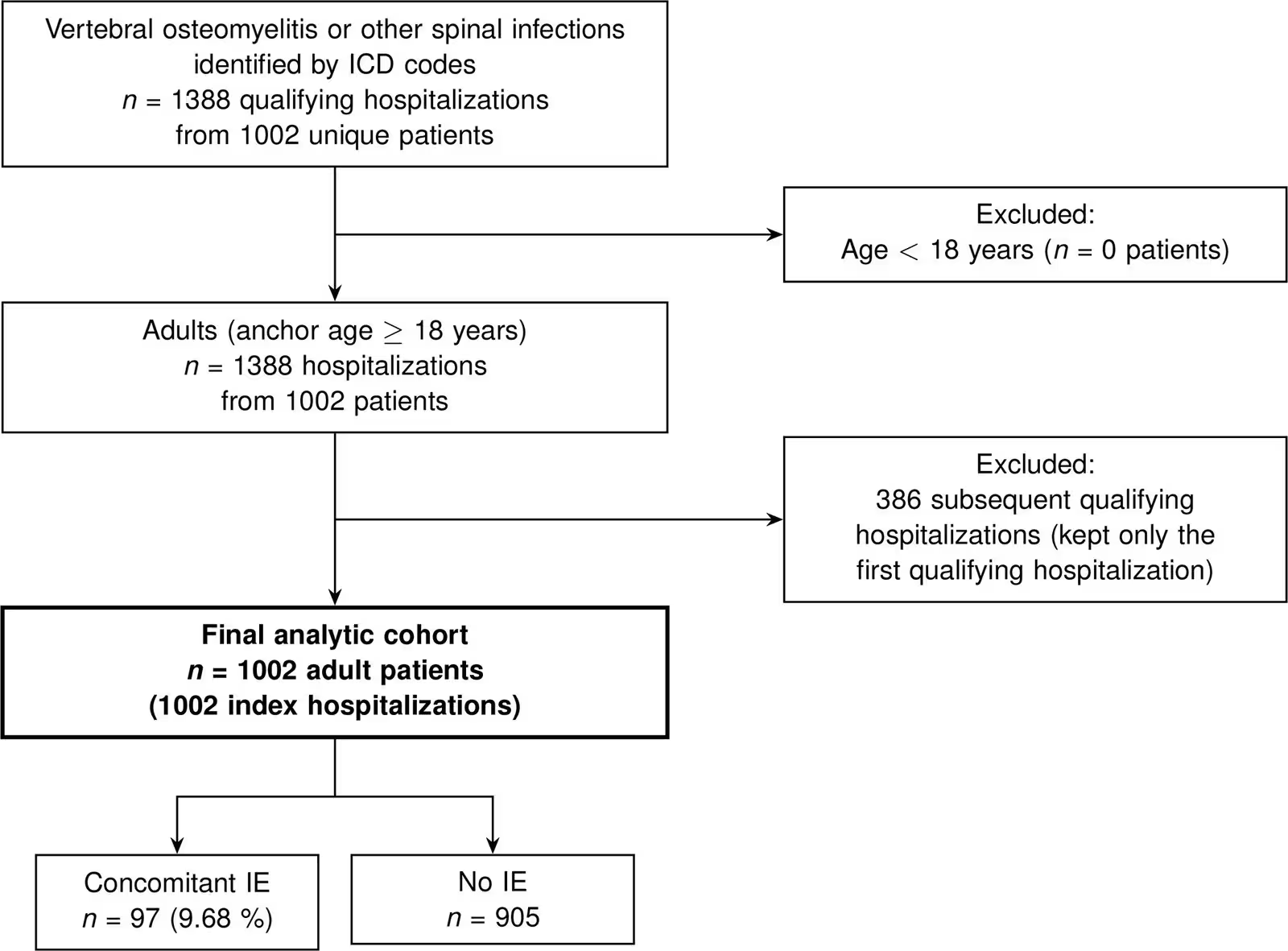
Led by researcher Jinghao Liu at the Saint Louis University School of Medicine alongside colleagues Wenwen Guo and Ramy A. Shoela, the team analyzed real-world electronic health records to measure the true scope of the problem. They drew data from a publicly available critical care database known as the Medical Information Mart for Intensive Care IV, capturing adults hospitalized with diagnosis codes for spinal infections. Out of one thousand two unique patients evaluated in the primary cohort, ninety-seven individuals, representing about nine point six eight percent, carried coded diagnoses of infective endocarditis during their index hospitalization.
To ensure the findings were robust, the researchers tested multiple alternative definitions. Using a broader definition of heart valve inflammation yielded a ten point three eight percent overlap. Meanwhile, focusing strictly on a narrower cohort of nine hundred seventeen patients with native vertebral osteomyelitis revealed an eight point eight three percent overlap. Across every cohort and case definition tested, the prevalence hovered consistently near one in ten hospitalized patients.
Which Bacterial Strains Drive the Hidden Heart Infection Risk?
When the researchers adjusted their statistical models to account for potential confounding factors like age and sex, specific microbiological risk factors emerged clearly. Patients with spinal infections were more than three times as likely to have co-occurring heart valve involvement if they tested positive for Enterococcus bacteria. The risk spiked even further with Streptococcus species, showing an adjusted odds ratio of more than five. Furthermore, patients with repeated positive blood cultures of the same bacterial group on two or more distinct dates faced a fourfold increase in the likelihood of a heart valve diagnosis.
Curiously, while Staphylococcus aureus is widely recognized as a leading cause of heart valve infections overall, its adjusted association with co-occurring spinal and heart infections was attenuated and did not reach statistical significance in the primary adjusted model. However, when the authors evaluated secondary phenotypes involving septic pulmonary emboli, which occur when infected blood clots travel from the heart to the lungs, those emboli showed a striking association with heart valve involvement, with an adjusted odds ratio approaching nine point five.
What Does This Mean for Hospital Recovery Times?
The dual burden of spinal and heart infections took a heavy toll on patient recovery trajectories. Unadjusted figures showed that patients with both conditions experienced a crude mean hospital stay of twenty-one point five days, compared to fourteen point five days for patients with spinal infections alone. After thorough statistical adjustment, co-occurring heart valve infection remained significantly linked to longer hospitalizations, raising the adjusted odds of staying fourteen days or longer by eighty-one percent, and doubling the odds of staying twenty-one days or longer.
Despite the extended hospital stays, adjusted mortality rates at thirty days, ninety days, and one year did not show a statistically significant difference between the two groups. The authors noted several limitations in their work, including its single-center design and reliance on diagnosis codes rather than formal chart-based diagnostic criteria like the Duke criteria. Because the electronic health records lacked detailed valve-level echocardiographic descriptions, the exact mechanisms linking specific bacterial strains to heart valve colonization require further validation in prospective clinical cohorts.
The research was published in Journal of bone and joint infection on November 17, 2026.
This article has been fact checked for accuracy, with information verified against reputable sources. Learn more about us and our editorial process.
Last reviewed on .
Article history
- Latest version
Reference(s)
- Liu, Jinghao., et al. “Concomitant infective endocarditis in vertebral osteomyelitis and other spinal infections: a retrospective cohort study.” Journal of Bone and Joint Infection, vol. 11, no. 6, November 17, 2026, pp. 715-722. Copernicus GmbH, doi: 10.5194/jbji-11-715-2026. <https://doi.org/10.5194/jbji-11-715-2026>.
Cite this page:
- Posted by Tariq Hassan