Over Three Quarters Of Online Fact-Checking Notes Never Receive A Verdict
Analysis of over two hundred million ratings shows complex moderation algorithms act as gatekeepers rather than changing crowd conclusions.
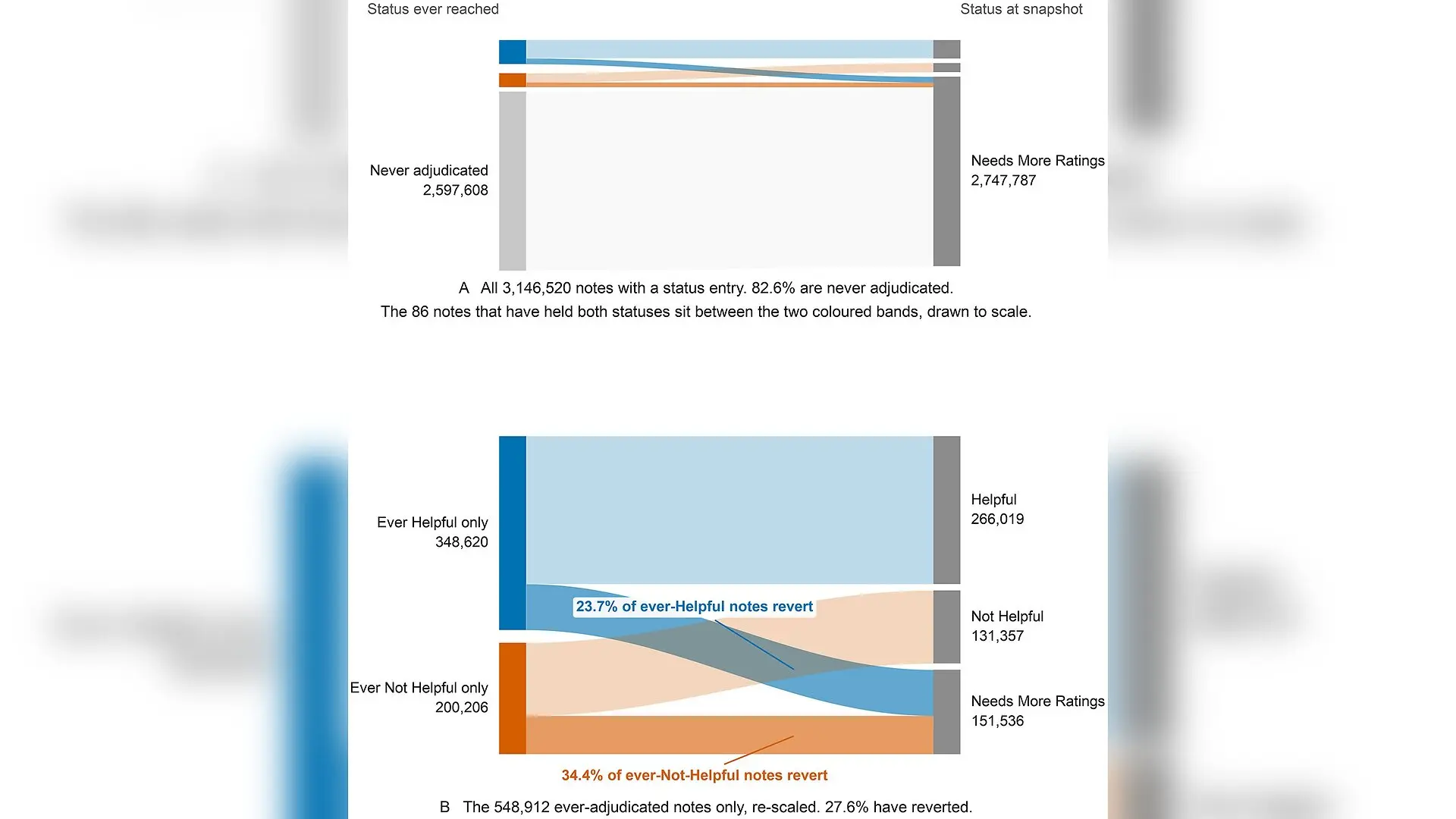
Nearly three-quarters of fact-checking notes submitted by users on social media never receive a final verdict from the platform, revealing a hidden bottleneck in crowd moderation. An analysis of over three million posts shows that complex algorithmic rules designed to force agreement across opposing political viewpoints mostly decide which notes get evaluated at all, rather than dictating how those notes are judged.
The research, published in PLOS One under the title Community Notes shows a note only when contributors who usually disagree with each other rate it helpful, examines the mechanics behind X’s massive crowdsourced fact-checking system. Francis D. Kim analyzed a public dataset snapshot containing more than two hundred twenty-seven million individual ratings across over three million notes. The findings challenge assumptions about how online crowds build consensus and expose deep asymmetries in how corrective information is treated.
Why Do Three Out Of Four Fact-Checking Notes Remain Stuck In Limbo?
Most community correction notes never escape their initial review state, known as Needs More Ratings. Out of more than three million notes carrying status entries in the dataset, only about seventeen percent have ever left that undecided status. Even among a heavily filtered subset of notes that collected at least ten ratings each, roughly seventy-five percent never reached a definitive conclusion.
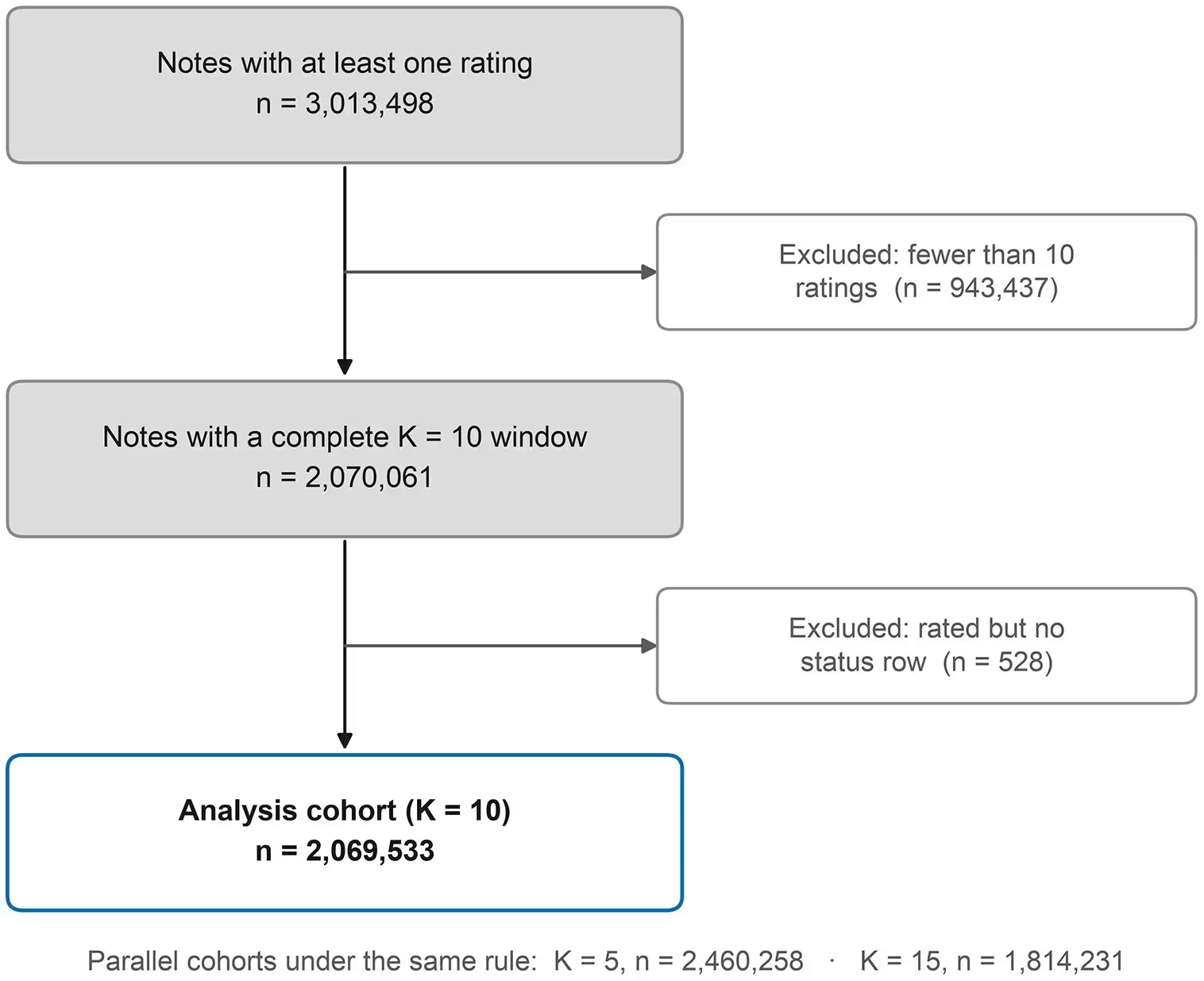
This persistent backlog is not simply a matter of low user engagement or split opinions. The platform relies on a bridging algorithm designed to prevent partisan groups from hijacking the system. Instead of counting raw majority votes, the software only awards a helpful status when a note draws support from contributors who have historically disagreed with one another.
When Kim tested the predictive power of early voting patterns, a surprising phenomenon emerged. Notes whose first ten raters were evenly divided almost never received a verdict, but unanimous early support was no guarantee either. Even when ten consecutive raters all marked a note as helpful, it achieved an official judgment less than half of the time.
Does A Bridging Algorithm Actually Change How Crowds Decide?
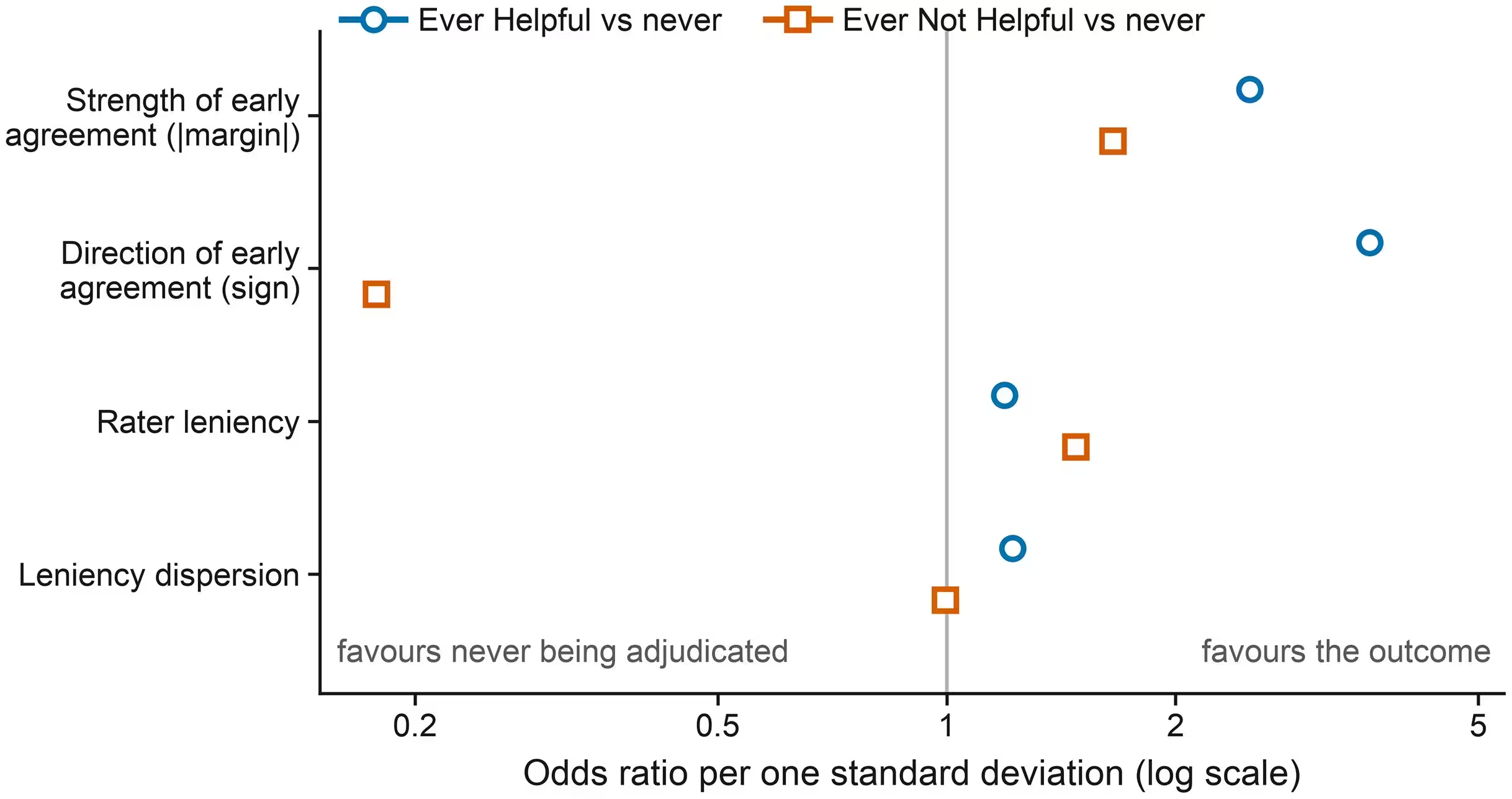
Once a note does manage to cross the threshold and receive a verdict, the sophisticated bridging model stops behaving differently from a simple majority vote. Kim found that the final verdict whether helpful or not helpful can be reproduced almost perfectly by calculating an unweighted count of the first ten ratings.
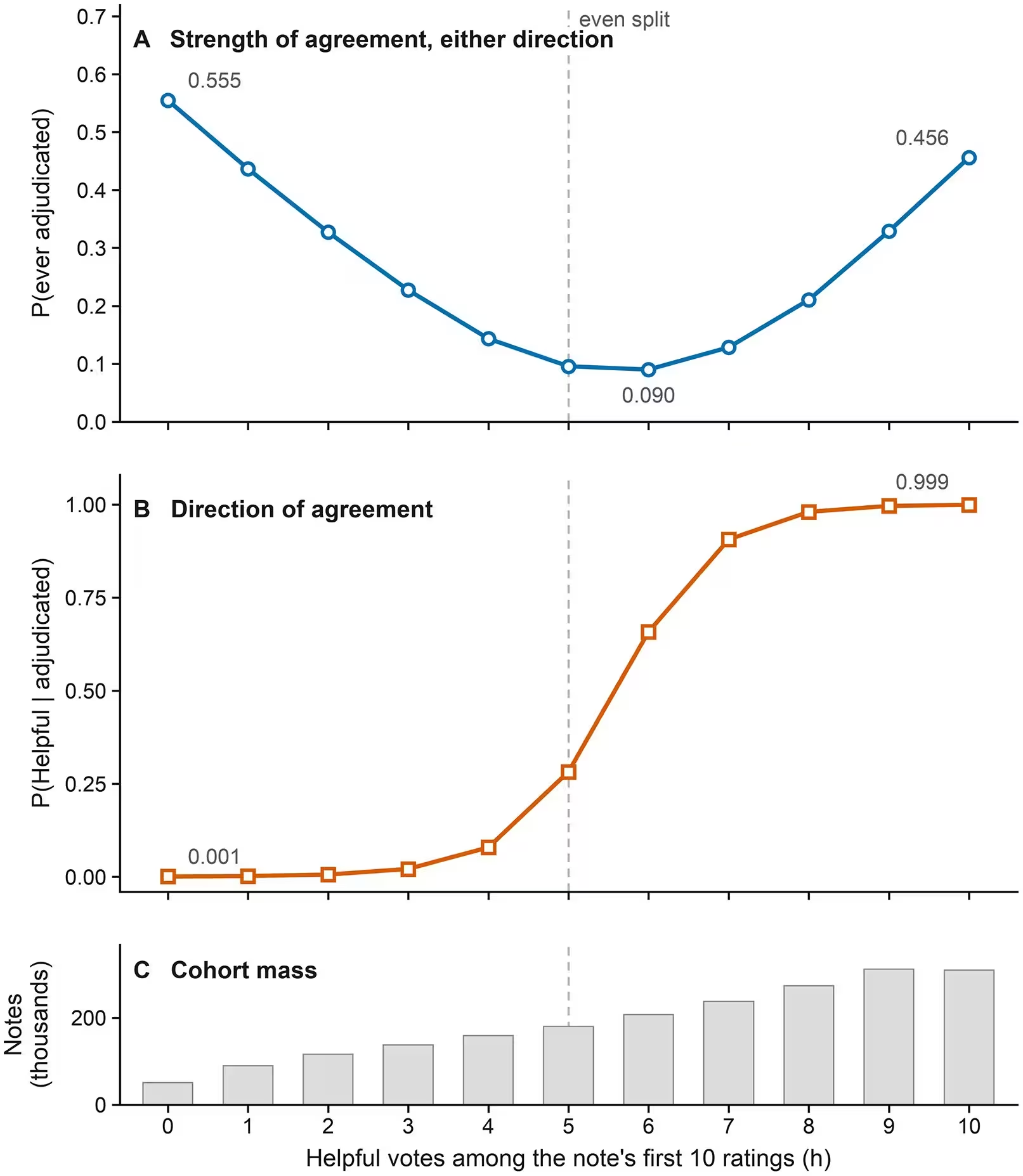
This indicates that the algorithm’s primary effect happens at the gatekeeping stage rather than the scoring stage. The complex mathematical rules do not necessarily alter the crowd’s final conclusion, but they act as a strict filter determining which pieces of context ever become visible to the general public.
Furthermore, the data reveal that a verdict is not a permanent state. Among all notes that ever achieved a decision, more than a quarter eventually slipped back into the undecided pool. This reversal rate was notably asymmetric, as notes previously judged as unhelpful lost their status nearly ten percent more often than those marked helpful.
What Limits Did The Researcher Encounter In The Data?
The study relies exclusively on public metadata without access to the underlying text, specific topics, author identities, or network connection maps. Because the analysis used a single cross-sectional snapshot of the platform, it could not track the long-term career of every single note or establish direct causal links between specific demographic shifts and adjudication speeds.
Additionally, the mathematical models assume statistical independence across notes, even though highly active super-contributors frequently appear in the early voting windows of multiple different posts. Kim noted that future work should employ competing-risks time-to-event models and reconstruct the latent rater factors directly from raw ratings matrices to fully map out viewpoint diversity.
The research was published in PLOS One on November 23, 2026.
This article has been fact checked for accuracy, with information verified against reputable sources. Learn more about us and our editorial process.
Last reviewed on .
Article history
- Latest version
Reference(s)
- Kim, Francis D.. “Early predictors of consensus in X's Community Notes: separating adjudication from verdict.” PLOS One, vol. 21, no. 11, November 23, 2026, pp. e0354388 Public Library of Science (PLoS), doi: 10.1371/journal.pone.0354388. <https://doi.org/10.1371/journal.pone.0354388>.
Cite this page:
- Posted by Karan Das