Supercomputer Models Reveal How Carbon Nanorackets Could Power Quantum Logic Gates
Advanced atomistic simulations and machine learning potentials are transforming how scientists design carbon-based quantum architectures on metal surfaces.
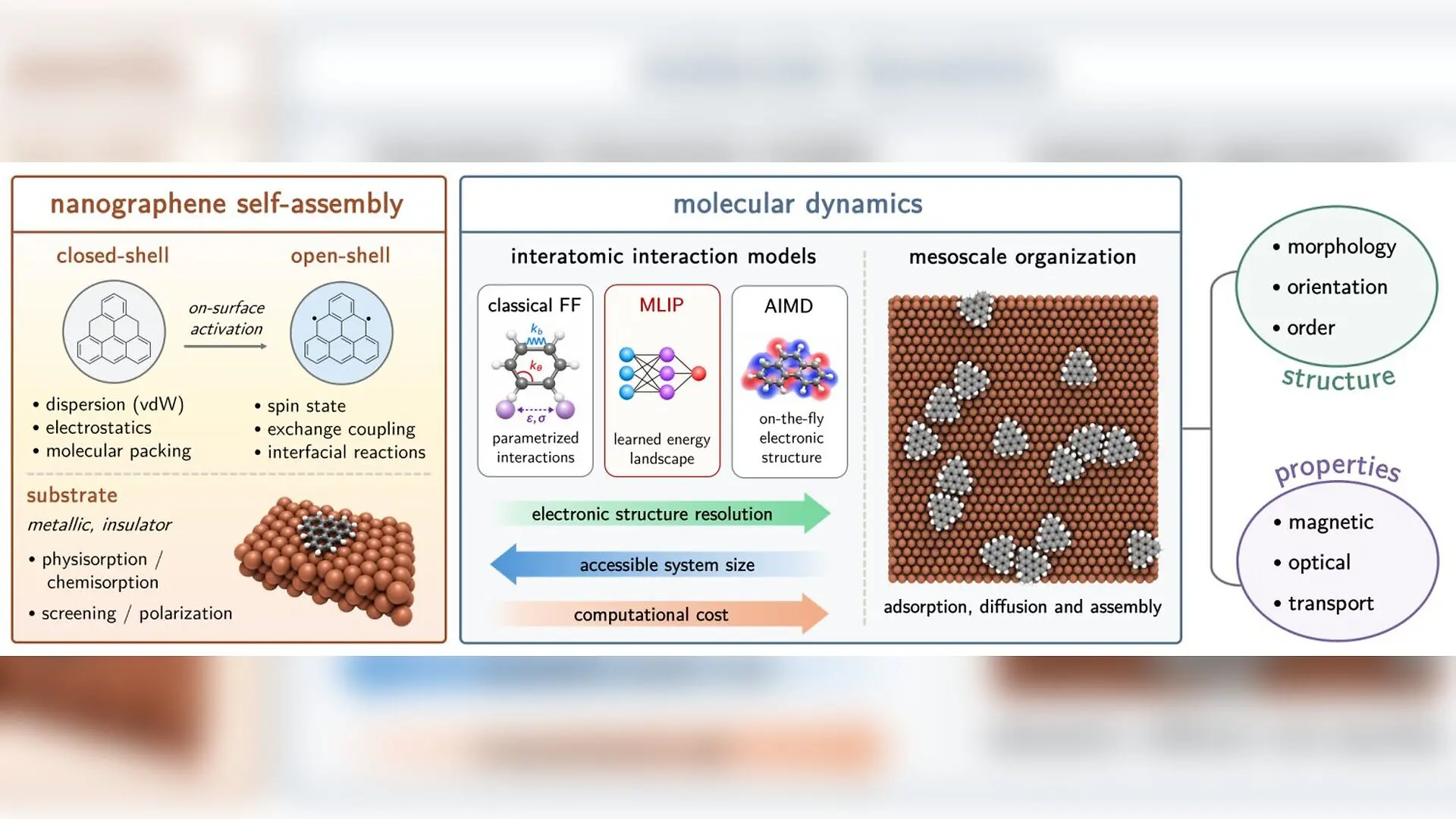
Tiny flakes of carbon just one atom thick can hold localized magnetic moments, offering a promising path toward carbon-based quantum computing architectures. Antonio Lorenzo Mariano and colleagues from the Università degli Studi di Firenze published a review available on the arXiv preprint server that explores how quantum chemists use multiscale atomistic methods to model these magnetic carbon structures before they are synthesized in the laboratory.
Quantum computers require qubits that can maintain fragile states of superposition and entanglement without decaying. Traditional solid-state technologies built on silicon or superconducting circuits suffer from manufacturing flaws and atomic defects that disrupt these quantum states. Carbon lattices present an attractive alternative because carbon atoms possess very weak spin-orbit coupling, meaning their electronic spins are shielded from external magnetic disruptions. Furthermore, carbon can be purified to contain only the carbon twelve isotope, eliminating nuclear spin noise entirely and theoretically allowing electron spin coherence times to stretch past hundreds of microseconds.
To harness this potential, researchers build atomically precise nanographenes using bottom-up chemical synthesis on metal surfaces under ultrahigh-vacuum conditions. The magnetic behavior of these molecules is dictated by their edges, particularly zigzag geometries that host unpaired electrons and localized topological zero-modes. The magnetic exchange interaction connecting these spin centers is exponentially sensitive to spatial distance and bonding topology, meaning even a tiny structural defect can destroy the entangled state. Computational modeling is therefore vital for predicting these magnetic properties prior to physical fabrication.
How Do Effective Hamiltonians Reveal the Magnetic Origin of Carbon Rings?
Predicting the electronic behavior of large carbon networks starting directly from the full many-electron Schrödinger equation is mathematically impossible for anything beyond the smallest systems. Physicists instead rely on a hierarchy of simplified effective lattice models defined on the carbon pi orbitals. The simplest approach, known as the Huckle model, treats electrons as moving through a nearest-neighbor hopping network while ignoring electrostatic repulsion. Solving this model for alternating hydrocarbon lattices reveals that zigzag edges naturally host non-bonding molecular orbitals where electrons become strongly localized at the boundaries without needing interaction terms.
To capture magnetism, researchers must introduce the Hubbard model, which adds an energetic penalty whenever two electrons try to occupy the same carbon atomic orbital. This creates a delicate competition between electron hopping, which spreads charge across the entire molecule, and on-site Coulomb repulsion, which localizes spins. For half-filled bipartite lattices, physicist Elliott Lieb proved mathematically that the total ground-state spin depends entirely on the difference in the number of carbon atoms assigned to opposing sublattices. In the strongly correlated limit where charge fluctuations freeze out, the Hubbard model simplifies further into the Heisenberg Hamiltonian, allowing scientists to calculate exact magnetic exchange coupling constants.
Why Must Researchers Look Beyond Standard Density Functional Theory for Metal Surfaces?
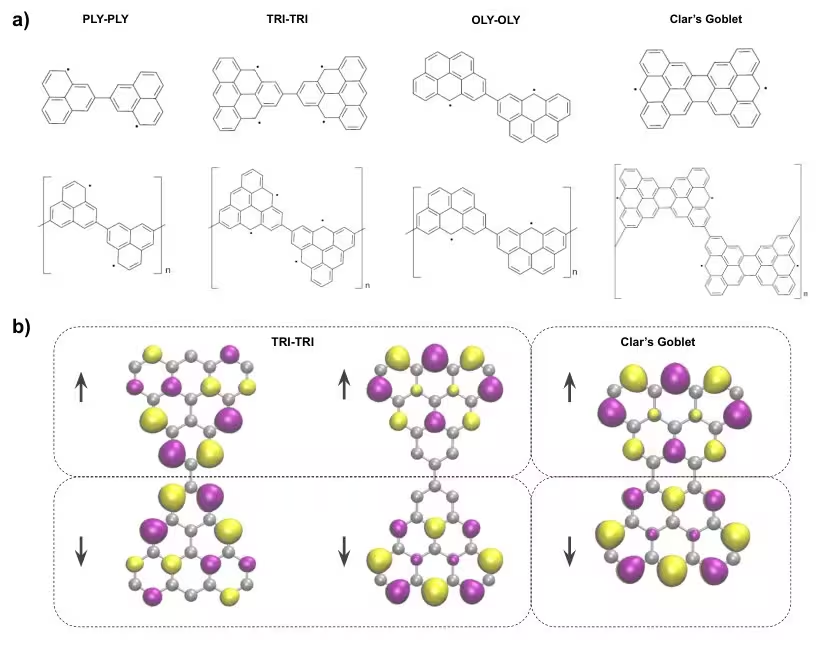
When moving to quantitative calculations, standard Kohn-Sham density functional theory acts as the primary workhorse because it can handle systems containing hundreds of atoms. However, standard density functional theory struggles with open-shell nanographenes because their ground states often require a multiconfigurational description that a single Slater determinant cannot capture. To fix this for antiferromagnetically coupled systems, researchers use broken-symmetry approaches that relax spin symmetry to stabilize opposing spin orientations, applying projection schemes like those developed by Noodleman, Ruiz, or Yamaguchi to extract reliable exchange couplings.
Furthermore, isolating molecules on metallic substrates like gold, silver, or copper introduces severe environmental complications. When an electron is added to a nanographene via a scanning tunneling microscope tip, the two-dimensional electron gas of the underlying metal reacts instantly, creating a dynamic image charge that electrostatically screens the added carrier. This screening effect shifts orbital energy levels and shrinks the fundamental electronic gap by roughly one electron volt compared to gas-phase calculations. To match experimental spectroscopy data, theorists must employ many-body perturbation theory through the GW approximation or apply semi-classical image-charge corrections.
What Role Do Machine Learning Potentials Play in Future Nanomanufacturing?
Synthesizing these quantum carbon structures involves complex surface reactions, such as the Ullmann coupling of halogenated precursors followed by cyclodehydrogenation via the Scholl reaction. Mapping out the potential energy surface to find activation barriers and transition states traditionally requires slow, manual quantum chemical calculations using algorithms like the nudged elastic band method. As molecular precursors grow heavier and more intricate, manual exploration becomes entirely unfeasible.
To overcome this computational bottleneck, modern atomistic modeling is turning toward machine learning interatomic potentials trained on extensive quantum chemical databases. These surrogate neural network architectures can predict atomic forces and total energies with near-first-principles precision while running up to ten thousand times faster. By coupling these machine learning models with automated reaction network explorers and coarse-grained molecular dynamics, researchers hope to transform computational chemistry from a purely explanatory tool into a fully predictive pipeline for designing custom quantum carbon materials.
The study was posted to the arXiv preprint server on November 23, 2026.
This article has been fact checked for accuracy, with information verified against reputable sources. Learn more about us and our editorial process.
Last reviewed on .
Article history
- Latest version
Reference(s)
- Mariano, Antonio. “Molecular Pawns on a Surface Chessboard: Computational Investigation of Nanographenes with Atomistic Methods.” arXiv.org <http://arxiv.org/abs/2611.30917v1>.
Cite this page:
- Posted by Nida Rehman