Blade Icing Cuts Wind Turbine Power By Nearly Half And Triggers Flutter Risk
New simulations reveal how rime and glaze ice distort blade geometry, destroy lift, and narrow structural vibration margins.

Ice accretion on wind turbine blades can slash electricity generation by nearly half and dangerously narrow the vibration margin between blade bending and twisting, according to a numerical study. When temperatures drop and humidity rises in cold regions, frozen deposits alter the aerodynamic shape of turbine blades, triggering premature airflow separation and substantial mechanical stress.
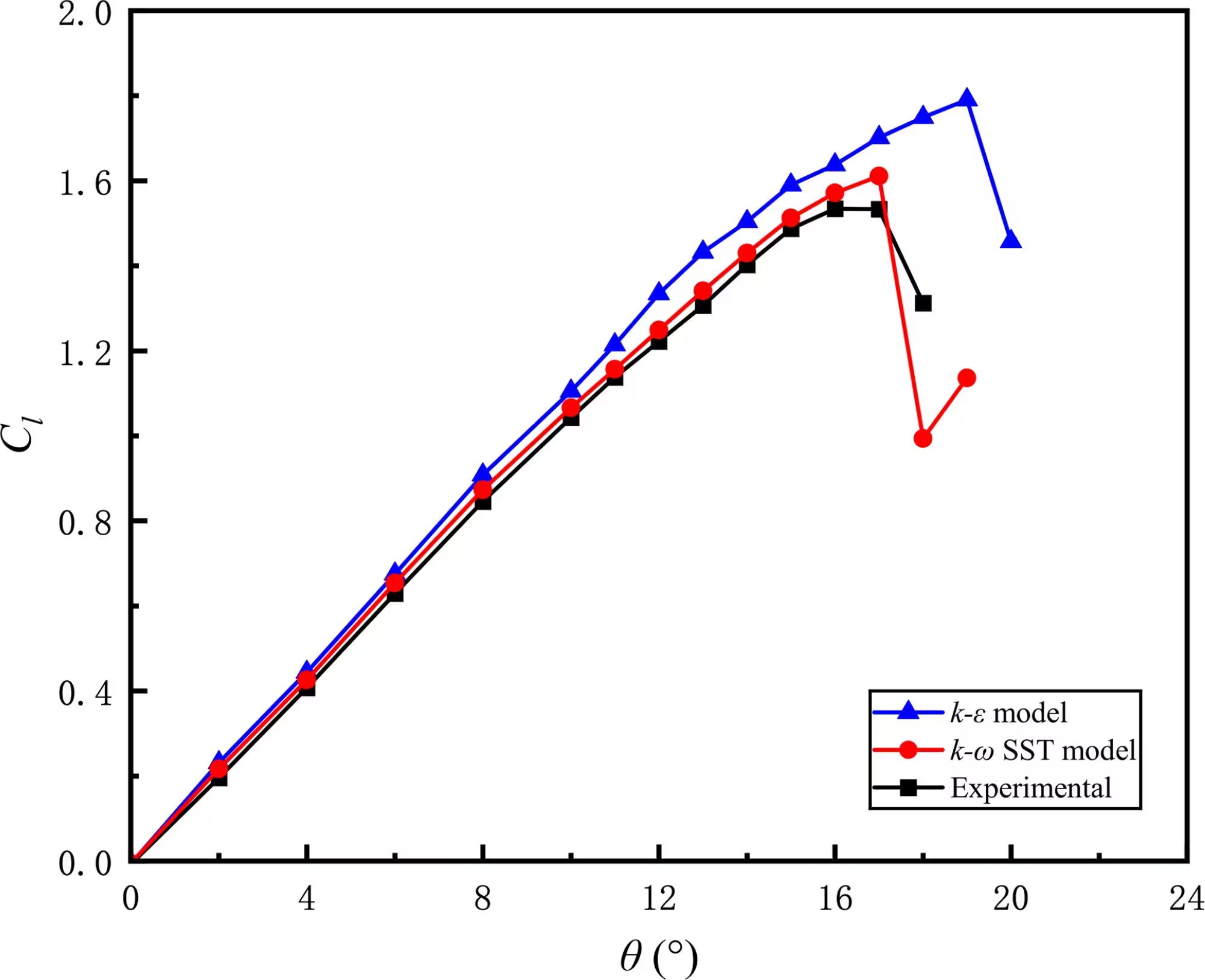
To clarify how different environmental conditions alter ice shapes and mechanical performance, Chongshuai Wang from North China Electric Power University and colleagues conducted a systematic parametric investigation. Their research, published in PLOS One, combined computational fluid dynamics simulations, droplet transport models, and structural dynamic analysis to evaluate both rime and glaze ice formation on wind turbine blades.
How Do Different Ice Types Form on Turbine Blades?
Atmospheric icing is generally divided into two main categories depending on how fast water droplets freeze upon impact. Rime ice forms when supercooled water droplets freeze almost instantly upon hitting the blade surface, capturing air bubbles and creating a relatively smooth, opaque, and compact layer concentrated near the leading edge.
By contrast, glaze ice forms at temperatures closer to freezing, where droplets do not solidify immediately. This creates a liquid water film that flows backward along the airfoil surface before eventually freezing into translucent, dense, and irregular shapes featuring sharp ice horns. The researchers found that the ice-covered area on a typical NACA 4412 airfoil grew rapidly during the first twenty minutes of exposure before slowing down, and glaze ice consistently produced a larger affected area than rime ice under comparable conditions.
What Environmental Factors Accelerate Ice Accumulation?
The study evaluated how various meteorological parameters influence ice morphology and growth. When the liquid water content in the air increased from half a gram to one and a half grams per cubic meter, the final ice-covered area more than tripled for both ice types after thirty minutes of exposure. Similarly, increasing the median volume diameter of the water droplets from twenty to forty micrometers allowed larger, heavier droplets to deviate from airflow trajectories and strike the blade surface more frequently.
Airflow velocity also played a critical role. Raising the wind speed from forty to eighty meters per second increased the 30-minute ice-covered area by nearly forty-four percent for both rime and glaze ice. Furthermore, the researchers discovered that ice crystals suspended in the airflow interacted with supercooled water droplets, significantly enhancing glaze ice formation when ice crystal concentrations and sizes increased.
How Much Power Is Lost When Wind Turbines Ice Up?
To measure the ultimate impact on energy production, the authors applied their simulated glaze ice profiles to an NREL five-megawatt wind turbine model using OpenFAST software. Under clean operating conditions, the turbine reached its rated power output at a wind speed of eleven point four meters per second. However, with iced blades, the turbine failed to achieve rated power until the wind speed reached seventeen meters per second, representing a maximum power loss of about forty-six percent across the evaluated wind speeds.
The geometric distortion caused by ice deposits degraded aerodynamic performance by increasing drag and reducing lift. For instance, at a four percent ice thickness ratio, the lift-to-drag ratio plummeted by thirty-two percent for rime-iced airfoils and by sixty percent for glaze-iced airfoils compared to a clean blade.
Does Blade Icing Increase the Risk of Structural Failure?
Beyond power losses, blade icing altered the structural dynamics of the wind turbine. The maximum flapwise tip displacement dropped by thirty-four percent under iced conditions, while edgewise tip displacement increased by nearly twenty-one percent. Most critically, modal analysis revealed that the frequency separation between the first flapwise bending mode and the first torsional mode shrank from five point zero five hertz for a clean blade down to four point seventy-three hertz when ice thickness reached six percent.
This narrowing frequency gap brings the vibration modes dangerously close together, increasing the likelihood of classical flutter and violent aeroelastic instability. The authors note that while two-dimensional sectional simulations successfully isolated primary aerodynamic trends, future research must incorporate full three-dimensional rotating blade models and time-varying atmospheric conditions to further refine ice-mitigation strategies for cold-climate wind farms.
The research was published in PLOS One on November 23, 2026.
This article has been fact checked for accuracy, with information verified against reputable sources. Learn more about us and our editorial process.
Last reviewed on .
Article history
- Latest version
Reference(s)
- Wang, Chongshuai., et al. “Aerodynamic analysis of iced wind turbines based on numerical simulation.” PLOS One, vol. 21, no. 11, November 23, 2026, pp. e0354214 Public Library of Science (PLoS), doi: 10.1371/journal.pone.0354214. <https://doi.org/10.1371/journal.pone.0354214>.
Cite this page:
- Posted by Farah Siddiqui