Physicists Design New Quantum Decoder That Heals Lost Qubits Without Measuring Them
A novel approach using nested linear codes and entropy extraction successfully reconstructs fragile quantum states damaged by photon loss.
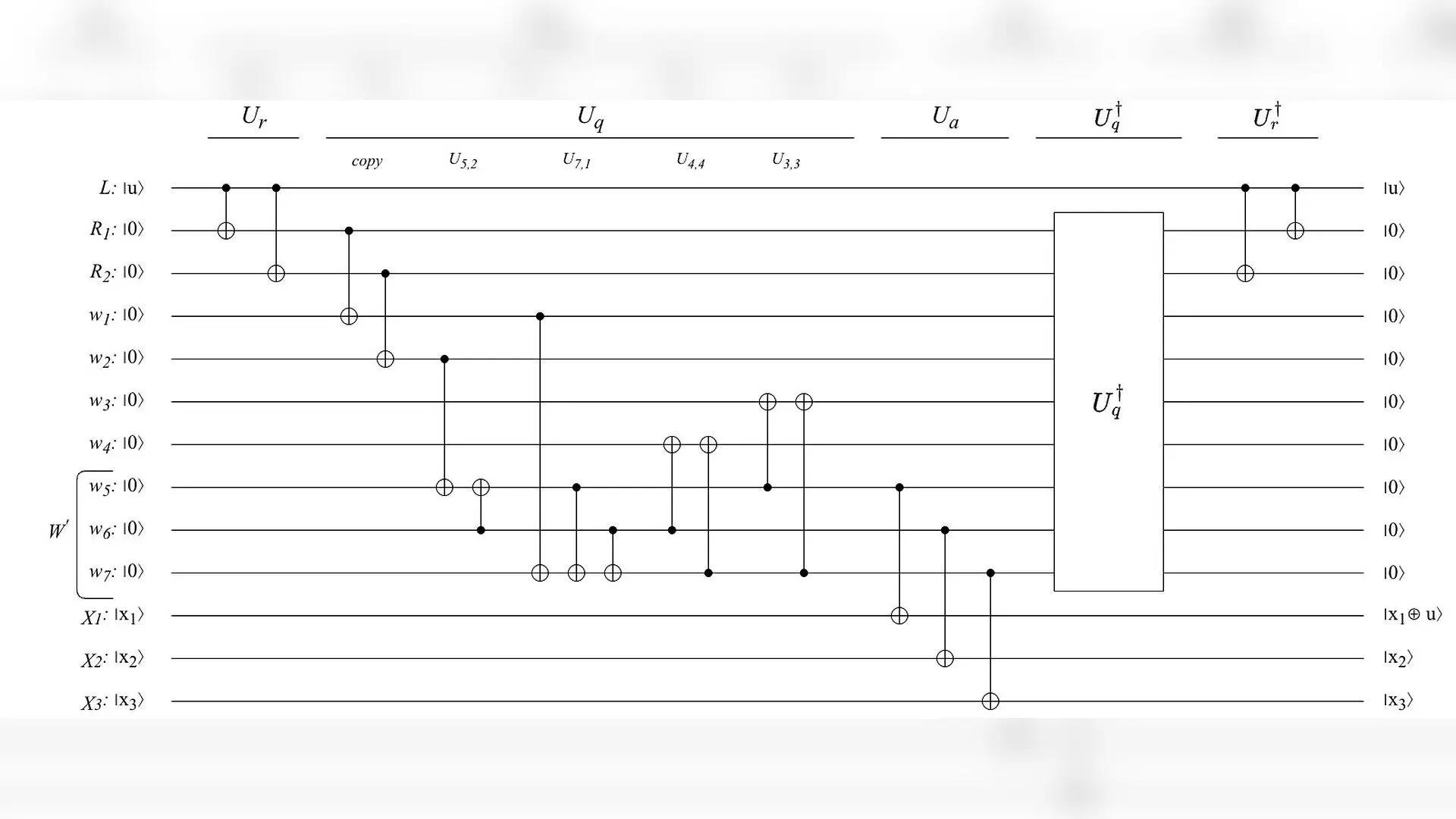
Physicists have developed a new quantum decoding architecture that can successfully heal lost quantum information without measuring the surviving qubits, solving a long-standing challenge in quantum communication. When photons or qubits travel across a noisy channel, losses leave behind an entangled mixture of environmental states that typically destroys delicate quantum properties.
To tackle this fragility, researchers Aditya Guhagarkar, S. Sandeep Pradhan, and Achilleas Anastasopoulos from the University of Michigan introduced a recovery framework based on nested linear codes, which is available on the arXiv preprint server. Think of it like a sophisticated filing system where an outer code reconstructs missing data, while an inner code scrambles and quantizes the information to prevent leaks into the environment.
How Can Quantum States Be Healed Without Measuring Surviving Qubits?
Traditional error correction relies heavily on measuring syndrome bits, a process that can disrupt the exact quantum state you are trying to preserve. The new study proposes two distinct decoder architectures that bypass direct measurement of surviving code variables. Architecture I uses a classically prepared schedule of binary operations, employing controlled NOT gates to reconstruct lost symbols and perform quantum state healing entirely behind the scenes.
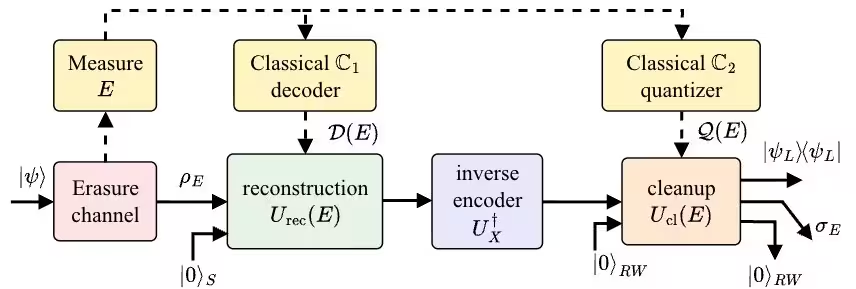
The research team demonstrated their approach using the standard seven-qubit Steane code, showing how the system handles erasure events where multiple physical positions are wiped out. By applying an inverse binary encoder followed by a specialized cleanup operation, the decoder isolates the core logical states from the random noise introduced by the environment. The mathematical proof guarantees that the residual environmental state remains completely independent of the original logical input.
What Role Does Entropy Extraction Play in Advanced Quantum Recovery?
The underlying physics of the process resembles a microscopic sorting machine, drawing comparisons to a quantum-scale version of Maxwell’s demon. As quantum states travel through an erasure channel, von Neumann entropy spreads across the system, distributing disorder into environmental branches. The proposed decoder acts as an entropy extractor, siphoning disorder away from the valuable data and dumping random ancilla states into the environment.
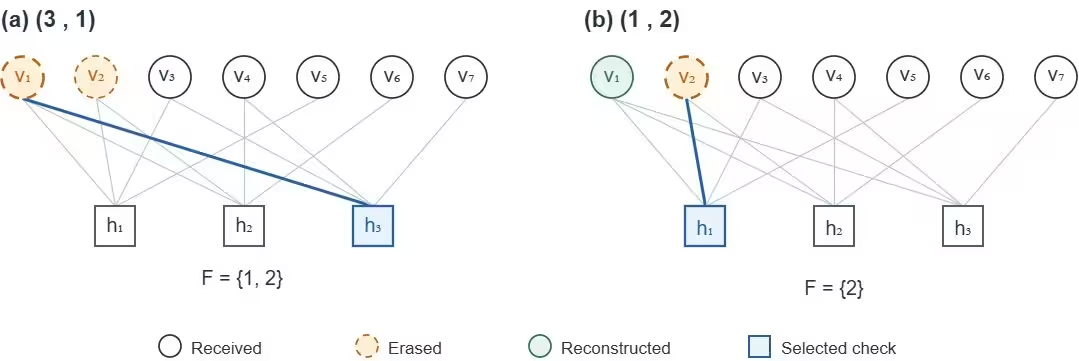
While the first architecture relies on classical scheduling to determine gate sequences, the team’s second architecture implements fully quantum belief propagation directly using ternary quantum gates. This second approach utilizes qutrits, which are three-state quantum units, allowing the system to evaluate parity-check constraints directly on the quantum registers. Both approaches achieve the same successful state reconstruction, though they trade off classical pre-computation for direct quantum hardware complexity.
What Are the Next Steps for Implementing These Quantum Decoders?
Despite the theoretical success in achieving exact logical recovery, several practical hurdles remain before such systems see hardware implementation. The worst-case computational complexity scales up quadratically with the block length in certain configurations, requiring further optimization to handle larger code structures efficiently. Future research will focus on refining ternary gate operations and minimizing the resource overhead required for ancilla resets and workspace management.
The study was posted to the arXiv preprint server on November 23, 2026.
This article has been fact checked for accuracy, with information verified against reputable sources. Learn more about us and our editorial process.
Last reviewed on .
Article history
- Latest version
Reference(s)
- Guhagarkar, Aditya. “Coherent Recovery of Nested Codes over the Quantum Erasure Channel Using Erasure Decoding and Quantization.” arXiv.org <http://arxiv.org/abs/2611.30884v1>.
Cite this page:
- Posted by Deepak Malhotra