Air Compressibility Has Surprising Dual Effects On Vibrating Cylinders
Computer simulations reveal that faster airflow dampens vibrations in one zone but amplifies them in another, following classic aerodynamic rules.
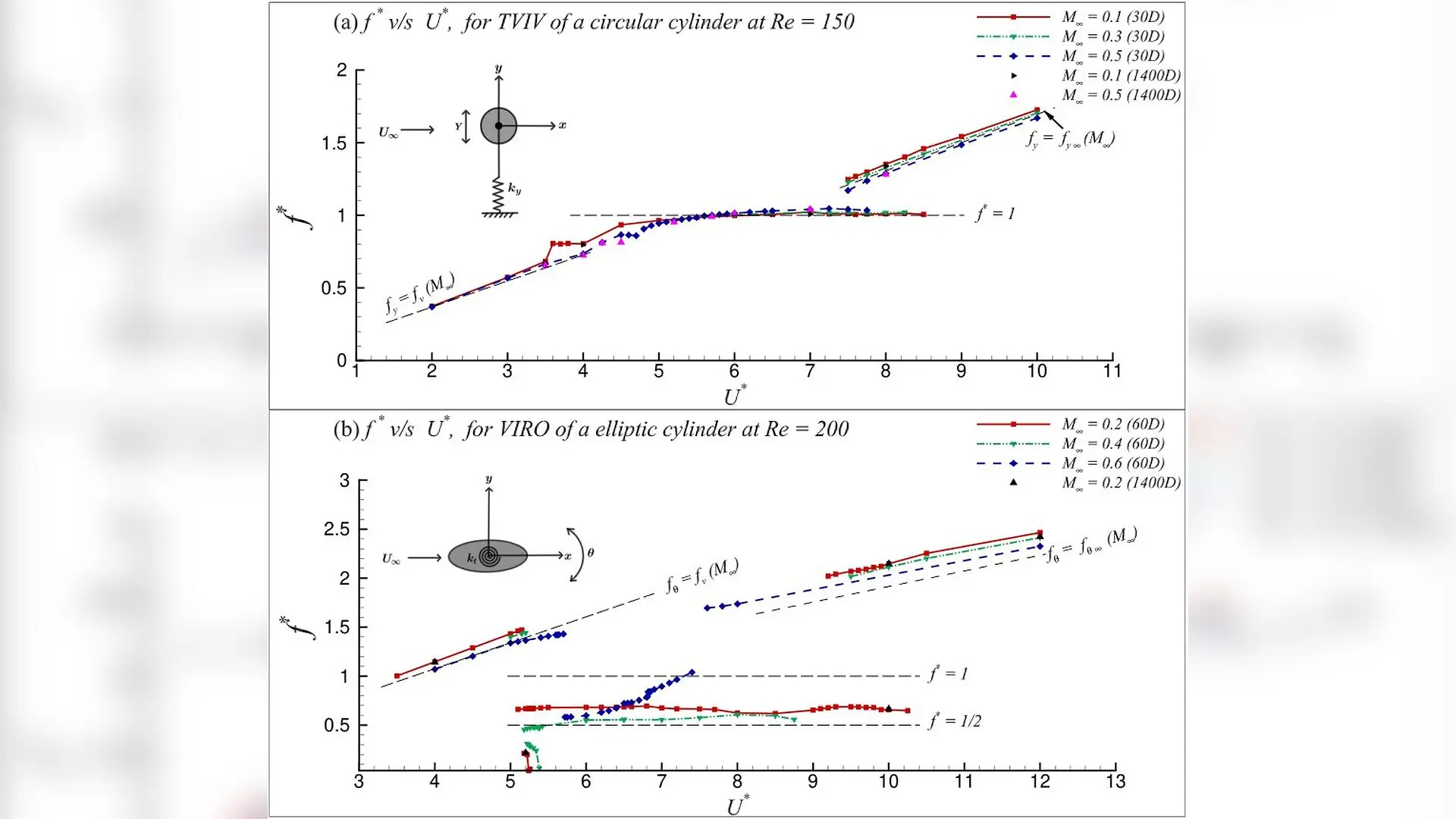
When air flows past a solid object like a cylinder, swirling eddies of wind create invisible rhythmic tugs that can make the structure shake violently. Researchers exploring how air compressibility changes these fluid-structure interactions have found that faster airflows have opposing effects depending on the vibrational state of the structure.
Sawant Omkar Deepak and Swagata Bhaumik from the Department of Mechanical Engineering at IIT (ISM) Dhanbad in India used advanced computer simulations to examine two distinct types of flow-induced motion. Their work, available on the arXiv preprint server, models the transverse vibration of a circular cylinder at a Reynolds number of 150, alongside the rotary oscillation of an elliptic cylinder with an aspect ratio of 0.5 at a Reynolds number of 250. The Reynolds number is a dimensionless quantity that measures the ratio of inertial forces to viscous forces in a fluid, helping physicists determine whether flow will be smooth or turbulent.
How Does Air Compressibility Alter Structural Vibrations?
The team tested free-stream Mach numbers, representing the speed of the airflow relative to the speed of sound, ranging from 0.1 to 0.6. Across this subsonic range, the researchers tracked how the structures behaved across three distinct response zones, known as the first desynchronized zone, the synchronous lock-in branch, and the second desynchronized zone.
Inside the lock-in branch, where the natural frequency of the structure matches the frequency of the shedding vortices, increasing the Mach number surprisingly suppresses vibrations. Higher Mach numbers lead to reduced oscillation amplitudes, smaller fluctuating aerodynamic coefficients, and weaker hysteretic jumps, which are sudden shifts in behavior as flow conditions change. The authors attribute this stabilization to enhanced viscous effects acting within the synchronized zone.
What Happens Outside the Synchronized Lock-In Zone?
In stark contrast, the second desynchronized zone exhibits the opposite trend. As the Mach number increases from 0.1 to 0.6, the oscillation amplitudes and aerodynamic forces grow significantly. For both the circular cylinder vibrating sideways and the elliptic cylinder twisting back and forth, the amplitude variations in this high-speed zone closely follow a mathematical guideline called the modified Prandtl-Glauert relationship.
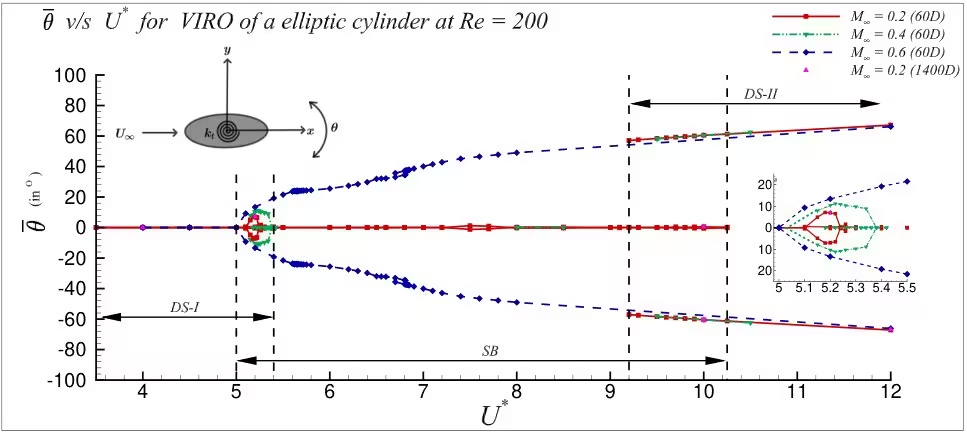
The Prandtl-Glauert rule is a classical aerodynamic correction derived for inviscid and irrotational flows, meaning fluids without friction or swirling rotation. This match points to a fundamental shift in physics: while friction-driven viscous stabilization dominates during the synchronized lock-in state, inviscid compressibility effects take over and amplify responses in the second desynchronized zone.
Why Do These Aerodynamic Forces Matter for Future Engineering?
Understanding these contrasting regimes helps engineers design more resilient aerospace components, control surfaces, and launch vehicles that operate at subsonic speeds where density variations matter. Although the simulations were performed at low Reynolds numbers to isolate the core physics cleanly, the underlying compressibility mechanisms are fundamental and likely persist in higher Reynolds number environments.
The authors note that real-world wind tunnels often experience rising effective Reynolds numbers alongside higher Mach numbers, which could amplify these vibration trends even further. Future investigations involving fully three-dimensional simulations at higher Reynolds numbers will be required to confirm the exact quantitative limits of these aerodynamic phenomena.
The study was posted to the arXiv preprint server on November 23, 2026.
This article has been fact checked for accuracy, with information verified against reputable sources. Learn more about us and our editorial process.
Last reviewed on .
Article history
- Latest version
Reference(s)
- Deepak, Sawant. “Compressibility effects on the flow-induced motions of bluff bodies: common features from transverse and rotary oscillations.” arXiv.org <http://arxiv.org/abs/2611.30903v1>.
Cite this page:
- Posted by Aisha Ahmed