Physicists Compress Complex Particle Physics AI Into a Single 577-Operation Equation for LHC Triggers
A new symbolic regression pipeline translates heavy neural networks into explicit mathematical formulas that run in 42 nanoseconds on trigger hardware.
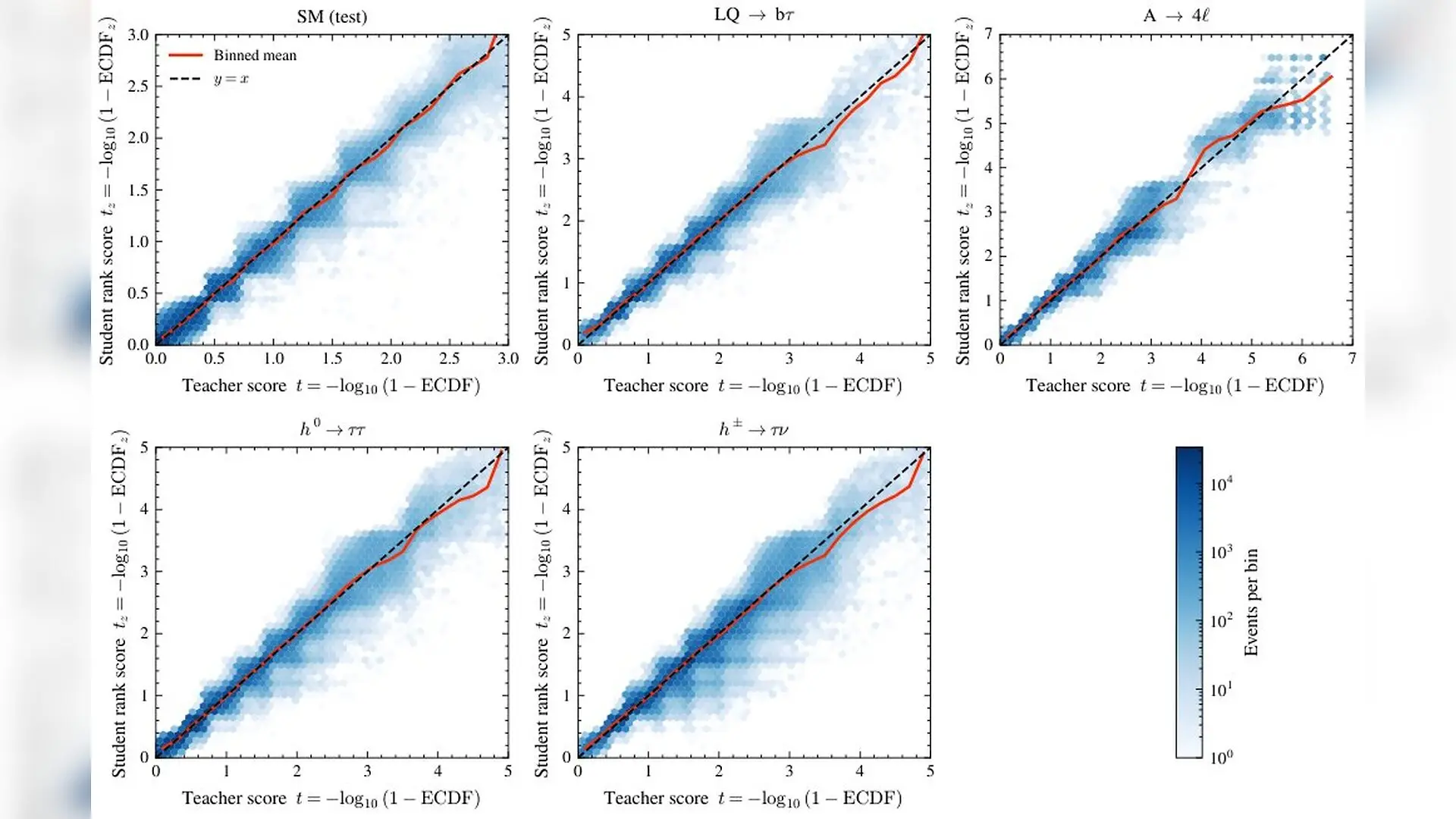
Physicists at CERN have compressed a massive artificial intelligence used to spot rare particle decays into a single explicit mathematical equation containing 577 operations, proving that complex machine-learning algorithms can be rewritten into human-readable formulas without losing their particle-sorting power. The new formula runs inside LHC trigger hardware in just 42.8 nanoseconds, matching the microsecond decision deadlines required when proton beams cross forty million times every second.
Modern particle physics experiments face a severe data bottleneck. The Large Hadron Collider generates petabytes of raw information every second, forcing detectors like ATLAS and CMS to make split-second choices about which collisions to keep and which to discard forever. Traditionally, these triggers rely on predefined signatures that look for specific decay products, but this leaves them blind to unexpected physics phenomena. To overcome this limitation, researchers recently turned to unsupervised anomaly detection models, such as normalizing flows, which learn standard collision patterns and flag any departures.
However, running these massive neural networks inside the hardware-based Level-1 Trigger presents a severe engineering hurdle. The system must process each event within a few microseconds, a time window too tight for standard deep learning architectures. While previous studies used knowledge distillation to train smaller neural networks to mimic larger models, this latest approach pushes the concept further by distilling the entire network into a direct mathematical formula.
How Does Symbolic Regression Compress Millions of Parameters Into a Compact Equation?
Led by researchers including Justin Bollhalder from the University of Zurich, the team utilized a neural symbolic regression framework known as SymbolNet. As published in arXiv, the technique trains a functional expression while simultaneously pruning unnecessary inputs, arithmetic operations, and coefficients through adaptive thresholding. The resulting student model learns to replicate the anomaly scores of a complex RealNVP normalizing flow teacher containing about 2.6 million trainable parameters.
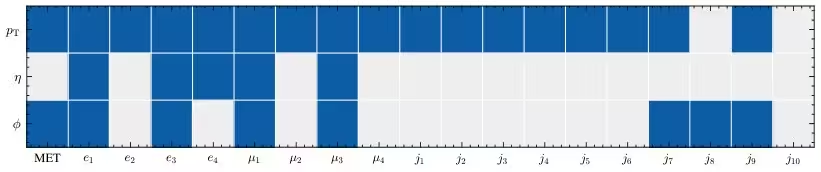
The distillation process relies on ranking events based on their empirical cumulative distribution function against standard model simulations. By mapping upper-tail probabilities to a logarithmic scale, the training loss function emphasizes rare, potentially interesting collisions. Through iterative pruning and size-targeted compression, the team reduced the formula until it contained 577 operations and evaluated only 30 of the 57 available trigger-level input features, dropping uninformative variables entirely.
Can a Simple Formula Match the Accuracy of a Deep Neural Network?
Performance evaluations across four distinct beyond-the-Standard-Model benchmark scenarios revealed that the symbolic student maintains high discrimination accuracy. Tested on simulated data including leptoquarks and neutral scalars, the explicit formula achieved area under the receiver operating characteristic curve values comparable to both the original teacher model and traditional distilled multilayer perceptron networks.
When converted into firmware using high-level synthesis tools for field-programmable gate arrays, the equation utilized fixed-point arithmetic with twenty-bit precision. By rounding coefficients to two signed binary digits, every constant multiplication simplified into a basic shift-and-add operation. This optimization reduced the number of required adders for constant multiplications from 600 down to 255 while keeping performance degradation below 0.13 percentage points in area under the curve metrics.
What Are the Hardware Resource Requirements on FPGA Chips?
Synthesized for a Xilinx Virtex UltraScale+ VU13P device operating at a clock frequency of 200 megahertz, the routed firmware design met all timing constraints with an estimated maximum frequency of 210.5 megahertz. The pipeline consumes 14,049 lookup tables, 4,785 flip-flops, 54 digital signal processing slices, and 13 block random access memory units, keeping total hardware utilization under one percent across all categories.
Compared to previous multi-bit neural network students implemented on the same hardware, the symbolic approach requires significantly fewer lookup tables and flip-flops than equivalent high-precision neural networks while providing an explicit, inspectable formula. This transparency allows engineers to study the arithmetic complexity and evaluate numerical stability operation by operation before physical deployment, paving the way for advanced real-time anomaly detection in high-energy physics.
The study was posted to the arXiv preprint server on November 23, 2026.
This article has been fact checked for accuracy, with information verified against reputable sources. Learn more about us and our editorial process.
Last reviewed on .
Article history
- Latest version
Reference(s)
- Bollhalder, Justin. “Distillation of a Normalising Flow into a Compact Symbolic Expression for Real-Time Anomaly Detection at the LHC Level-1 Trigger.” arXiv.org <http://arxiv.org/abs/2611.30896v1>.
Cite this page:
- Posted by John Williams