AI Models Fail to Spot Their Own Math Mistakes But Can Easily Be Guided to Fix Them
Evaluating over 15,000 reasoning attempts reveals that while models cannot self-monitor in real time, injecting external uncertainty successfully triggers error recovery.
When artificial intelligence models solve complex math problems step by step, they regularly fail to notice their own mistakes while generating solutions, according to a study evaluating over 15,000 reasoning attempts across four major systems. Researchers discovered that even as language models output high confidence ratings during a derivation, their internal tracking of mistakes remains largely blind to reality.
The work, available on the arXiv preprint server and conducted by Daniel Theron, analyzed how open-weights instruction-tuned models including Alibaba’s Qwen2.5-7B-Instruct, Meta’s Llama-3.1-8B-Instruct, Mistral-7B-Instruct-v0.3, and Microsoft’s Phi-4 handle stepwise mathematical reasoning. Many automated reasoning systems rely on self-reported confidence scores to decide whether to continue down a path, backtrack, or prune a bad branch. However, Theron found that verbalized confidence scores failed to distinguish sound reasoning steps from erroneous ones across all four tested systems.
Why Do Language Models Fail to Catch Their Own Reasoning Errors?
To test how well models monitor their progress, the author evaluated thousands of reasoning traces across mathematics benchmark problems from GSM8K and the MATH-500 test subset. Using an automated process judge built on Claude Opus 5.5 to pinpoint the exact steps where derivations went off track, the evaluation revealed that reported trajectory confidence remained flatly saturated between 95 and 100 percent even when a reasoning error occurred.
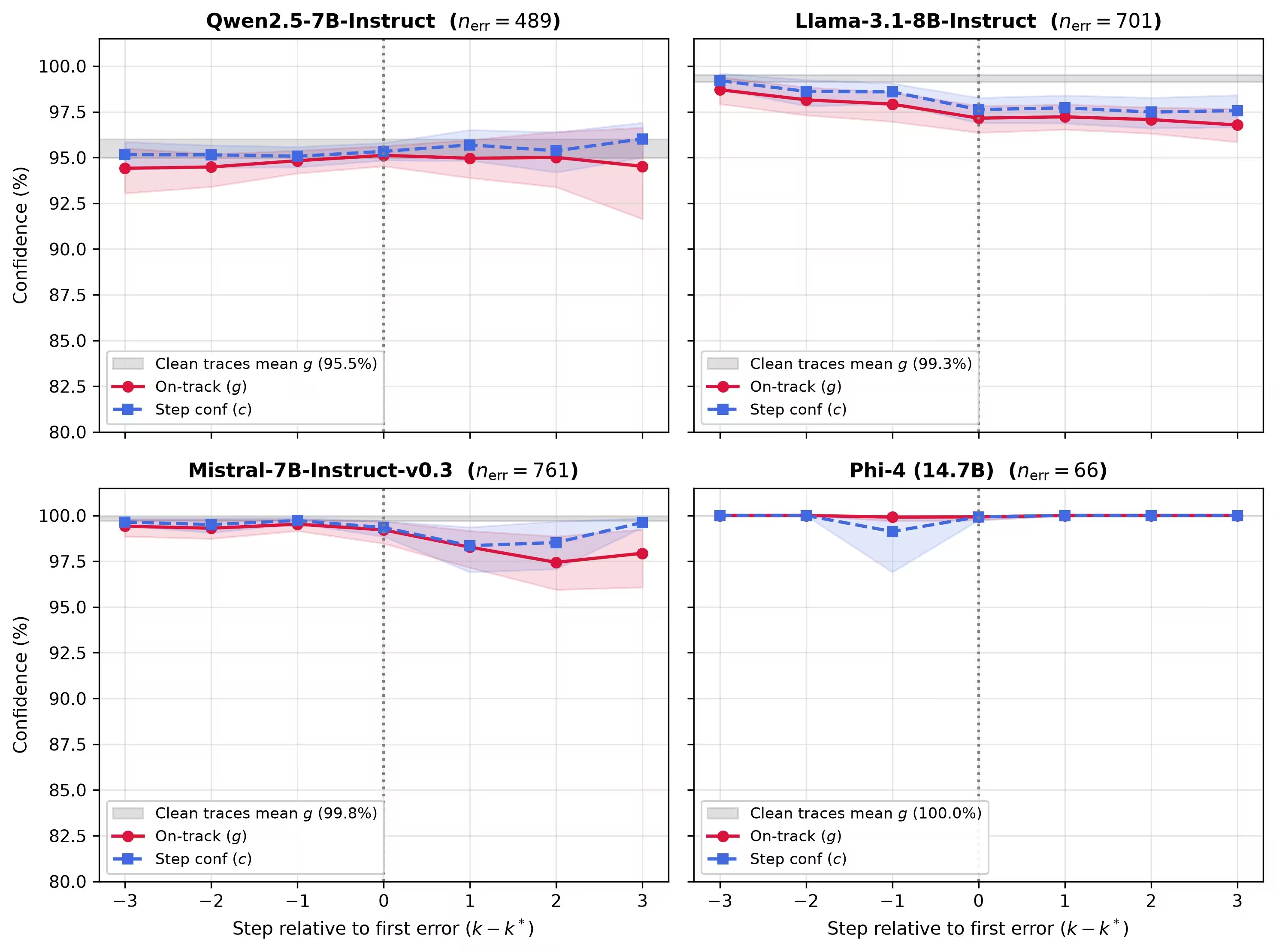
Significant confidence drops of ten points or more appeared on fewer than nine percent of errors in Llama, and under two percent of errors in the other three models. The data point to an in-situ monitoring failure, meaning the generative process itself fails to recognize when an ongoing calculation has turned invalid. Instead of accumulating uncertainty as errors compound, models treated confidence tags as uncalibrated repetitions of local step assessments.
Can External Doubt Force Models to Fix Their Mistakes?
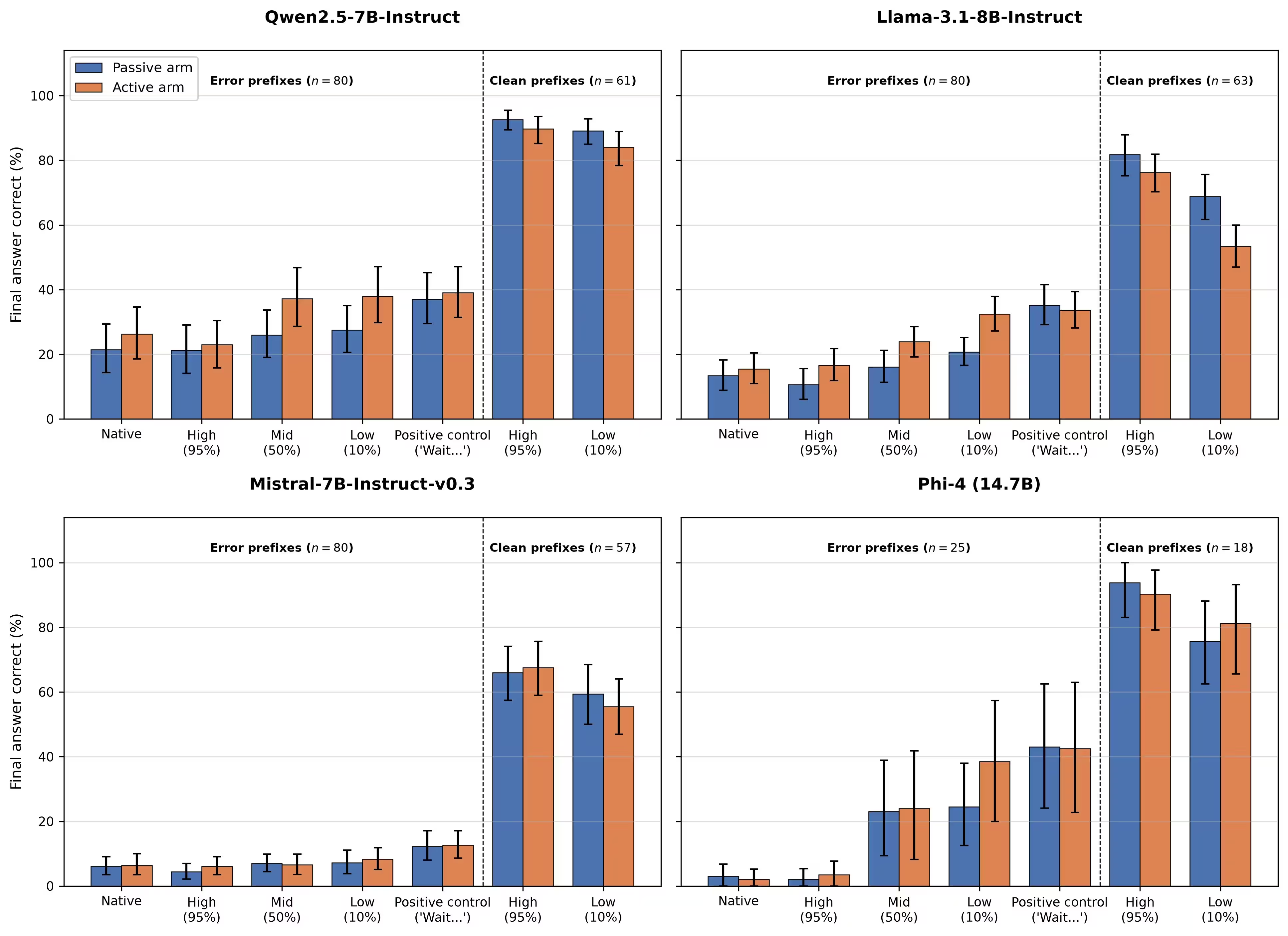
While models struggled to spot their own errors spontaneously, they proved remarkably responsive to external intervention. When researchers artificially injected low confidence tags of 10 percent at the exact point of failure, downstream error correction jumped significantly across all four models. Passive insertion of uncertainty increased final answer correction rates by up to 22.5 percentage points compared to high-certainty tags.
When combined with active prompts instructing the model to re-examine previous steps if confidence dropped below 50 percent, correction rates climbed even higher, reaching 38 percent in models like Qwen and Phi-4. This split demonstrates that inference-time self-correction is bottlenecked by error detection rather than a lack of repair capacity. Models can readily steer toward recovery when prompted with doubt, but they cannot generate that doubt on their own.
What Happens When AI Doubt Triggers False Alarms?
Injecting uncertainty into a reasoning chain is not without risks, as external monitors can flag sound derivations by mistake. When researchers tested low-confidence tags on valid, clean reasoning prefixes, overall answer retention dropped across all models. For instance, Llama suffered a drop in clean retention from 81.8 percent down to 68.8 percent under passive low-confidence injection, as unnecessary doubt triggered disruptive backtracking.
These findings establish clear operational thresholds for automated reasoning agents. External verifiers must maintain high precision to prevent collateral damage on valid calculations, especially in sensitive models where unearned doubt causes valid reasoning paths to be discarded. The study suggests that future AI reasoning architectures should decouple error detection from error recovery by utilizing external process monitors to flag mistakes while letting models handle the downstream repairs.
The study was posted to the arXiv preprint server on November 23, 2026.
This article has been fact checked for accuracy, with information verified against reputable sources. Learn more about us and our editorial process.
Last reviewed on .
Article history
- Latest version
Reference(s)
- Theron, Daniel. “Language Models Steer on Injected Uncertainty Tokens, but Fail to Self-Monitor In Situ.” arXiv.org <http://arxiv.org/abs/2611.31228v1>.
Cite this page:
- Posted by Asif Iqbal