New Pruning Method Shrinks Autonomous Driving AI Models Without Causing Reasoning Collapse
By combining text reasoning and action trajectory objectives, researchers cut model parameters by nearly forty percent while preserving safe driving performance.
Autonomous driving models can now reason about traffic rules and hazards using camera feeds, but running these large systems in real time requires massive computing power that standard vehicle hardware struggles to handle. A team of researchers from KAIST and LG Innotek has developed a new pruning strategy that strips away about forty percent of model parameters without destroying the ability to steer and reason on the road. The technique reduces peak memory usage by over thirty-six percent and accelerates end-to-end inference speed by a factor of 1.37, all without requiring any post-compression retraining.
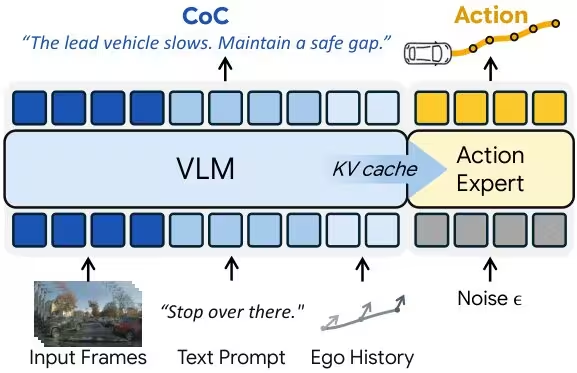
Modern reasoning vision-language-action models, such as the Alpamayo framework published in a study available on the arXiv preprint server, pair a large vision language backbone with a specialized action expert. The main language model generates an explicit chain of causation explaining driving decisions, while the action expert denoises Gaussian noise across multiple steps to output continuous driving trajectories. Previous attempts to compress these architectures by optimizing for just one objective, such as text reasoning or action generation alone, typically caused the model’s reasoning to collapse or its driving performance to plummet.
Why Do Text Reasoning and Action Generation Require Different Neural Structures?
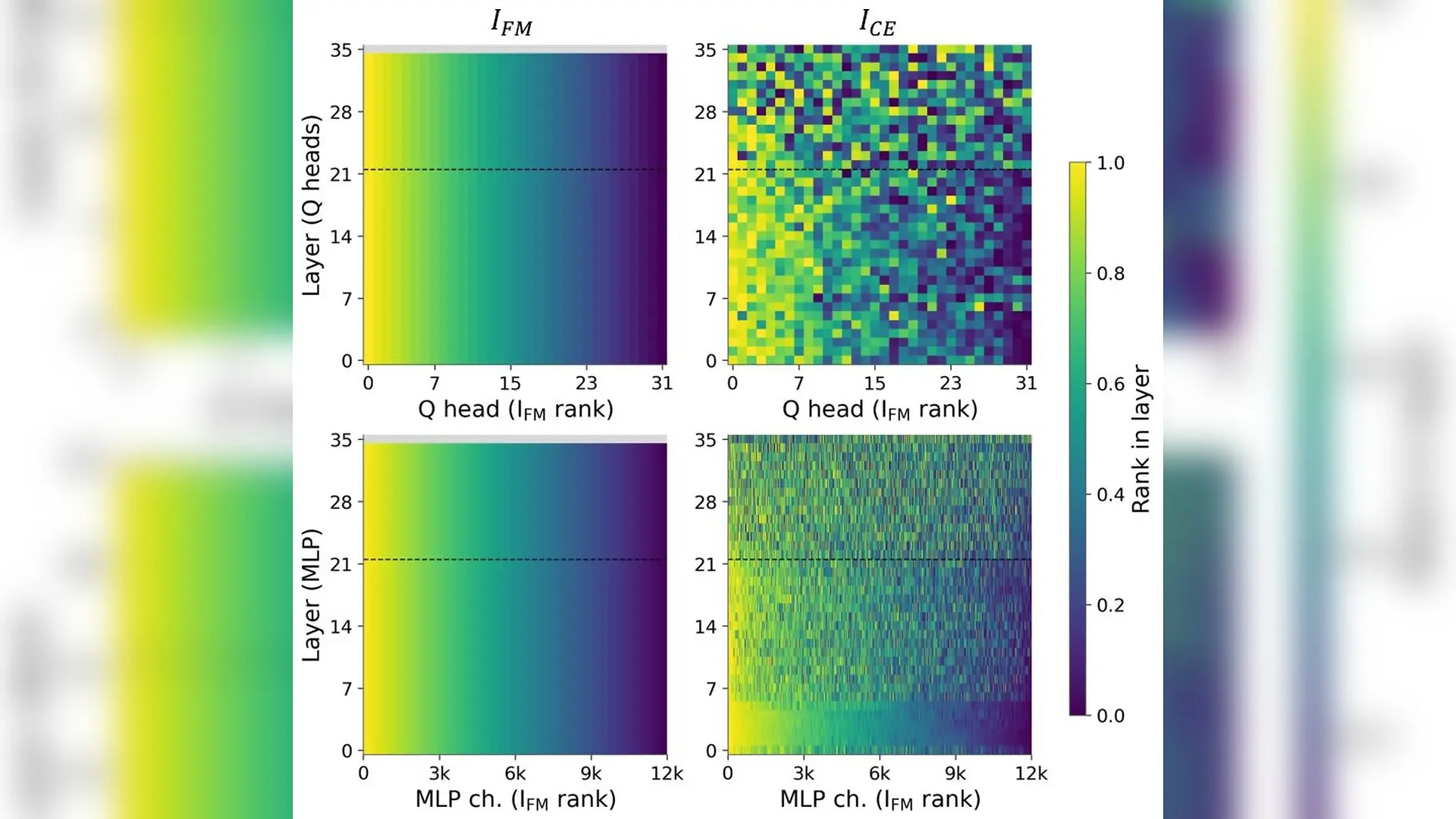
Lead author Seongchan Kim and colleagues discovered that the parameters important for text reasoning and those needed for action prediction only partially overlap in late model layers. By analyzing Taylor importance scores, which estimate how much the loss function changes when a specific neural unit is removed, the team found that cross-entropy optimization for text heavily prioritizes text tokens in deeper layers. Meanwhile, flow-matching optimization for action generation distributes its importance evenly across vision, text, and ego-history tokens.
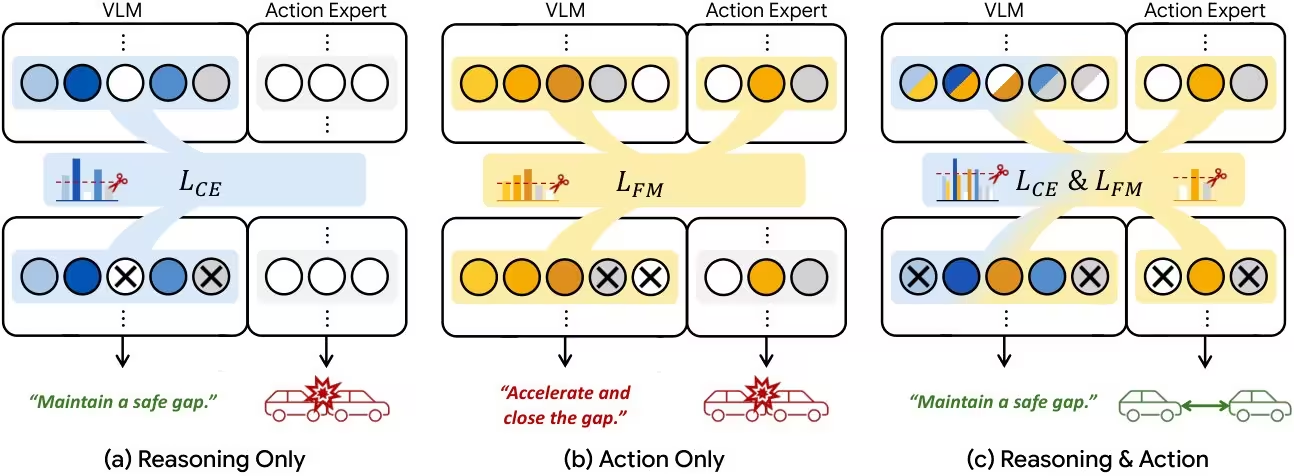
This fundamental divergence explains why single-objective pruning fails. Removing units based solely on language tasks damages the visual conditioning required to predict steering trajectories safely. To solve this, the researchers introduced Mixture-of-Objective Pruning, which combines importance rankings from both training objectives. By taking the maximum rank of each unit across both goals, the system retains structural components that serve either reasoning or physical movement, discarding only the dead weight.
How Does Pruning the Action Expert Preserve Real-Time Performance?
Beyond the main language backbone, the action expert processes multi-step denoising to determine precise vehicle paths. The authors analyzed whether attention heads or multi-layer perceptron channels maintain stable importance rankings across these iterative denoising steps. They found that attention head importance shifts dramatically between steps, whereas multi-layer perceptron channel rankings remain remarkably stable. Furthermore, a tiny fraction of these channels accounts for nearly all of the measured importance, while ninety percent of the channels contribute less than two percent of the total score.
This extreme concentration of importance allowed the team to remove ninety-three percent of the action expert’s intermediate multi-layer perceptron channels while keeping all attention heads intact. Because the importance rankings do not fluctuate across denoising steps, a single static set of channels can be pruned once without needing separate configurations for each step. This expert-level compression eliminates 1.71 billion parameters and over three gigabytes of peak memory.
What Happens When Compressed Models Face Complex Real-World Scenarios?
The compressed system was evaluated on open-loop trajectory prediction benchmarks and closed-loop driving simulations using AlpaSim. At a total parameter reduction of thirty-nine percent, the model maintained competitive route completion scores, low collision rates, and an accuracy of nearly forty-seven percent on driving visual question answering benchmarks. Standard pruning baselines saw their reasoning capabilities drop to levels indistinguishable from random guessing, often hallucinating missing traffic signals or failing to spot pedestrians at zebra crossings.
The research team notes that their findings also generalize to smaller architectures such as Alpamayo 2 Edge, proving that dual-objective ranking and stable channel pruning are broadly applicable principles. By respecting the distinct functional roles of vision-language reasoning and action experts, this approach brings resource-intensive autonomous driving models closer to practical deployment on standard vehicular hardware.
The study was posted to the arXiv preprint server on November 23, 2026.
This article has been fact checked for accuracy, with information verified against reputable sources. Learn more about us and our editorial process.
Last reviewed on .
Article history
- Latest version
Reference(s)
- Kim, Seongchan. “Pruning Autonomous Driving VLAs: What to Preserve for Reasoning and Action.” arXiv.org <http://arxiv.org/abs/2611.31240v1>.
Cite this page:
- Posted by James Whitmore