New AI Framework Lets Connected Cars See Around Blind Corners Without Retraining
By separating cooperative data perception from trajectory planning, researchers achieved higher driving safety scores and fewer collisions in complex simulations.
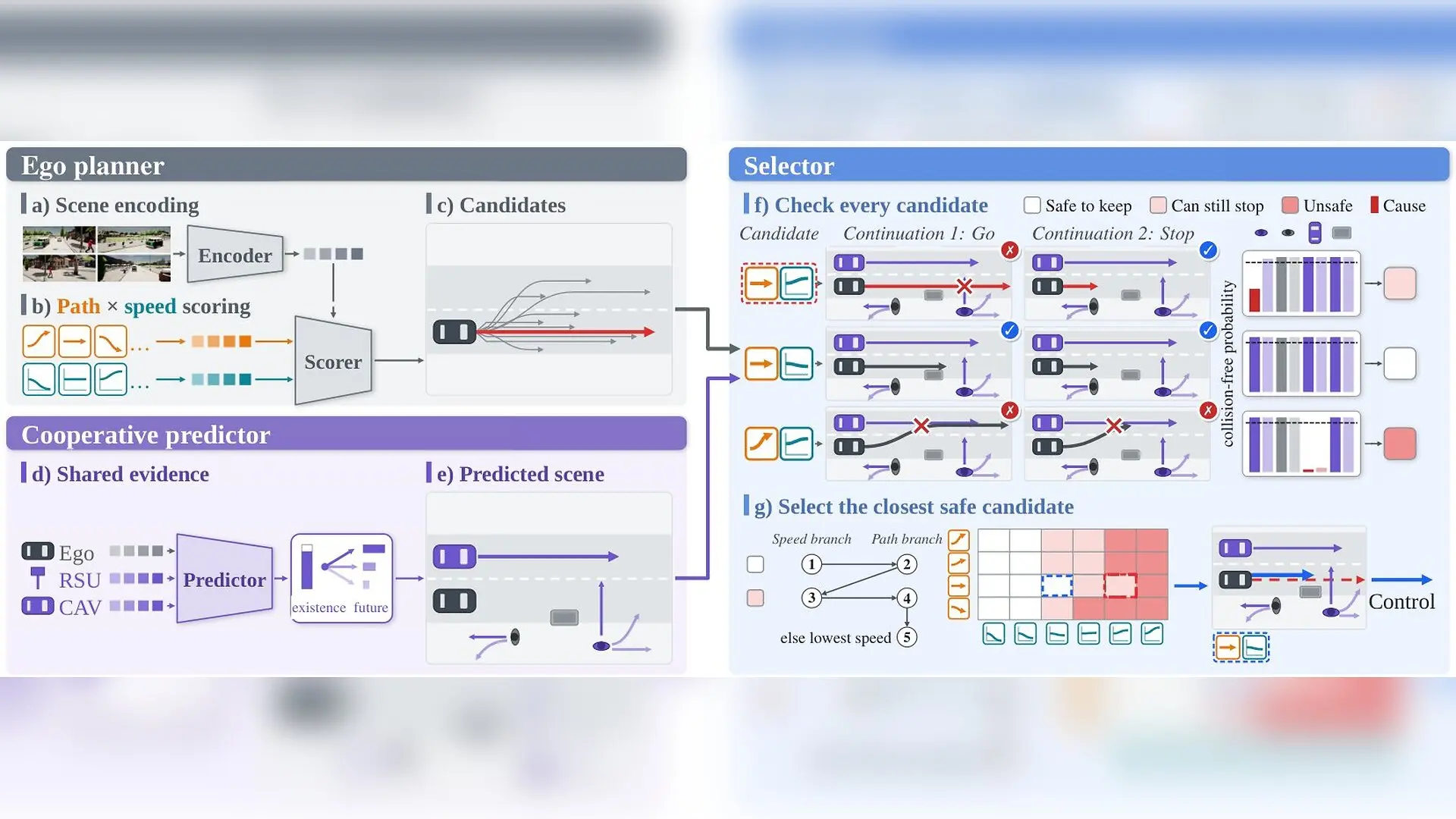
Autonomous vehicles can now see around blind corners and anticipate hidden hazards by tapping into data shared by roadside units and other connected cars on the road. Traditional end-to-end driving systems try to bake this shared sensor data directly into their core neural networks, but this approach struggles because critical moments requiring sudden cooperation are exceedingly rare during routine training.
To overcome this limitation, a research team led by Yiping Li at the University of Georgia has developed a new cooperation-as-selection framework called CoSel. Instead of retraining the underlying vehicle planner to digest external sensor data, CoSel leaves the core driving planner entirely untouched and relies on a separate predictor to evaluate future collision risks. The study is available on the arXiv preprint server, detailing how the system achieved top scores in closed-loop autonomous driving simulations.
How CoSel Evaluates Alternative Driving Trajectories
Most modern autonomous vehicle planners do not just output a single steering angle. Instead, they propose a dense vocabulary of candidate trajectories that span different geometric paths and speed profiles. CoSel leverages this existing architecture by letting the vehicle’s standard ego planner propose its preferred route while a lightweight cooperative predictor forecasts the future movements of every surrounding agent in the scene.
The system gathers perception feeds from the ego vehicle itself, roadside infrastructure units, and connected automated vehicles within radio range. A transformer encoder processes these inputs into probabilistic future paths over a four-second horizon without needing positional encodings. When the selector evaluates the planner’s preferred choice against the predicted scene, it checks whether any anticipated collision risk exceeds a strict safety budget threshold.
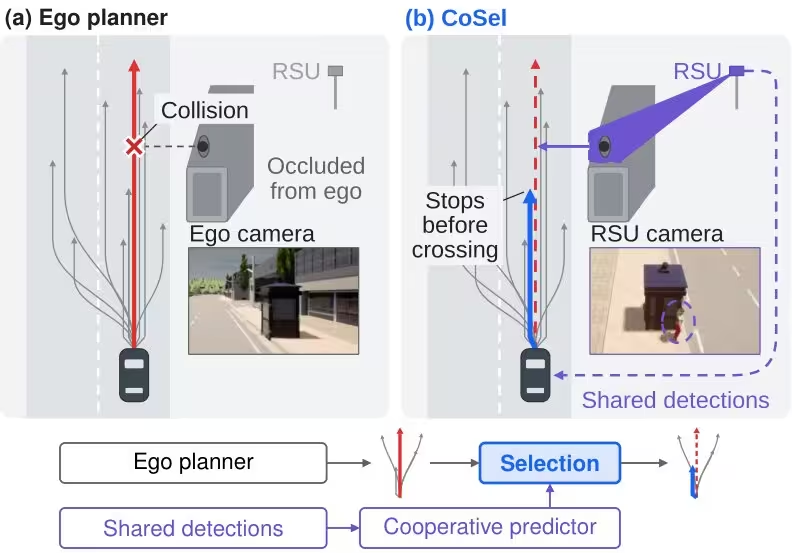
If the vehicle’s default trajectory remains completely safe, CoSel preserves the planner’s original choice without any interference. However, if shared sensor data reveals an occluded hazard, such as a pedestrian stepping out from behind a parked truck or kiosk, the selector instantly intervenes by choosing the safest alternative trajectory that satisfies the established safety constraints.
Performance Gains in Closed-Loop Simulations
The researchers tested CoSel extensively in closed-loop CARLA simulation environments, including the V2Xverse-85 benchmark and the MDrive multi-agent dataset. On the 85 challenging routes of V2Xverse, the baseline vehicle planner alone achieved a driving score of 57.6, while existing cooperative methods topped out near 59.1. By comparison, CoSel reached an overall driving score of 70.7 while cutting vehicle collisions per kilometer by sixty-seven percent.
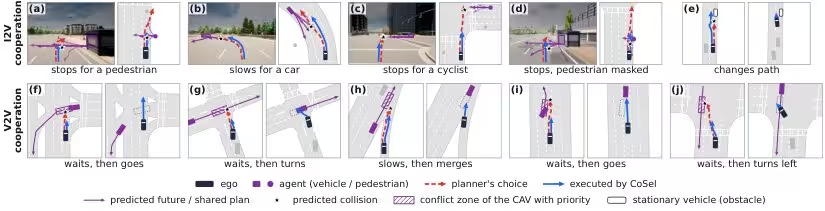
In rigorous stress tests designed to evaluate hidden hazards, CoSel demonstrated remarkable resilience against sensor failures. When researchers intentionally masked pedestrians out of the ego vehicle’s direct camera and light detection and ranging sensor feeds, forcing the system to rely exclusively on roadside infrastructure reports, CoSel maintained stable operation with only a minimal increase in collisions. In contrast, baseline configurations suffered severe performance drops when local sensor views were compromised.
Limitations and Future Research Directions
Despite these promising simulation results, the authors note several current limitations that will guide future work. The system currently treats surrounding agents as statistically independent entities and focuses primarily on dynamic objects rather than complex traffic light signals. Furthermore, the evaluation assumes ideal wireless communication without packet loss, latency, or pose errors.
By shifting cooperative driving from complex policy retraining to straightforward trajectory selection, the method proves that sharing external sensor intelligence does not require overhauling a vehicle’s neural network planner. Future developments will test the selection framework across alternative state-of-the-art driving architectures and evaluate performance under real-world wireless network conditions.
The study was posted to the arXiv preprint server on November 23, 2026.
This article has been fact checked for accuracy, with information verified against reputable sources. Learn more about us and our editorial process.
Last reviewed on .
Article history
- Latest version
Reference(s)
- Li, Yiping. “CoSel: Cooperation as Selection for End-to-End Driving.” arXiv.org <http://arxiv.org/abs/2611.30918v1>.
Cite this page:
- Posted by Asif Iqbal