Unconscious Body Movements Reveal True Message Authorship During Assisted Typing
Wearable sensors show how non-dominant limb micro-movements distinguish spontaneous creative thought from prompted instruction in non-speaking communication.
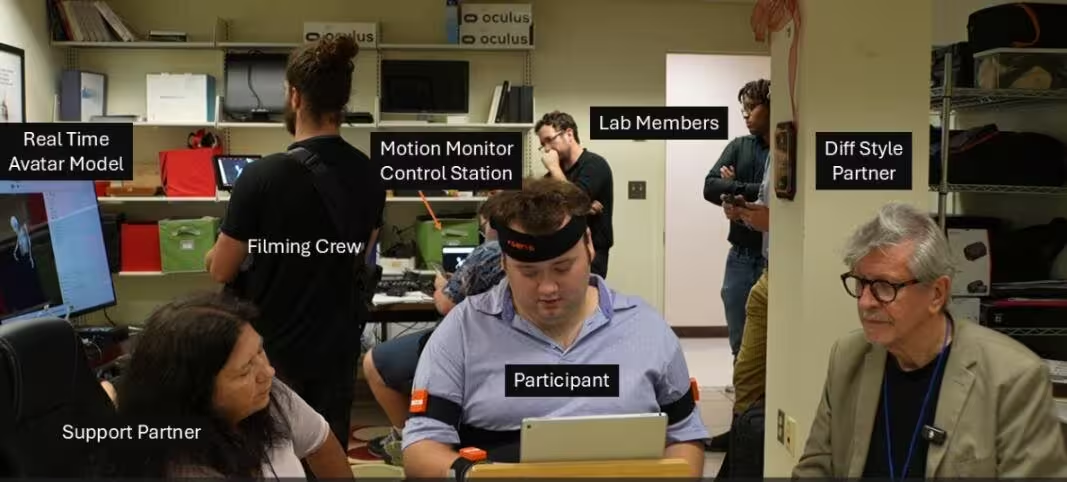
When non-speaking individuals use assisted typing to communicate, subtle physical movements occurring completely beneath conscious awareness can reveal whether the thoughts being expressed originate entirely from the person themselves. Researchers at Rutgers University recently investigated how involuntary gestures and micro-movements on the non-dominant side of the body reflect cognitive effort and authorship during communication. The study, available on the arXiv preprint server, examined these unconscious physical signatures in an adult participant with autism spectrum disorder who communicates through various typing tools.
How Do Unconscious Body Movements Reveal Who Is Driving the Conversation?
For individuals who require high levels of physical support or assisted typing, determining true agency and message authorship has long remained an open challenge in behavioral science. Traditional observations often rely on subjective impressions, leaving a critical need for objective, biometric methods that can track who is truly leading an interaction. To address this, Elizabeth Torres and her colleagues at the Sensory Motor Integration Laboratory examined the continuous trajectories of both dominant and non-dominant limbs during different communication tasks.
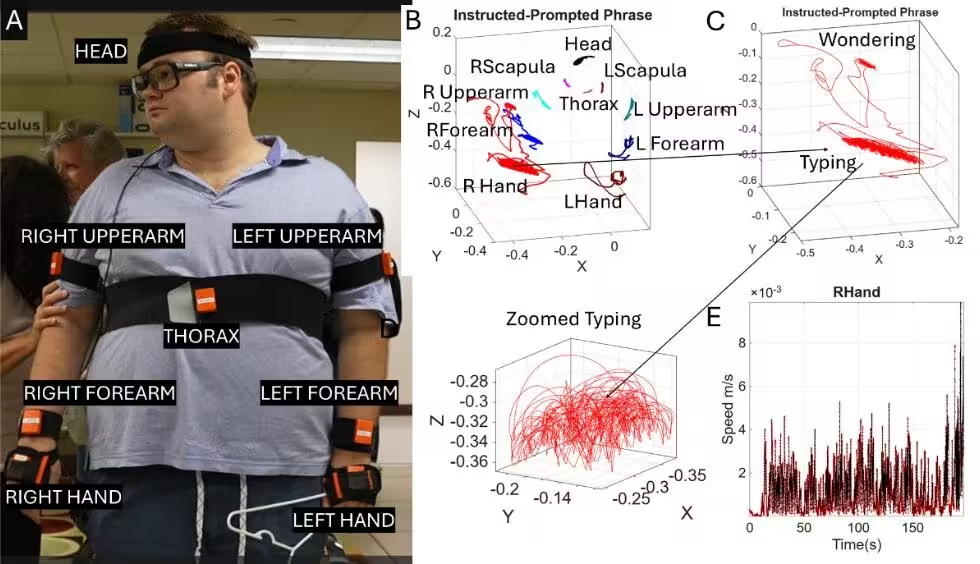
While a person types deliberately with their dominant hand, the opposite side of the body simultaneously produces small, spontaneous movements that escape conscious control. Because these non-dominant motions cannot be easily manipulated by an outside partner without notice, they act as a reliable window into the typer’s internal cognitive state. The team tracked these micro-movements using wearable sensors operating at one hundred hertz to capture physical position, velocity, and acceleration across the upper body.
What Happens When Spontaneous Creativity Gives Way to Rote Instruction?
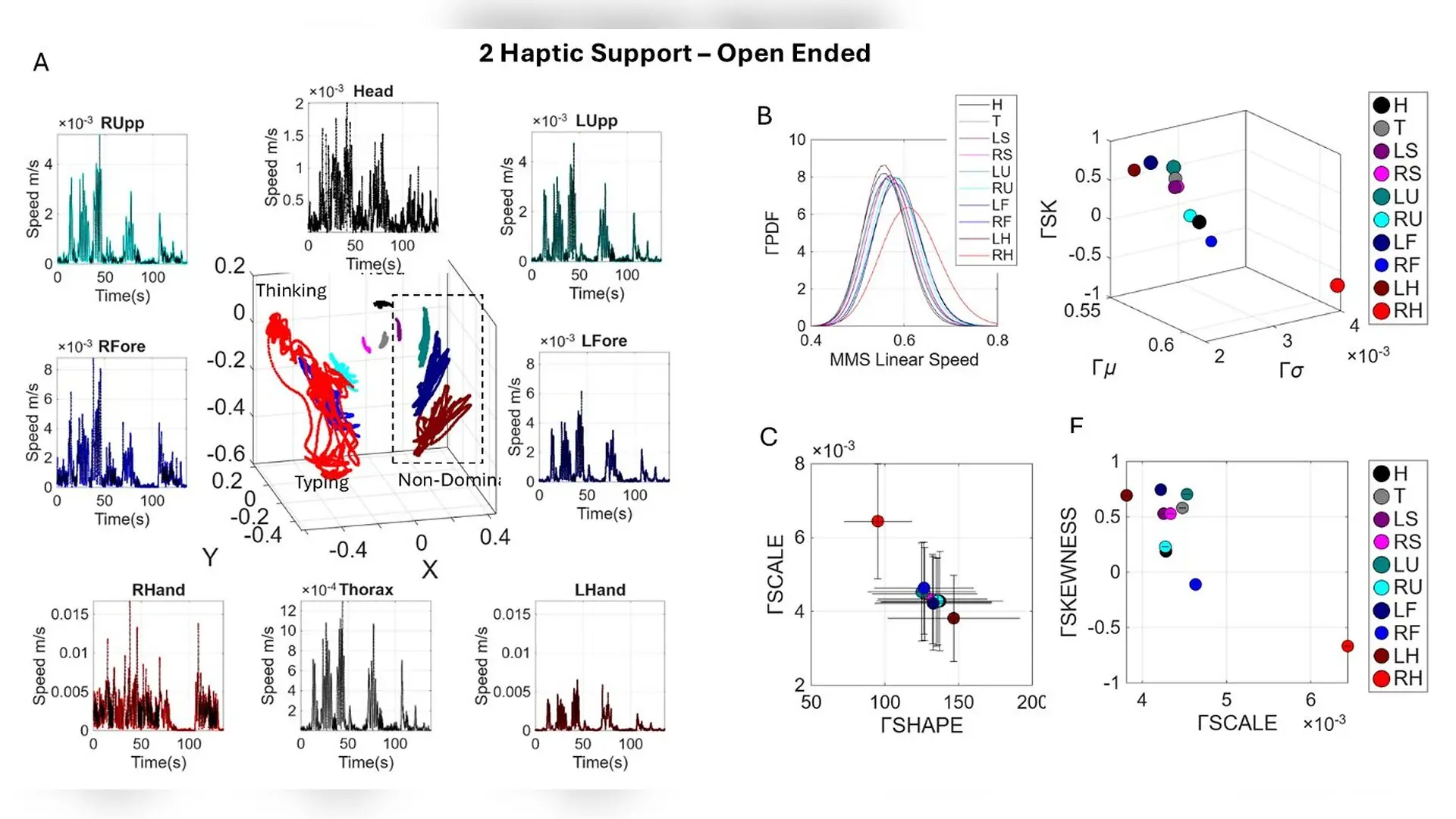
The study compared spontaneous communication, where the participant answered open-ended questions by typing freely, with instructed communication, where the exact same phrases were prompted by an investigator. During open-ended responses, the participant exhibited expansive pre-typing movements near the face and peripersonal space, reflecting creative thought and cognitive elaboration before starting to type. In contrast, when typing the same phrases under direct instruction with low cognitive load, the non-dominant side of the body grew largely dormant and smooth.
To further test the limits of cognitive and memory load, the researchers introduced more demanding conditions, such as covering a familiar letter board with a blank sheet of paper to block visible letters and requiring the participant to rely entirely on mental mapping. Under these heightened loads, the non-dominant side of the body re-engaged dynamically. Stochastic analyses of linear speed variations showed that these changes follow distinct geometric patterns on mathematical manifolds, providing a quantitative metric of cognitive effort.
Can These Objective Biometrics Help Improve Assisted Communication Methods?
The findings offer a new framework for evaluating assisted typing by shifting away from subjective controversy toward rigorous, transparent measurement. By analyzing metrics such as transfer entropy and statistical distributions of movement speeds, the researchers were able to quantify agency within the dyad between the typer and the communication partner. When support was introduced, the data mapped how control shifted, offering a way to ensure that human autonomy is preserved and nurtured as learners gain independence.
While the study focused on an advanced adult speaker-typer to establish an upper benchmark of performance, the authors emphasize that the underlying biometrics are universal. The methods can be adapted for novices who cannot speak and are learning to communicate with physical guidance. By treating spontaneous movement variability as a meaningful signal rather than random noise, this work opens new avenues for supporting non-speaking individuals with dignity and objective clarity.
The study was posted to the arXiv preprint server on November 22, 2026.
This article has been fact checked for accuracy, with information verified against reputable sources. Learn more about us and our editorial process.
Last reviewed on .
Article history
- Latest version
Reference(s)
- Torres, Elizabeth. “Motoric signatures to detect original authorship versus cognitive effort in instructed motor responses of an emerging speaker with ASD.” arXiv.org <http://arxiv.org/abs/2611.29594v1>.
- Posted by Zubair Ali