Regular Exercise and Phone Habits Reveal Hidden Links to Student Social Anxiety
A study of 1,025 university students links physical activity and compulsive mobile device use to face-to-face social discomfort.
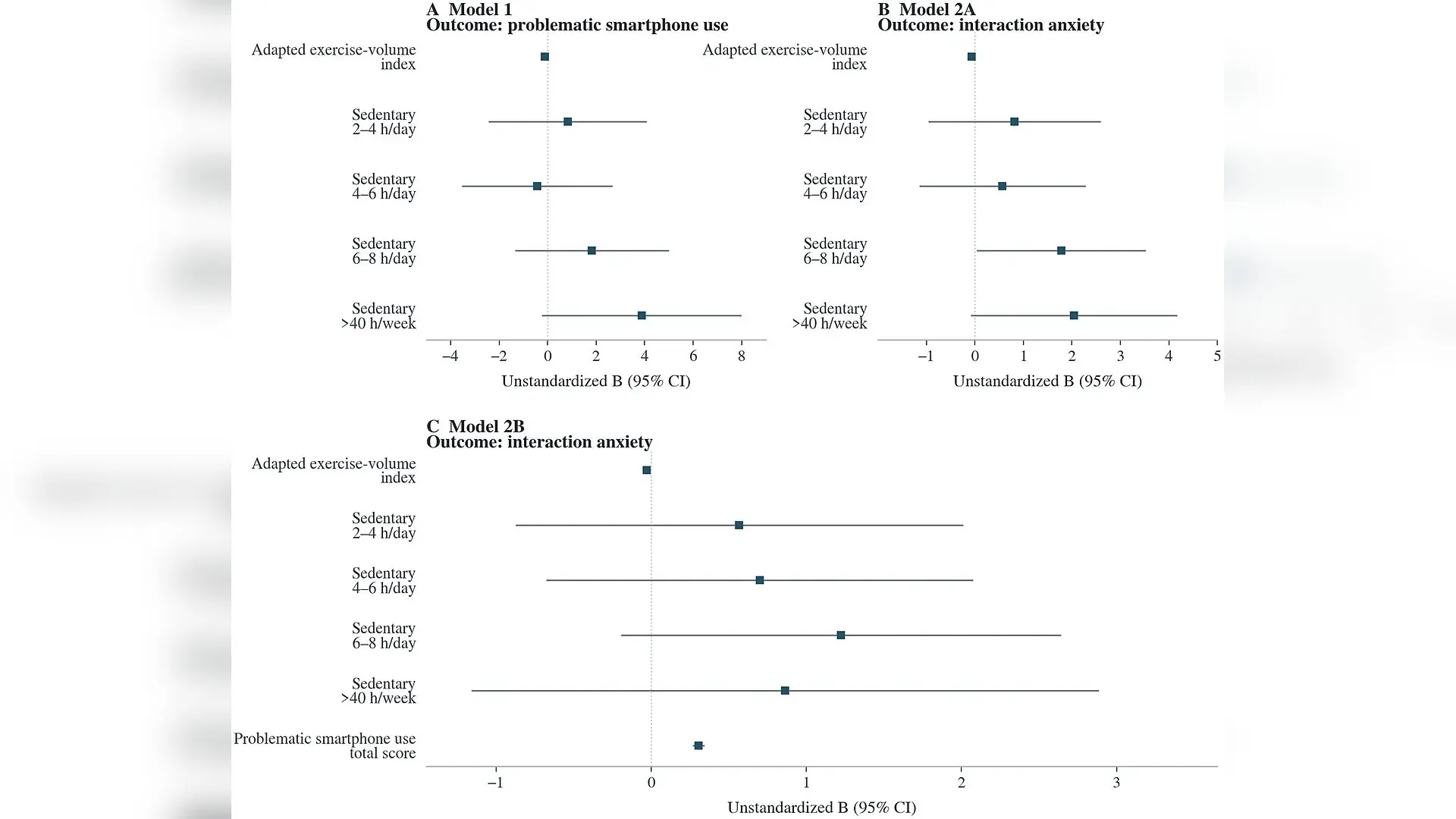
University students who struggle to put down their phones often experience heightened anxiety during face-to-face conversations, but regular physical exercise may help buffer these social difficulties. A new observational study reveals that while daily sitting habits show inconsistent links to interpersonal tension, problematic mobile device use shares a powerful connection with campus social anxieties.
Many young adults navigate academic pressures and personal relationships almost entirely through digital screens. While previous investigations connected heavy screen time to emotional distress and poor sleep, researchers wanted to understand how offline habits like working out or sitting through long lectures interact with digital behaviors. To explore these dynamics, Qi Han from the Yancheng Institute of Technology examined data collected from 1,025 university students across 36 institutions, as published in PLOS One.
How Do Offline Habits Relate to Screen Overload?
The participants completed standardized assessments measuring overall mobile phone habits, direct social discomfort, and self-reported physical activity. Most of the cohort consisted of first-year students, with an average age of 18 years or older. Researchers utilized an adapted exercise index to gauge physical movement based on intensity, duration, and frequency, while evaluating sitting habits through self-reported daily time frames.
Statistical evaluations demonstrated a small inverse correlation between regular physical exercise and mobile phone difficulties. Students who reported higher activity scores tended to score lower on scales measuring compulsive device habits and direct social anxiety. However, the models accounted for only a modest share of the total variance, suggesting that working out is just one piece of a much larger psychological puzzle.
Why Does Digital Over-Reliance Predict Social Tension?
When researchers evaluated face-to-face social comfort, compulsive phone use emerged as a major factor. Incorporating mobile device scores into the regression models substantially increased the explained variation in social anxiety outcomes. Students who displayed problematic smartphone behaviors reported considerably greater nervousness during direct interpersonal encounters, such as group projects or supervisory discussions.
This pattern aligns with the idea that individuals experiencing discomfort in live social settings may lean more heavily on digital communication as a controlled alternative. Because text-based interactions allow for delayed responses and careful self-presentation, they can become a safe refuge for people who feel uneasy in physical group environments.
What Role Do Long Hours of Sitting Play?
Unlike physical activity and digital habits, sedentary behavior did not yield stable associations across different analytical tests. Initial categorical comparisons showed mostly nonsignificant links between sitting duration and psychological outcomes. Sensitivity checks confirmed that altering the scoring criteria or adjusting for specific student subgroups changed how sitting habits appeared in the models.
The authors note that the single-item sitting measure combined inconsistent time units and failed to differentiate between academic study, transit, and leisure screen time. Consequently, researchers cannot draw firm conclusions about sedentary duration alone without accounting for the specific contexts in which sitting occurs.
What Are the Limits of These Findings?
Because the investigation relied on a cross-sectional design and convenience sampling, the findings establish concurrent statistical relationships rather than direct cause-and-effect pathways. The data cannot determine whether digital dependency triggers social anxiety or whether preexisting social fears drive students toward their screens. Future longitudinal research incorporating objective tracking devices and balanced representation across all academic years will be necessary to clarify these behavioral patterns over time.
The research was published in PLOS One on November 23, 2026.
This article has been fact checked for accuracy, with information verified against reputable sources. Learn more about us and our editorial process.
Last reviewed on .
Article history
- Latest version
Reference(s)
- Han, Qi. “Associations of physical exercise and sedentary behavior with problematic smartphone use and interaction anxiety in a predominantly first-year convenience sample of Chinese college students: A cross-sectional study.” PLOS One, vol. 21, no. 11, November 23, 2026, pp. e0363619 Public Library of Science (PLoS), doi: 10.1371/journal.pone.0363619. <https://doi.org/10.1371/journal.pone.0363619>.
Cite this page:
- Posted by Jessica Martin