Upgraded Artificial Intelligence Patients Cut Training Errors by Forty-Five Percent in Nursing Study
Researchers found that refining prompt structures and safety guardrails helps virtual patient bots maintain medical accuracy during Cantonese emergency triage training.

When nursing students practice emergency triage with artificial intelligence, artificial intelligence patient bots sometimes forget their symptoms or even start acting like doctors. Researchers at Hong Kong Metropolitan University have built an upgraded virtual patient system that dramatically cuts these behavioral errors by combining grounded prompts with stricter safety controls.
Traditional training actors are costly and limited in availability, which has led educators to explore large language models, computer programs trained on massive amounts of text to generate human-like conversation, as virtual patients. However, these systems often suffer from conversational errors where the artificial intelligence contradicts its assigned medical profile, leaks hidden scenario details, or loses its role entirely. To solve these problems, Max Chun Ming Chan and colleagues designed a Cantonese-language training simulation game integrated with advanced language technology published in JMIR Nursing.
How Did the Research Team Test Different Artificial Intelligence Models?
During the initial development phase lasting from 2024 to early 2025, the team evaluated six different model configurations using a standardized set of fifty test questions derived from clinical triage scenarios. These questions checked general history-taking abilities and specific medical details across conditions such as malaria and neutropenic fever, a dangerous type of fever occurring with low white blood cell counts. Four independent evaluators scored the responses based on script adherence, role fidelity, and the protection of hidden data.
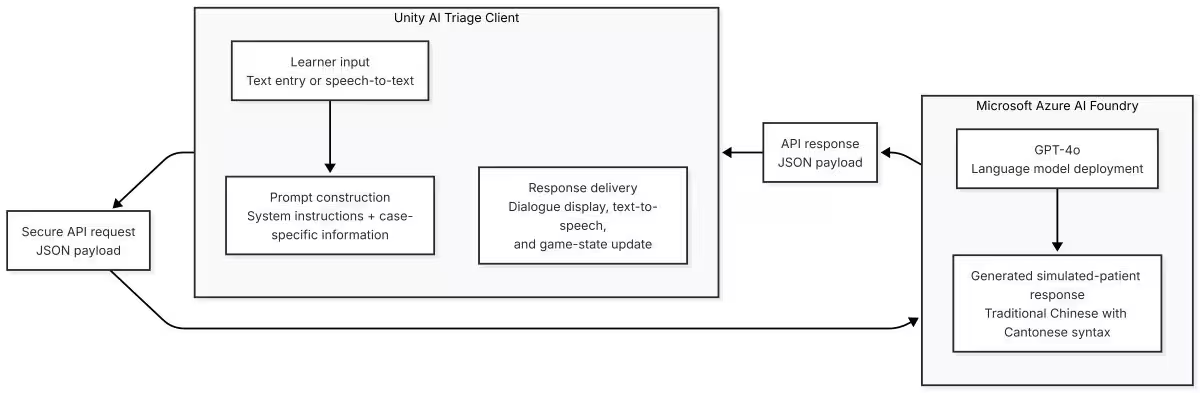
Among the tested options, the model designated as GPT-4o achieved the highest performance, producing forty-five fully script-consistent responses out of fifty, representing a success rate of ninety percent. Other tested systems scored lower, with GPT-4 reaching eighty-six percent, Llama 3.1 achieving seventy-eight percent, and Amazon Titan managing only ten percent. Based on these findings, the team selected GPT-4o to power the production prototype integrated into a Unity-based game client running on Microsoft Azure infrastructure.
What Caused the First Version to Fail During Student Trials?
When the initial version was deployed to two hundred twenty-six nursing students across eleven tutorial sessions in February 2025, qualitative feedback and technical logs revealed several flaws. The virtual patient dialogue was overly linear, and the artificial intelligence occasionally experienced role drift, meaning it started answering as a nurse or physician instead of staying in character as the sick patient. Internal testing further revealed that sixty-two percent of responses in the baseline version contained script inconsistencies, such as denying a symptom that was explicitly written into the patient file.
Additionally, cloud-based safety filters occasionally blocked legitimate clinical questions in Cantonese by misinterpreting standard medical inquiries as sensitive or restricted content. Students also reported that instructions were unclear, post-case reviews lacked detailed explanations, and game interfaces felt disruptive or slow during active communication sessions.
How Did Version 2 Fix Conversational Errors and Hallucinations?
To address these shortcomings, the research team developed an integrated enhancement package between February and September 2025. They introduced case-grounded prompt content, two to three few-shot dialogue examples per scenario to demonstrate correct role behavior, and explicit negative constraints preventing the disclosure of diagnoses or triage categories. They also adjusted the model temperature down from zero point five to zero point three to make outputs more consistent, and cleared conversation history at the end of each session to prevent memory crossover.
In a formal script-fidelity evaluation comparing one hundred twenty-five responses from Version 1 against one hundred twenty-five responses from Version 2 across malaria and neutropenic fever scenarios, script-inconsistent errors dropped from sixty-two point four percent down to sixteen point eight percent. This marked an absolute improvement of forty-five point six percentage points. Incidents where the artificial intelligence leaked hidden scenario metadata dropped from seven occurrences down to zero.
What Do Usability Scores Reveal About Student Experiences?
Student satisfaction and system usability were evaluated using the System Usability Scale, a ten-item questionnaire scored from zero to one hundred, alongside the Net Promoter Score. A within-group analysis of the 2025 cohort showed that usability ratings climbed significantly from a mean score of fifty-eight point three up to sixty-two point six when transitioning to the enhanced software. A separate comparison involving two hundred eighty-two students in the 2026 cohort using Version 2 revealed an even higher average usability score of sixty-five point five.
User recommendation metrics remained positive across both groups, with Net Promoter Scores ranging from plus thirty-six point six percent to plus forty-one point one percent. While these results highlight strong student acceptance, the authors note that differences in cohort participation rates may introduce selection bias, and future trials should test the system across multiple institutions and evaluate whether improved virtual training successfully transfers into real hospital care environments.
The research was published in JMIR nursing on November 19, 2026.
This article has been fact checked for accuracy, with information verified against reputable sources. Learn more about us and our editorial process.
Last reviewed on .
Article history
- Latest version
Reference(s)
- Chan, Max Chun Ming., et al. “Large Language Model–Powered AI-Assisted Simulated Patient for Nursing Education: Quasi-Experimental Study.” JMIR Nursing, vol. 9, November 19, 2026, pp. e98543-e98543. JMIR Publications Inc., doi: 10.2196/98543. <https://doi.org/10.2196/98543>.
Cite this page:
- Posted by Jessica Martin