NASA Spacecraft Data Exposes Hidden Velocity Turbulence Cascading Just Outside Earth
Analysis of hundreds of magnetosheath intervals reveals two distinct ion populations controlled by plasma pressure and flow speed.
NASA spacecraft data reveal how energy cascades through invisible velocity dimensions in the stormy region just outside Earth’s magnetic shield. The discovery uncovers two distinct physical populations shaping the behavior of charged particles in space plasma.
Space and astrophysical plasmas, such as the solar wind and the regions surrounding planets, rarely sit in thermal equilibrium. Instead, particles possess varying velocities that generate an excess of free energy, driving complex dynamics across both ordinary physical space and abstract velocity dimensions. While scientists have long understood how energy flows across physical distances through turbulence, tracking how it cascades through particle velocity distributions has remained challenging.
To investigate this phenomenon on a large scale, Tien Vo from the University of California, Los Angeles, and colleagues analyzed data collected during a specialized campaign by NASA’s Magnetospheric Multiscale mission. The study is available on the arXiv preprint server and examines six hundred fifty three distinct intervals sampled within the Earth’s magnetosheath, which is the turbulent region downstream of the bow shock where the solar wind slows down and heats up.
How Do Spacecraft Measure Velocity-Space Turbulence?
Turbulence in ordinary fluid dynamics transfers energy from large scales down to tiny eddies until friction dissipates it into heat. In collisionless plasmas, where particles rarely collide with one another, energy instead undergoes a phase-space cascade governed by complex kinetic equations. To quantify this behavior, researchers applied a three-dimensional mathematical expansion known as a Hermite transform to high-resolution ion measurements.
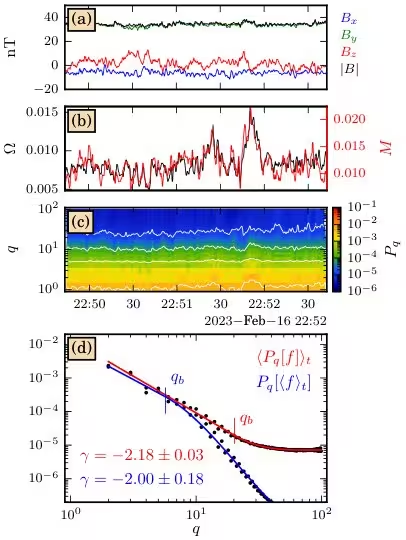
This approach breaks down particle distribution functions into spectral modes, analogous to how standard Fourier analysis evaluates spatial waves. The resulting velocity-space spectra reveal how deviations from a standard thermal state, measured as dimensionless enstrophy, distribute across different scales. The team evaluated hundreds of times more data than previous case studies, enabling a robust statistical evaluation of plasma behavior.
What Controls the Two Distinct Ion Populations?
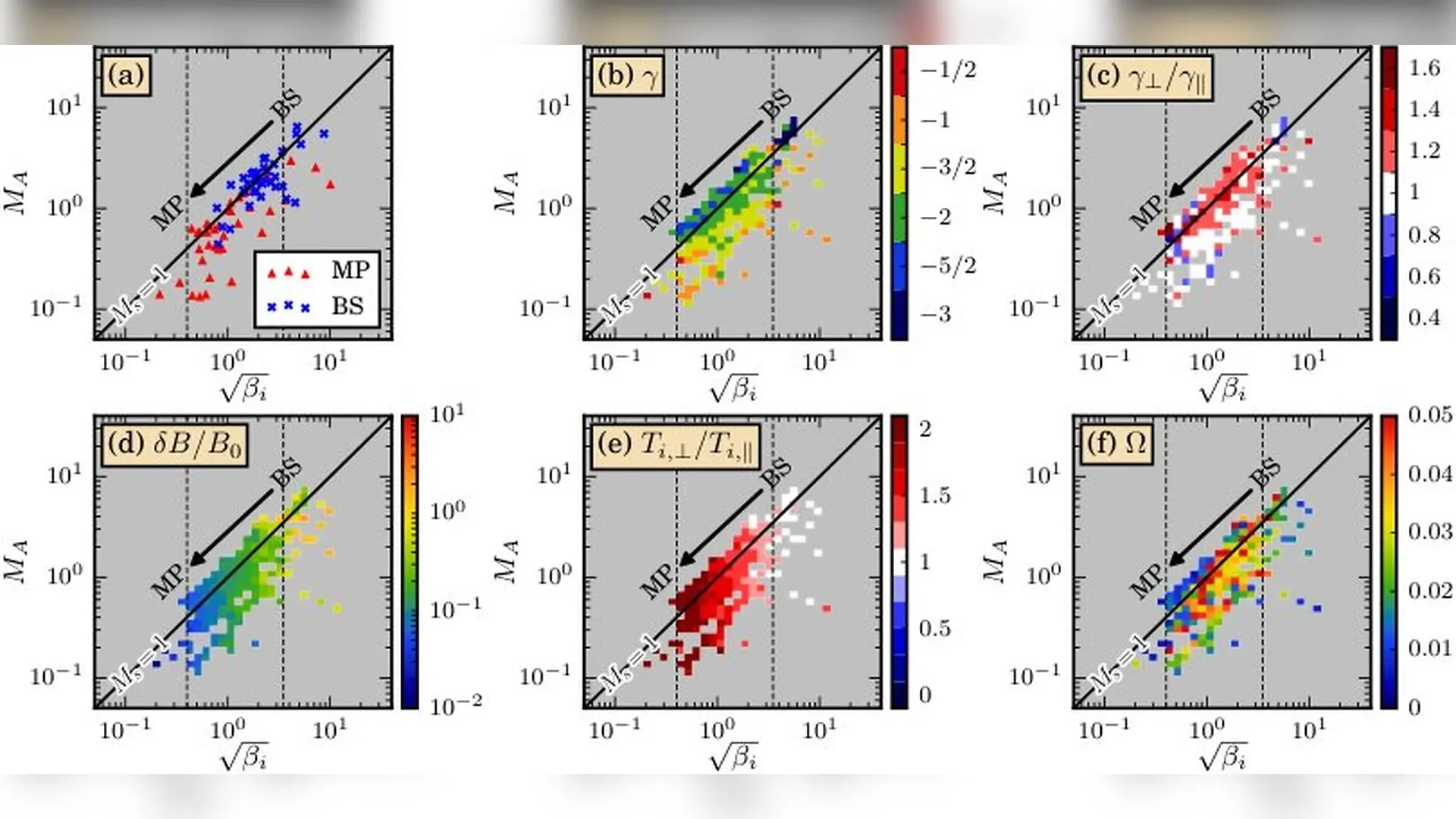
The analysis uncovered two prominent populations within the ion velocity spectra, organized primarily by the plasma beta parameter, which measures the ratio of particle pressure to magnetic pressure, alongside the bulk ion flow speed. One group exhibits a spectral scaling index averaging around negative two, characterized by strong magnetic dominance and high directional anisotropy where spectra stretch preferentially along the background magnetic field.
The second population displays a shallower scaling index averaging around negative one point five, which is dominated by kinetic pressure and exhibits much lower anisotropy. The transition between these two distinct regimes depends heavily on local plasma conditions, with the magnetic regime aligning closely with conditions where the acoustic Mach number equals one, while the kinetic regime tends to be subsonic.
Are Velocity-Space and Real-Space Turbulence Connected?
A surprising finding emerged when the team compared velocity-space properties with traditional spatial turbulence measurements. The spectral indices calculated in velocity space show no direct statistical correlation with standard Fourier-space indices observed in the inertial or kinetic ranges of the magnetic field. This indicates that fluctuations operating in physical space and those operating in velocity space act largely independently.
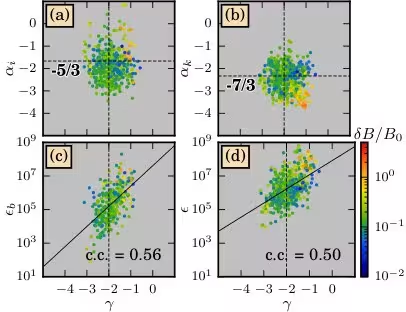
However, the researchers found a moderate correlation between the velocity-space spectral slope and the estimated real-space energy transfer rates. Intervals exhibiting stronger real-space turbulence tend to feature shallower velocity-space spectra, suggesting an underlying energetic link even though the specific spectral shapes do not mirror one another directly.
What Are the Implications for Space Weather and Astrophysics?
These findings provide an observational foundation for understanding how non-thermal particle populations form and evolve in planetary magnetospheres and interplanetary shocks. The velocity-space cascade plays a vital role in determining how turbulent energy partitions between thermal heating and particle acceleration.
Because similar magnetosheath jets and turbulent boundaries exist around other worlds like Mars and Jupiter, the insights gained from Earth’s environment offer a universal window into plasma physics across the solar system. Future investigations combining simultaneous measurements of magnetic fields and particle distributions will help clarify the exact mechanisms driving energy conversion in phase space.
The study was posted to the arXiv preprint server on November 21, 2026.
This article has been fact checked for accuracy, with information verified against reputable sources. Learn more about us and our editorial process.
Last reviewed on .
Article history
- Latest version
Reference(s)
- Vo, Tien. “Statistical Signatures of Velocity-Space Turbulence in the Earth's Magnetosheath.” arXiv.org <http://arxiv.org/abs/2611.28546v1>.
Cite this page:
- Posted by Aisha Ahmed