Scientists Just Discovered That Adding Microscopic Roughness Can Dramatically Reduce Drag
A long-standing assumption in aerodynamics has been challenged by the discovery of a surprising exception hidden within microscopic surface roughness.

In a striking departure from decades of aerodynamic design, researchers at Tohoku University have demonstrated that a precisely roughened surface can actually slash drag by nearly 44 percent. By challenging the long-held industry standard that perfectly smooth surfaces are the only path to efficiency, the team has opened new questions about how microscopic textures influence the air flowing over high-speed objects.
The study, published in the Journal of Fluid Mechanics, utilized a sophisticated one-meter-long aluminum model suspended in a wind tunnel via magnetic fields. By removing physical supports, the team eliminated the interference that typically plagues aerodynamic testing, allowing them to isolate the impact of surface conditions with unprecedented accuracy.
Defying the Smooth-Surface Standard
For nearly a century, engineers have focused on achieving laminar flow—a state where air slides across a surface in orderly, parallel layers. Any disturbance, such as microscopic bumps, is traditionally viewed as a liability that triggers turbulent, drag-inducing chaos. However, Associate Professor Aiko Yakeno and her team discovered that when the surface of their test model was sandblasted to create a specific, minute roughness, the expected penalty did not occur.

Instead, the roughness—averaging just 2.6 to 2.8 micrometers—appeared to suppress the energy of the turbulent flow, leading to a significant reduction in skin-friction drag. This effect was observed during the “transitional” phase, the delicate window where air moves from smooth to chaotic. The researchers recorded a maximum drag reduction of 43.6% compared to the identical model in a polished state.
The Physics of Micro-Texture
The team was quick to distinguish their findings from the “golf-ball effect,” where dimples delay flow separation to reduce pressure drag. Through large-eddy simulations and oil-flow visualization, the researchers determined that their results were primarily driven by changes to skin friction rather than pressure dynamics. The texture was so fine that, under conventional definitions, the surface should have still been considered “hydraulically smooth.”
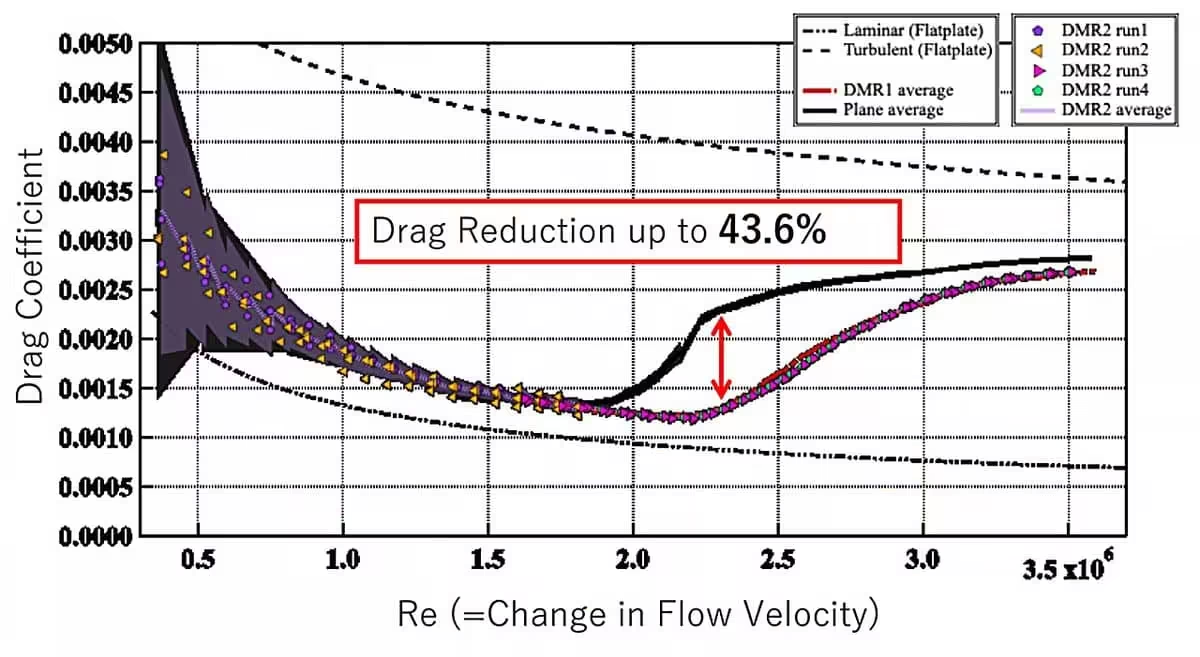
The effectiveness of this method appears to hinge on the precise distribution and depth of the pits on the model’s surface. While the results are promising, the researchers remain cautious about immediate industrial application. The test was conducted on a specific model shape under controlled laboratory conditions, and factors like ambient vibrations and the complexity of real-world flight mean that more validation is required.
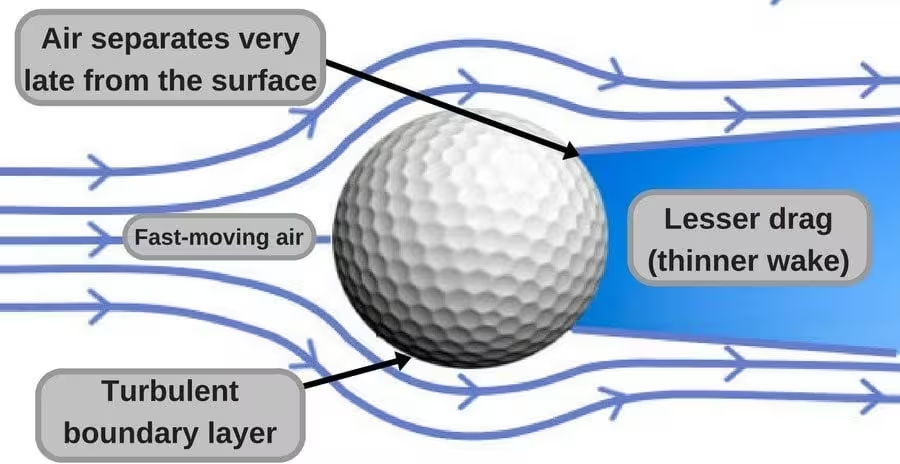
Looking ahead, the Tohoku University team has partnered with researchers at Imperial College London to further deconstruct the fluid dynamics at play. If these findings can be scaled to larger vehicles, the ability to fine-tune surface textures could provide a revolutionary method for reducing energy consumption and emissions across the transportation sector.
This article has been fact checked for accuracy, with information verified against reputable sources. Learn more about us and our editorial process.
Last reviewed on .
Article history
- Latest version
Reference(s)
- Yakeno, Aiko. “DMR effect on drag reduction of a streamlined body measured by magnetic suspension and balance system | Journal of Fluid Mechanics | Cambridge Core.”, vol. 1034, pp. A50 Cambridge Core, doi: 10.1017/jfm.2026.11520. <https://www.cambridge.org/core/journals/journal-of-fluid-mechanics/article/dmr-effect-on-drag-reduction-of-a-streamlined-body-measured-by-magnetic-suspension-and-balance-system/0E3FF950CCC66DEFCBA3D3DCD36CE2B6>.
Cite this page:
- Posted by Karan Das