Simulations Reveal How Plasma Turbulence Redistributes Energy Across Scales
A new computational study uncovers how Hall effects and magnetic Prandtl numbers drive complex energy cascades in space plasmas.
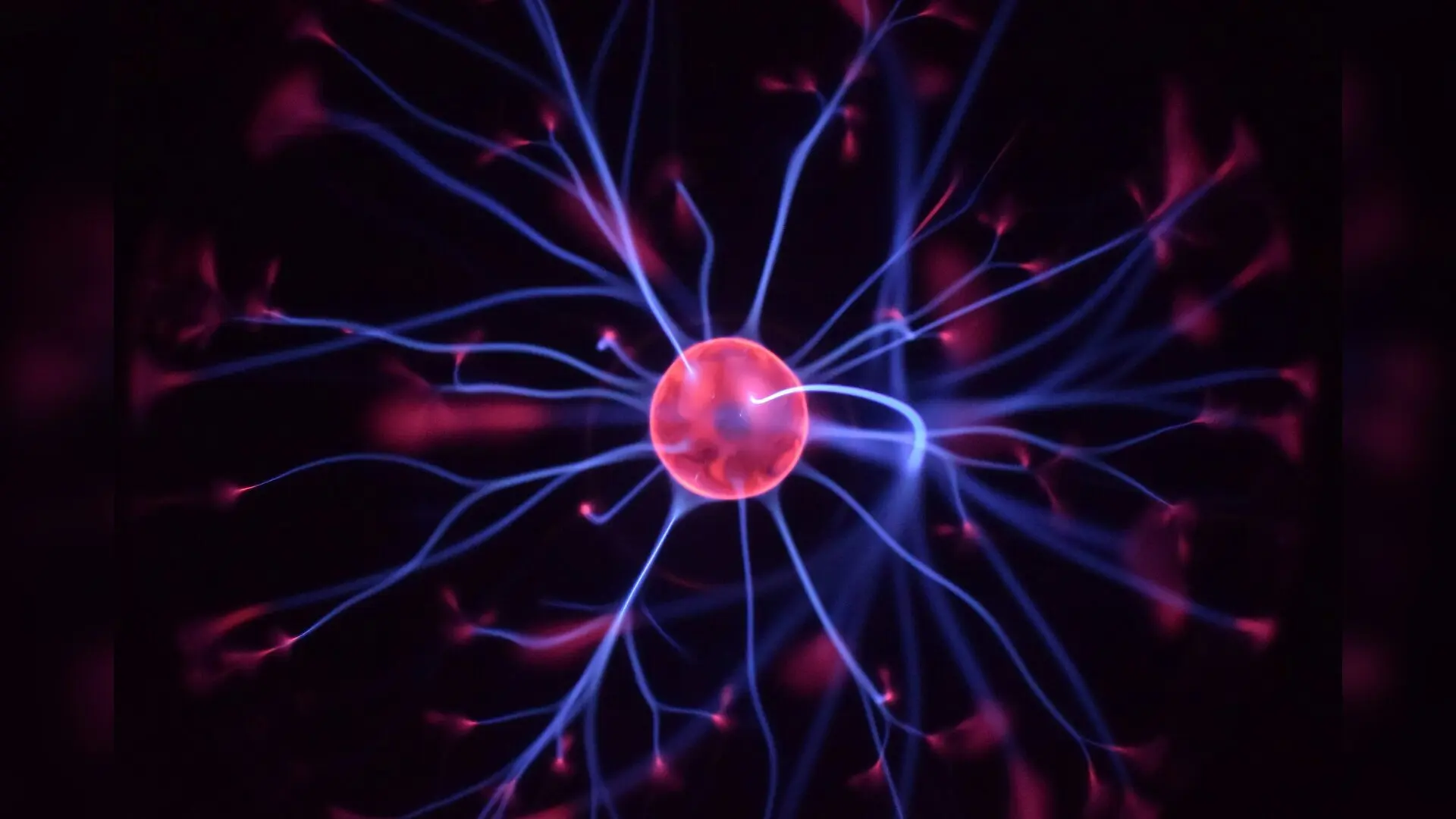
Turbulence in space plasmas involves complex energy exchanges across vast ranges of scale, driven by fundamental equations that govern how magnetic fields and conducting fluids interact. A team of researchers has mapped out these energy pathways in unprecedented detail, revealing how turbulent motion redistributes energy when small-scale plasma physics comes into play.
To investigate these multiscale dynamics, Pratik Patel and colleagues carried out extensive computer simulations of three-dimensional decaying turbulence, tracking how energy moves through different physical channels. The team performed their simulations using specialized high-performance computational tools to model both standard magnetohydrodynamics and its more complex counterpart, Hall magnetohydrodynamics. The results are available on the arXiv preprint server, offering fresh insight into how plasma systems behave when magnetic fields decouple from ion motion at microscopic scales.
How Does the Hall Term Alter Energy Cascades?
Standard fluid and magnetic turbulence typically follows a straightforward forward cascade, meaning energy moves continuously from large eddies down to smaller and smaller structures until it is dissipated as heat. The inclusion of the Hall term, which becomes significant at length scales smaller than the ion-inertial length, introduces dispersive effects that complicate this picture. The ion-inertial length represents the spatial scale where ions and electrons decouple in a plasma.
When the authors analyzed shell-to-shell energy transfers, they found that like-field interactions, such as kinetic-to-kinetic and magnetic-to-magnetic energy flows, remain predominantly local and forward in direction across all tested parameters. This means energy is handed off smoothly between neighboring scales of motion. However, cross-field transfers between velocity and magnetic fields show distinct non-local signatures when the magnetic Prandtl number sits near unity. The magnetic Prandtl number measures the ratio of viscous dissipation to magnetic diffusivity within a fluid.
What Happens at High and Low Prandtl Numbers?
The behavior of the turbulent plasma changes noticeably when researchers adjust the magnetic Prandtl number. At very low and very high values, these non-local energy transfers become heavily suppressed, remaining visible only across narrow inertial ranges. Furthermore, the analysis indicates that the Hall term actively drives both inverse and forward transfers of magnetic energy. Specifically, the Hall-driven contributions generate a local inverse transfer at large spatial scales, pushing energy back toward bigger structures, while simultaneously fueling forward cascades at microscopic scales.
These findings carry important implications for understanding real-world astrophysical environments where turbulent plasmas are widespread. Phenomena such as solar wind streams, magnetospheric dynamics, and the behavior of neutron stars all involve physical conditions where Hall effects play a critical role. By quantifying how energy routes through these diverse channels under varying Prandtl numbers, the study provides a stronger theoretical foundation for interpreting space weather observations and modeling magnetized cosmic fluids.
The study was posted to the arXiv preprint server on November 19, 2026.
This article has been fact checked for accuracy, with information verified against reputable sources. Learn more about us and our editorial process.
Last reviewed on .
Article history
- Latest version
Reference(s)
- Patel, Pratik. “Energy transfers in decaying three-dimensional Hall-magnetohydrodynamics turbulence: Dependence on the Ion-Inertial Length and the Magnetic Prandtl Number.” arXiv.org <http://arxiv.org/abs/2611.25686v1>.
Cite this page:
- Posted by Karan Das