How Pupil Dilation Reveals the Brain’s Hidden Learning Mechanism
Eye-tracking data reveals that human probability learning is driven primarily by confidence-weighting and mediated by distinct arousal pathways.
When human participants try to track changing probabilities in uncertain environments, their brains rely heavily on confidence rather than simply reacting to unexpected surprises. Researchers exploring how people update their beliefs when outcomes are difficult to predict found that prior uncertainty about existing beliefs acts as the main driver of learning adjustments. The study, published in PLOS Computational Biology, combined behavioral modeling with eye-tracking measurements to reveal how internal uncertainty states map onto different physiological arousal signals.
How Humans Track Hidden Probabilities in Volatile Settings
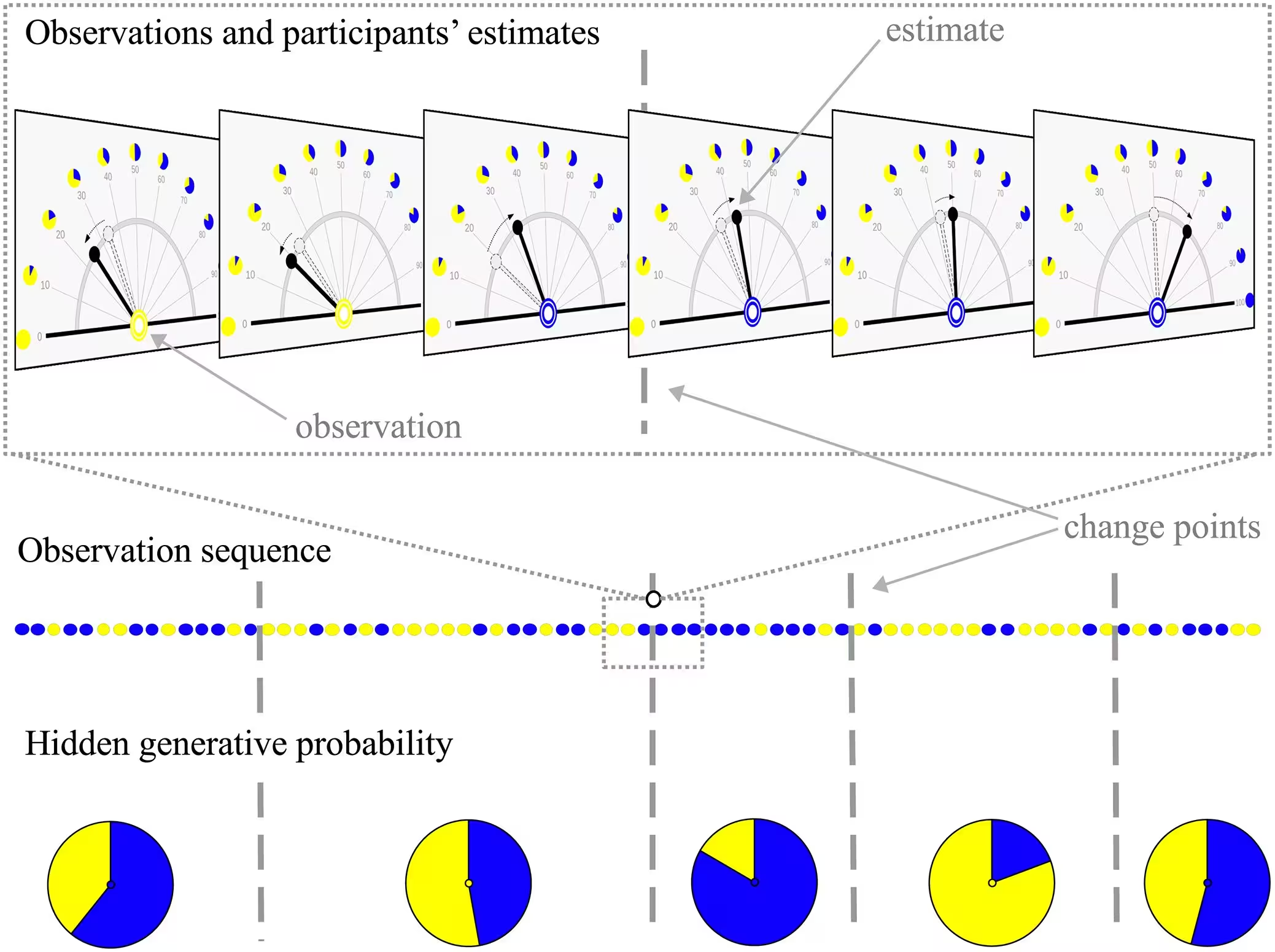
The experiment involved 31 human participants who observed a continuous sequence of 75 colored outcomes displayed on a screen. Participants were instructed to imagine a spinning roulette wheel divided into blue and yellow sections, where the proportion of blue represented a hidden generative probability. As the sequence progressed, this hidden proportion could shift abruptly at unpredictable moments without any direct signal given to the participants. Every time a new observation appeared, participants had to adjust a marker on a semi-circular slider to estimate the current proportion of blue outcomes. By analyzing these adjustments, Aaron Greenhouse-Tucknott and colleagues measured how much individuals altered their beliefs on a trial-by-trial basis, establishing what researchers call an apparent learning rate.
To evaluate how optimal performance compares to human behavior, the authors applied a Bayesian ideal observer model. This computational approach calculates the statistically optimal posterior distribution of the hidden probability based on past observations. It also extracts two key latent uncertainty factors from the environment. The first factor, known as prior uncertainty, measures the imprecision or lack of confidence in beliefs held just before a new observation appears. The second factor, change-point probability, reflects the likelihood that an abrupt environmental shift has occurred since the last observation.
Separate Pupil Signals Encode Different Forms of Uncertainty
The researchers tracked participants’ eye movements and pupil diameters to examine how central arousal systems represent these statistical variables. Previous work in magnitude-based tasks showed that phasic pupil dilations track change-point probabilities. However, probability learning presents a much harder inference challenge because individual observations carry very little information. The team discovered that prior uncertainty and change-point probability are encoded separately across tonic and phasic pupil signals. Specifically, baseline-corrected phasic pupil dilations responded to change-point probability starting about 630 milliseconds after a stimulus appeared. Meanwhile, non-baseline-corrected tonic pupil signals tracked prior uncertainty continuously across the entire epoch, even before a new observation was presented.
Further analysis demonstrated that both of these physiological signals help mediate the transformation of uncertainty factors into actual belief updates. When tonic arousal levels were extremely high, however, the coupling between change-point probability and phasic pupil responses weakened significantly. This suggests that elevated tonic arousal states might alter how the brain processes environmental changes, prioritizing the maintenance of confidence over the detection of sudden shifts.
Methodological Nuances and Broad Implications
The study provides new insight into the neural mechanisms that govern adaptive learning in dynamic environments. While the findings point to a clear dissociation between tonic and phasic arousal pathways, the authors note certain limitations. For instance, short interstimulus intervals can introduce residual phasic activity into tonic pupil measurements, though supplementary deconvolution analyses confirmed the main results held true. Understanding how the brain balances confidence-weighted learning with arousal dynamics could eventually shed light on cognitive flexibility and decision-making difficulties in clinical and everyday contexts.
The research was published in PLOS Computational Biology on November 20, 2026.
This article has been fact checked for accuracy, with information verified against reputable sources. Learn more about us and our editorial process.
Last reviewed on .
Article history
- Latest version
Reference(s)
- Greenhouse-Tucknott, Aaron., et al. “Pupil dynamics reflect uncertainty-driven adjustments of probability learning.” PLOS Computational Biology, vol. 22, no. 11, November 20, 2026, pp. e1014064 Public Library of Science (PLoS), doi: 10.1371/journal.pcbi.1014064. <https://doi.org/10.1371/journal.pcbi.1014064>.
Cite this page:
- Posted by Zubair Ali