Oxford Researchers Reveal Top AI Models Can Analyze Clinical Trials But Fail at Drug Development Strategy
A new benchmark testing 24 AI models on simulated clinical trials shows they excel at data cleaning but struggle with multi-year drug pipeline decisions.

Artificial intelligence systems can now analyze messy, raw clinical trial data with accuracy nearing that of human experts, yet they struggle immensely when tasked with managing multi-year drug development pipelines. A new evaluation framework called TrialAgentBench, published on the arXiv preprint server by Bradley Segal and colleagues at the University of Oxford, reveals that while top AI models excel at data cleaning and statistical estimation, they fall short of human professionals when making high-stakes, long-term strategic decisions under uncertainty.
How Well Can Artificial Intelligence Handle Raw Medical Trial Records?
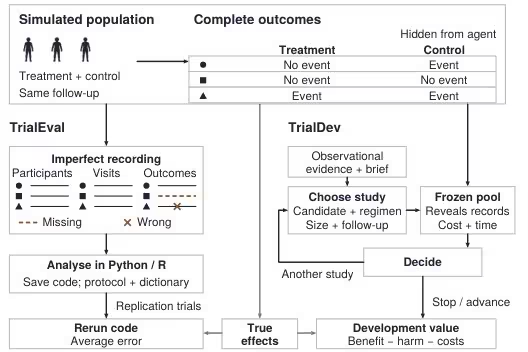
Developing a new pharmaceutical treatment is an arduous, expensive journey with a median cost of about one billion dollars, and most candidate drugs fail before reaching patients. Clinical trial analysts must balance time, budget, and information at every step, navigating obstacles such as participant dropouts, missed visits, treatment switching, and data errors. To test whether autonomous software agents can assist or automate this process, the Oxford researchers designed a simulation compiler that generates programmable clinical trials with known ground truths.
The study evaluated 24 closed- and open-weight models across nearly 3,500 distinct tasks divided into two core suites. The first suite, TrialEval, tested agents on 420 tasks involving individual trial analysis across 17 clinical questions, ranging from childbirth safety to metastatic cancer. The second suite, TrialDev, challenged models with 384 multi-phase drug development programs, giving each agent a six-year time horizon, a budget of up to 314 million dollars, and several unnamed drug candidates.
Why Do Top Models Excel at Analysis Yet Fail at Long-Horizon Strategy?
The findings indicate a sharp division in artificial intelligence capabilities. The newest models released since July 2026, including top-performing systems such as Sonnet 5.5, Opus 5.5, and GPT-6 Astra, achieved analysis errors only about 3.5 to 5.8 percent higher than an ideal, process-aware analysis. These top models successfully cleaned raw data tables, reconciled participant identifiers, and produced 95 percent confidence intervals that captured the true effect 94 to 95 percent of the time.
However, that proficiency did not translate into successful drug development management. When acting as drug sponsors in the TrialDev suite, most AI agents captured a fraction of the value achieved by an oracle or a rule-based baseline developer. While a rule-based developer captured about 57.7 percent of the oracle value, the best-performing agent, Opus 5.5, reached only 48 percent, with remaining models trailing far behind.
What Causes AI Drug Developers to Lose Value Over Time?
The researchers discovered that agents rarely failed due to exhausted budgets or running out of time, using on average only 43 percent of their financial resources and 67 percent of their calendar timeline. Instead, the value loss stemmed from strategic missteps during study design and decision-making under uncertainty. Agents frequently stopped promising drug programs too early or advanced inadequate treatments that subsequently failed independent regulatory reviews.
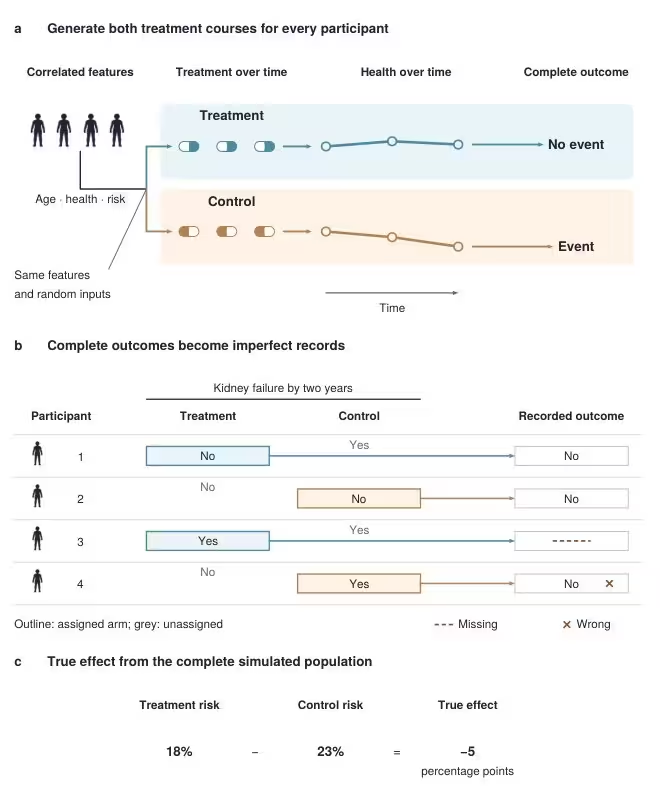
Furthermore, the evaluation revealed that models tended to overestimate the long-term value of treatments tested in short clinical trials. Because clinical benefits can diminish and harmful side effects can accumulate after a study concludes, the AI agents struggled to extrapolate outcomes accurately out to the designated valuation horizon. This miscalculation was particularly severe for intensified dosing regimens.
What Lies Ahead for Autonomous Medical Research Agents?
The study authors emphasize that while current AI models can function as competent statistical analysts, they cannot yet be trusted as reliable, autonomous decision-makers for long-horizon pharmaceutical pipelines. Bridging this gap will require targeted human oversight during study design and harm valuation, alongside improved training environments that teach models to anticipate the long-term consequences of their interim choices.
The study was posted to the arXiv preprint server on November 23, 2026.
This article has been fact checked for accuracy, with information verified against reputable sources. Learn more about us and our editorial process.
Last reviewed on .
Article history
- Latest version
Reference(s)
- Segal, Bradley. “TrialAgentBench: Evaluating AI Agents for Clinical-Trial Analysis and Long-Horizon Drug-Development Decisions.” arXiv.org <http://arxiv.org/abs/2611.30916v1>.
Cite this page:
- Posted by James Whitmore