Artificial Intelligence Tool Automatically Extracts Decades Of Complex Evolutionary Biology Data
A new automated curation pipeline recovers missing metadata from historical research papers and cuts data processing costs by ninety percent.

Extracting decades of trapped biological data from scientific papers now takes a fraction of the usual time thanks to an artificial intelligence tool that automatically converts text into standardized phylogenetic tables. Historically, researchers spent up to two hours manually transcribing just one hundred anatomical traits from published studies to build evolutionary trees, a notoriously tedious bottleneck for museums and open digital archives.
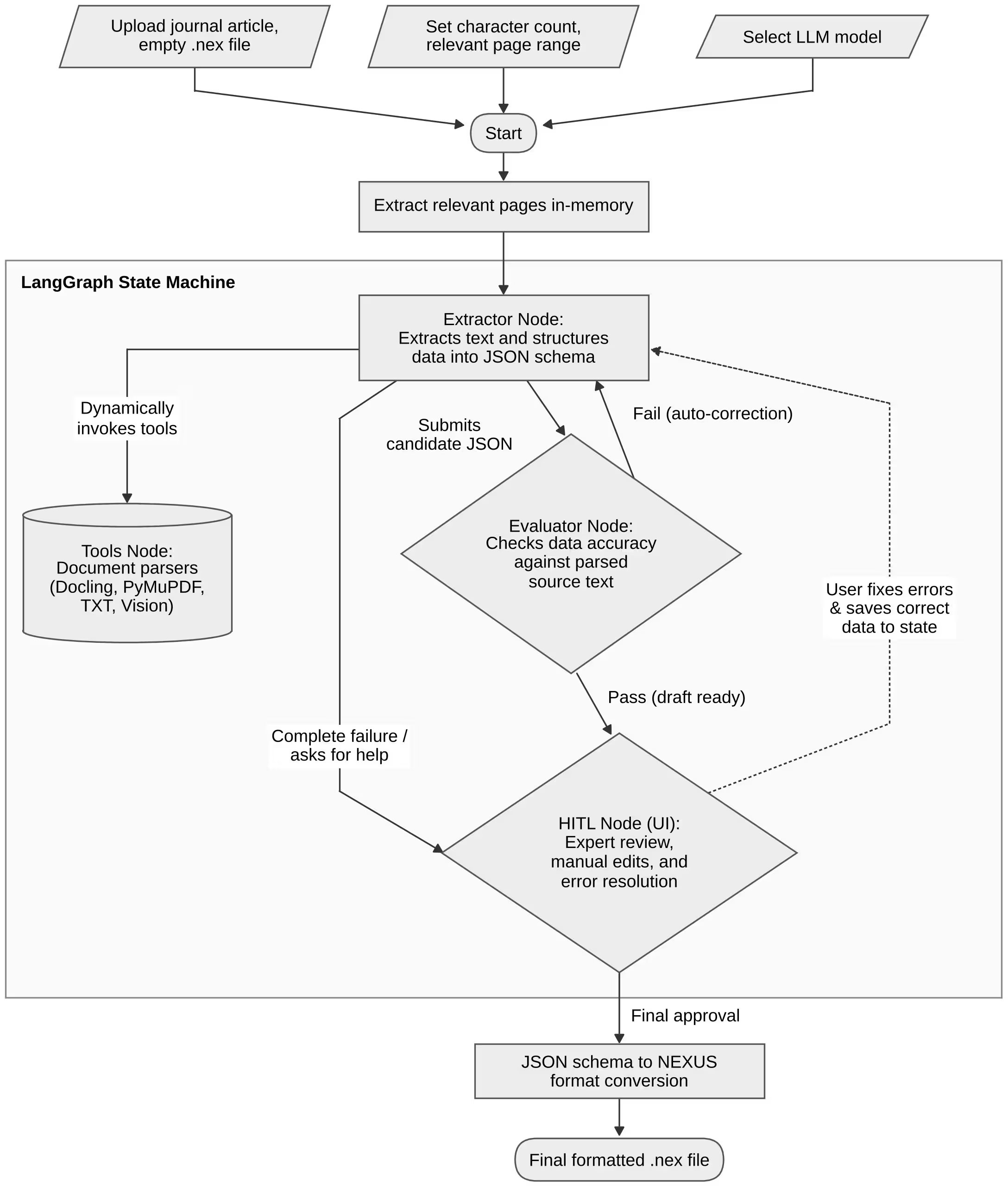
Shreya Jariwala and colleagues at the MorphoBank repository developed a proof-of-concept pipeline called MatrixCurator to automate this heavy lifting, which was published in PLOS One. The system uses advanced language models and document parsers to scan complex PDF and Word files, extract character definitions, and structure them into community-standard NEXUS files without human transcription errors.
How Can Artificial Intelligence Untangle Decades of Complex Biological Literature?
Morphological datasets are the backbone of evolutionary biology and paleontology, encoding physical traits across different species into massive data matrices. However, many historical studies published over the last thirty years stored these crucial character definitions only as raw text tables inside the original papers, leaving modern digital archives with matrix files missing their essential descriptive metadata.
To solve this, the MatrixCurator system relies on a stateful multi-node architecture managed by the LangGraph framework. The workflow splits tasks between an extractor node that generates candidate character states as structured JavaScript Object Notation (JSON) objects, and an evaluator node that checks the semantic correctness of the extracted data against the raw source text before a human expert reviews the results.
What Makes Multi-Node Validation Outperform Traditional Automated Extraction?
When tested against a benchmark dataset of thirty-three research papers published between 1991 and 2020 containing over two thousand character states, the system demonstrated strong performance. The Google Gemini 3.1 Flash Lite model achieved an average extraction accuracy of about 91.8 percent in a strict one-shot test, while open-source models such as Gemma 3 and Llama 4 struggled significantly with scores near thirty and twenty-five percent respectively.
Document parsing tests showed that Docling achieved complete recall for Word documents, while PyMuPDF slightly outperformed other tools on standard PDF layouts. Furthermore, context caching allowed the developers to store pre-computed key-value activations of each research paper in memory, cutting processing costs by roughly ninety percent from about $13.20 down to $1.44 per matrix.
What Are the Hidden Catch Points and Limits of Automated Curation?
Despite these efficiency gains, the system is designed strictly as an assistive tool rather than a fully autonomous replacement for human expertise. Systematic evaluation revealed that about 81.4 percent of extractions contained no errors, but the remaining outputs included minor hallucinations where models appended external citations, occasional state fabrications, and partial omissions of anatomical descriptions.
Curators must still manually specify the relevant page ranges and character counts at the start of the process, as fully automated scope detection reduces accuracy on older documents with irregular layouts. These safeguards ensure that human experts retain final interpretive authority over every dataset ingested into repository archives.
How Does This Technology Transform Global Biodiversity Research Repositories?
By automating the reconstruction of missing metadata blocks, the pipeline directly advances Findability, Accessibility, Interoperability, and Reusability data standards across evolutionary science. Enriched NEXUS files generated by the tool become fully self-contained and human-readable, allowing seamless integration with standard phylogenetic software like PAUP* and MrBayes.
The research team has already processed over thirty-five thousand character-state entries across more than four hundred published papers for MorphoBank. As repositories race to mobilize legacy data for large-scale biodiversity syntheses, hybrid workflows combining artificial intelligence speed with human oversight offer a scalable path forward.
The research was published in PLOS One on November 23, 2026.
This article has been fact checked for accuracy, with information verified against reputable sources. Learn more about us and our editorial process.
Last reviewed on .
Article history
- Latest version
Reference(s)
- Jariwala, Shreya., et al. “Advancing FAIR data management through AI-assisted curation of morphological data matrices.” PLOS One, vol. 21, no. 11, November 23, 2026, pp. e0361639 Public Library of Science (PLoS), doi: 10.1371/journal.pone.0361639. <https://doi.org/10.1371/journal.pone.0361639>.
Cite this page:
- Posted by James Whitmore