Quantum Geometry Drives Mott Transitions and Heavy Fermions in Topological Flat Bands Without Kinetic Energy
A new theoretical framework shows how orbital overlap and Berry curvature replace electron hopping to generate heavy quasiparticles and correlation cascades in moire materials.

Physicists have uncovered how interacting electrons can form heavy quasiparticles and trigger metal-to-insulator transitions in flat electronic bands without needing traditional kinetic energy pathways. The theoretical investigation reveals that quantum geometry alone can drive a Mott transition in materials lacking standard localized orbital structures.
Electrons in topological flat bands with a nonzero Chern number cannot form the neatly localized Wannier orbitals that typically underpin the physics of strongly correlated materials. Yet magic-angle twisted bilayer graphene, which features topological flat bands, exhibits classic correlation phenomena such as insulating states, electronic compressibility cascades, and high-temperature pseudogaps.
To resolve this tension, researcher Ya-Hui Zhang from Johns Hopkins University examined a Hubbard interaction model applied directly to coherent orbitals projected onto flat bands. The findings are available on the arXiv preprint server.
How Can Flat Bands Host Strongly Correlated Physics?
In standard materials, electrons hop from site to site, and their kinetic energy competes with local repulsion. In a flat band, electrons possess almost zero kinetic energy, meaning interactions dominate completely. Zhang modeled these systems by using coherent orbitals that are localized but overcomplete, overlapping with neighboring sites.
The degree of this spatial overlap is controlled by a parameter representing the fraction of the Brillouin zone carrying Berry curvature, the geometric property of quantum wavefunctions. By developing a dynamical mean-field theory based on these coherent orbitals, the author captured how electron interactions generate local magnetic moments and dynamic baths purely through orbital overlap.
What Happens at Integer Fillings and Doped Regimes?
At specific integer electronic fillings, the system undergoes a quantum phase transition from an insulator to a metal as the overlap parameter increases past a critical threshold. For eight electronic flavors, the Mott transition at a filling of two electrons per site occurs at a critical overlap fraction of about 0.025.
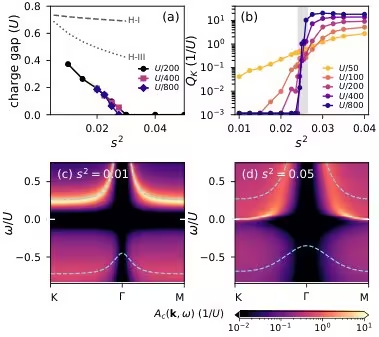
Below this critical value, the system exhibits a clear charge gap and unscreened local magnetic moments. Above it, local moments become Kondo-screened by the surrounding electronic environment, transforming the material into a heavy Fermi liquid with a large Fermi surface.
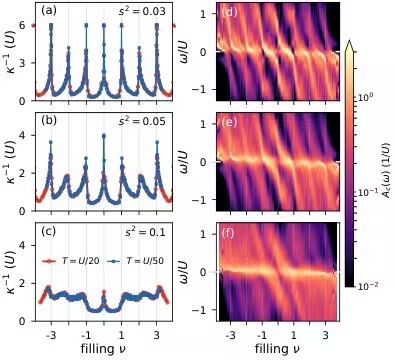
When doped away from integer fillings, the calculations successfully reproduce the experimentally observed cascade of electronic transitions and inverse-compressibility sawtooth patterns seen in moiré superlattices. Furthermore, introducing an anti-Hund’s coupling between valleys favors spin-singlet formation, opening a pseudogap that matches features observed in twisted bilayer graphene normal states.
What Are the Limitations of the Model?
While the single-site dynamical mean-field theory provides powerful analytical insight without needing remote electronic bands, it relies on approximations for the impurity solver and analytical continuation methods to map spectra. The framework points toward a new paradigm where quantum geometry and topological overlap take the place of kinetic energy in driving quantum phase transitions.
The study was posted to the arXiv preprint server on November 23, 2026.
This article has been fact checked for accuracy, with information verified against reputable sources. Learn more about us and our editorial process.
Last reviewed on .
Article history
- Latest version
Reference(s)
- Zhang, Ya-Hui. “Quantum-geometry-tuned Mott transition and emergent heavy fermions in a topological flat band.” arXiv.org <http://arxiv.org/abs/2611.31242v1>.
Cite this page:
- Posted by John Williams