Metal Fractal Cubes Printed With Lasers Reveal Surprising Limits To Energy Absorption Efficiency
Pushing 3D-printed metal fractal structures to higher complexity orders reduces their energy absorption due to manufacturing limits in sub-millimeter struts.

When engineers design lightweight structures to absorb heavy impacts for aerospace or automotive safety, they often turn to fractal geometries that repeat intricate patterns across smaller and smaller scales. Researchers recently discovered that pushing these complex designs to their theoretical limits can backfire, because tiny manufacturing flaws in sub-millimeter struts weaken the structure more than the fractal design helps it. A team of scientists set out to investigate how different complexity orders of a famous three-dimensional fractal shape, known as the Menger sponge, behave under heavy crushing loads when printed out of a durable aluminum-silicon-magnesium alloy.
Led by researcher Zhang Dong Li and colleagues, the team fabricated first-, second-, and third-order Menger sponge fractal structures out of AlSi10Mg using selective laser melting, a form of 3D printing that uses a high-powered laser to fuse metal powder layer by layer. Each cube measured exactly twenty-seven millimeters on a side, but internal through-holes varied in size across the orders from nine millimeters down to one millimeter. Before testing the complex cubes, the team conducted tensile calibrations on solid material test rods from the same print batch, measuring an average base elastic modulus of 60.73 gigapascals and a yield strength of 170.1 megapascals. The detailed findings are published in PLOS One to provide a rigorous benchmark for high-performance energy absorbers.
Why Does Pushing Fractal Complexity Too Far Reduce Energy Absorption?
The researchers subjected the metal cubes to quasi-static compression tests using an electronic universal testing machine, stopping when the displacement reached twenty millimeters to fully capture the densification stage. Digital image correlation cameras tracked surface strain throughout the crushing process to reveal how deformation traveled across the internal network. The first-order structure, featuring thickest walls, sustained a maximum peak force of 220.9 kilonewtons before collapsing. The second-order structure achieved a maximum crushing force of 195.1 kilonewtons, while the third-order structure dropped sharply to a peak force of 68.9 kilonewtons.
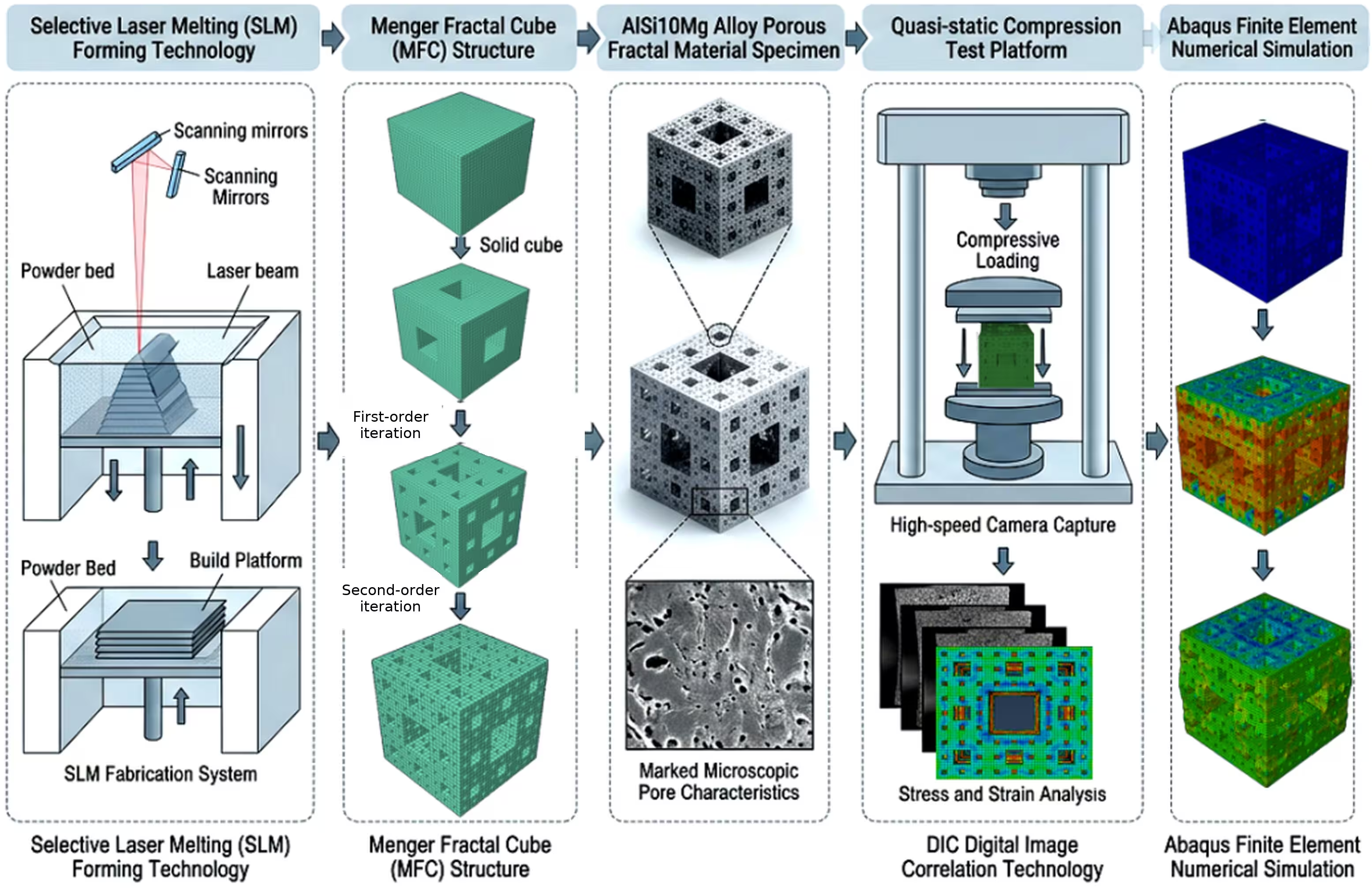
When evaluating energy absorption per unit mass, the second-order structure emerged as the clear winner with a specific energy absorption of 60.32 joules per gram, representing a 65.2 percent improvement over the first-order design. However, instead of continuing to improve, the third-order structure saw its specific energy absorption drop back down to 41.08 joules per gram. High-precision weighing revealed that the third-order cubes suffered a 15.3 percent negative mass deviation from theoretical values, showing that printing one-millimeter thin rods pushes the selective laser melting process to its physical limit.
What Four Mechanisms Drive Stiffness Attenuation in Metal Fractals?
Initial stiffness values plummeted across the orders, dropping from 133.03 kilonewtons per millimeter in the first-order cube down to 46.97 kilonewtons per millimeter in the third-order cube. Comparing these results against existing theoretical recurrence models showed that the predicted stiffness values systematically overestimated actual performance by a wide margin, with measured stiffness reaching only eighteen to thirty-three percent of predicted lower bounds.
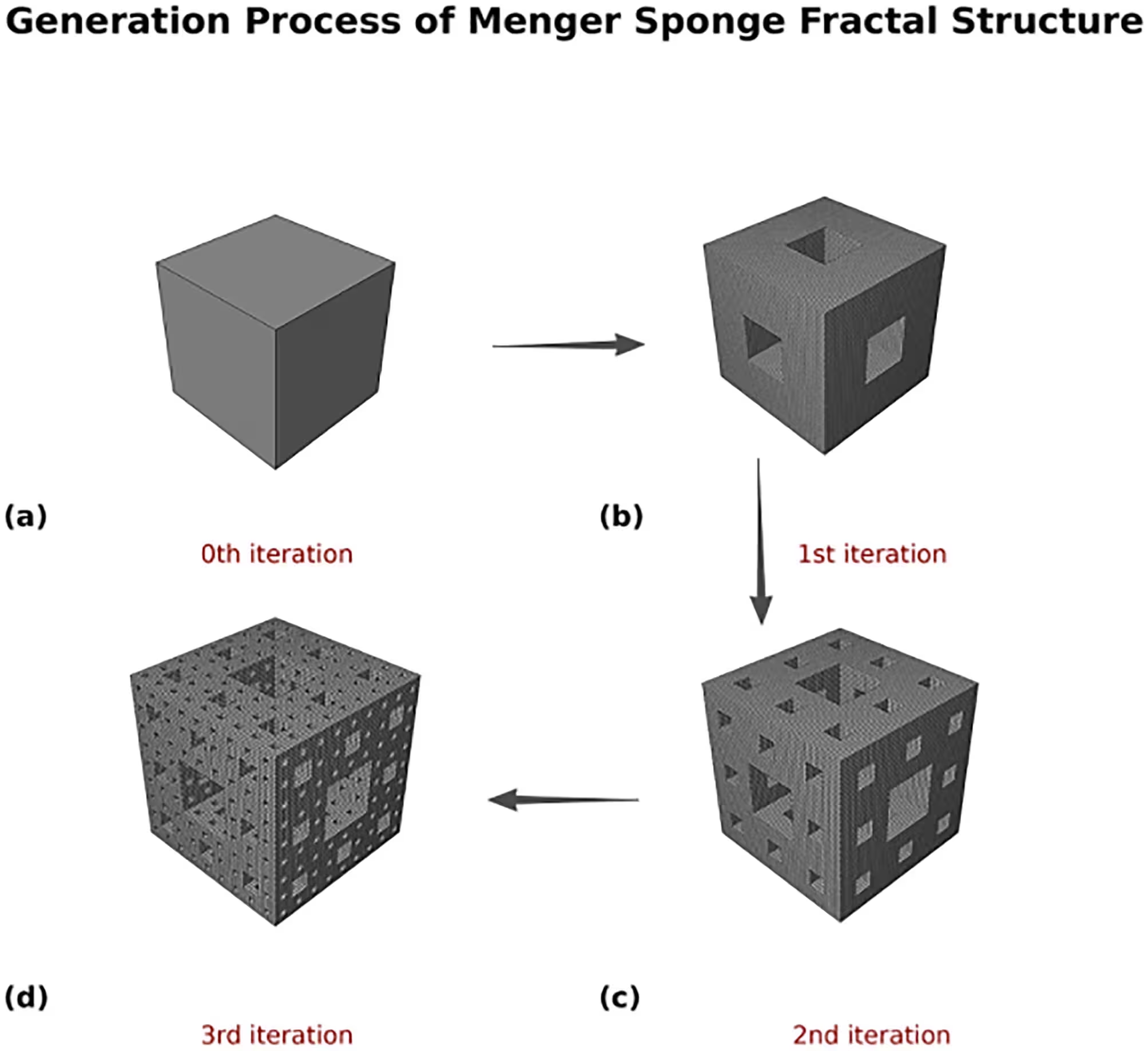
The team traced this stiffness decay to four distinct physical mechanisms acting in tandem:
- Geometric dilution, where increasing porosity reduces the total amount of load-bearing solid material.
- Bending-dominated deformation, which accelerates modulus reduction faster than tension-dominated designs.
- Severe stress concentration around hole edges, causing those fine regions to yield prematurely into plasticity.
- Manufacturing imperfections, where internal micro-pores and rough surfaces heavily weaken slender one-millimeter struts.
Finite element simulations conducted in Abaqus successfully replicated the experimental curves with peak force deviations staying below 6.1 percent and cumulative energy absorption errors under 4.7 percent. The authors caution that this optimal second-order threshold is tied to the twenty-seven millimeter absolute specimen size and the specific printing window utilized, noting that scaling up the overall dimensions could alter how higher-order structures perform.
The research was published in PLOS One on November 23, 2026.
This article has been fact checked for accuracy, with information verified against reputable sources. Learn more about us and our editorial process.
Last reviewed on .
Article history
- Latest version
Reference(s)
- Li, Zhang Dong., et al. “Quasi-static mechanical properties of AlSi10Mg menger sponge fractal structures fabricated by selective laser melting.” PLOS One, vol. 21, no. 11, November 23, 2026, pp. e0362374 Public Library of Science (PLoS), doi: 10.1371/journal.pone.0362374. <https://doi.org/10.1371/journal.pone.0362374>.
Cite this page:
- Posted by Rabia Shah