Physicists Reveal How Subatomic Strings Snap Inside Exotic Four-Quark Systems
A five-dimensional string model suggests that string breaking distances in tetraquarks are non-universal and depend strictly on spatial geometry.
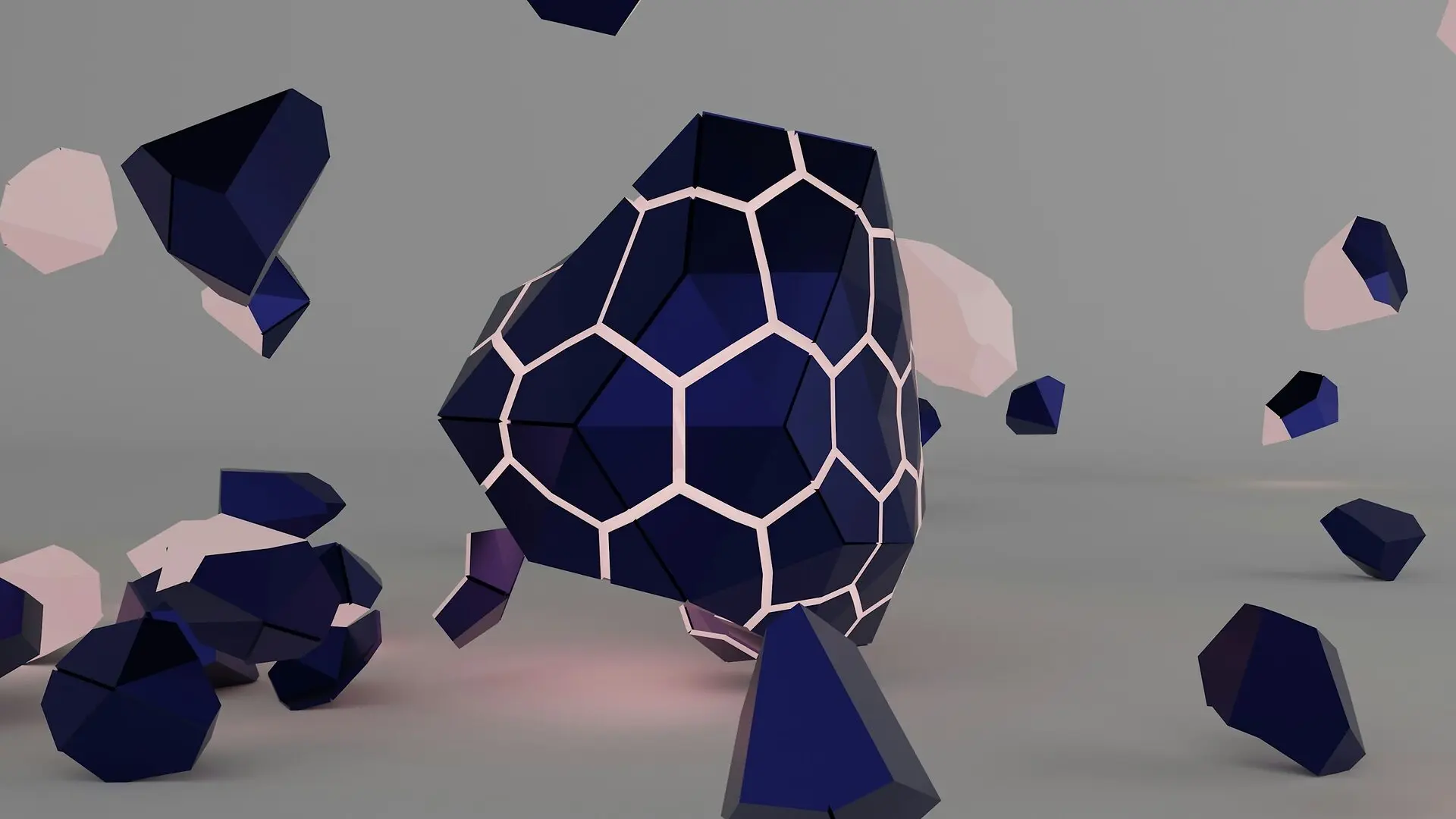
Exotic subatomic particles made of two charm quarks and two charm antiquarks are forcing physicists to rethink how elementary constituents bind together inside matter. These tightly packed configurations, known as all-charm tetraquarks, challenge conventional models of quantum chromodynamics, the fundamental theory describing the strong force that glues quarks together.
To understand how these four-quark states interact over varying distances, researcher Oleg Andreev from the L.D. Landau Institute for Theoretical Physics in Russia modeled heavy tetraquark systems using a geometric framework called gauge/string duality. The theoretical work, available on the arXiv preprint server, analyzes string-like flux tubes connecting quarks in five-dimensional space to compute the lowest Born-Oppenheimer potentials.
How Do Subatomic Strings Break in Four-Quark Systems?
In the framework of string models, quarks are imagined as endpoints of fundamental flux tubes of energy that stretch like rubber bands. When two heavy quarks and two antiquarks are arranged at the corners of a rectangle, the stretching strings can eventually snap by creating virtual light quark-antiquark pairs from the vacuum. This process, known as string breaking, causes the tetraquark system to decay into separate hadronic molecules or pairs of heavy baryons.
The calculations reveal that while the fundamental string tension remains universal across different multiquark systems, the physical distance at which these strings break is not universal. Instead, the string breaking distance depends heavily on the spatial geometry and the separation width between the quark sources. Specifically, the breaking distance for the four-quark setup is found to be smaller than the corresponding distance measured in standard quark-antiquark meson systems.
Why Is the Universal String Tension Only Part of the Story?
When analyzing rectangular and collinear geometries with a fixed width, the author evaluated how different string configurations compete to form the lowest energy states. For narrow widths around zero point nineteen femtometres, the ground state potential transitions smoothly from a two-meson molecular arrangement to an interconnected tetraquark state containing baryon junctions. As the separation length increases beyond about one point two femtometres, string breaking triggers a strong decay into two doubly heavy baryons.
The analysis also highlights critical length scales associated with various string interactions, such as string reconnection, junction annihilation, and pinching events that correspond in higher dimensions to brane-antibrane bound states. At larger widths exceeding zero point seven femtometres, the ground state potential flattens due to double string breaking, pointing to multi-meson decay channels that standard potential models often overlook.
What Challenges Remain for Explaining Excited Tetraquark States?
Computing the first excited potential for these multiquark systems presents an even greater theoretical challenge because it involves a complex mixture of six distinct string configurations. The inclusion of gluonic excitations, modeled as cusp-like defects on the strings, suggests that hybrid potentials could influence excited tetraquark states in ways that current lattice simulations have yet to fully resolve.
Ultimately, these theoretical insights demonstrate that traditional diquark approximations, which treat tetraquarks simply as rigid diquark-antidiquark pairs, miss important dynamical effects arising from string breaking and multi-strand interactions. Future high-precision numerical simulations on spatial lattices will be essential to test these predictions and map out the complex potential landscapes governing exotic hadrons.
The study was posted to the arXiv preprint server on November 24, 2026.
This article has been fact checked for accuracy, with information verified against reputable sources. Learn more about us and our editorial process.
Last reviewed on .
Article history
- Latest version
Reference(s)
- Andreev, Oleg. “$QQ\bar Q\bar Q$ Quark System and Gauge/String Duality II: String Breaking.” arXiv.org <http://arxiv.org/abs/2611.33140v1>.
Cite this page:
- Posted by Farah Siddiqui