New AI Architecture Predicts Quantum Phase Transitions Without Retraining
Physicists map fluid-to-crystal quantum states using a transformer model that generates explicit wavefunctions on demand.
A new artificial intelligence architecture successfully models quantum phase transitions in exotic particle systems without requiring retraining for every parameter change. Physicists have long struggled to compute explicit many-body wavefunctions for large collections of quantum particles because standard numerical simulations either grow too complex or fail to map complete states across structural shifts.
To tackle this challenge, Daniil Antonenko and colleagues at Yale University and MIT developed a neural network model designed specifically for quantum particles that follow bosonic statistics. The research is available on the arXiv preprint server, as detailed in the study published in arXiv, where the authors introduce a transformer-based framework that captures both fluid and solid behaviors in two dimensions.
How Does This Neural Network Predict Quantum States?
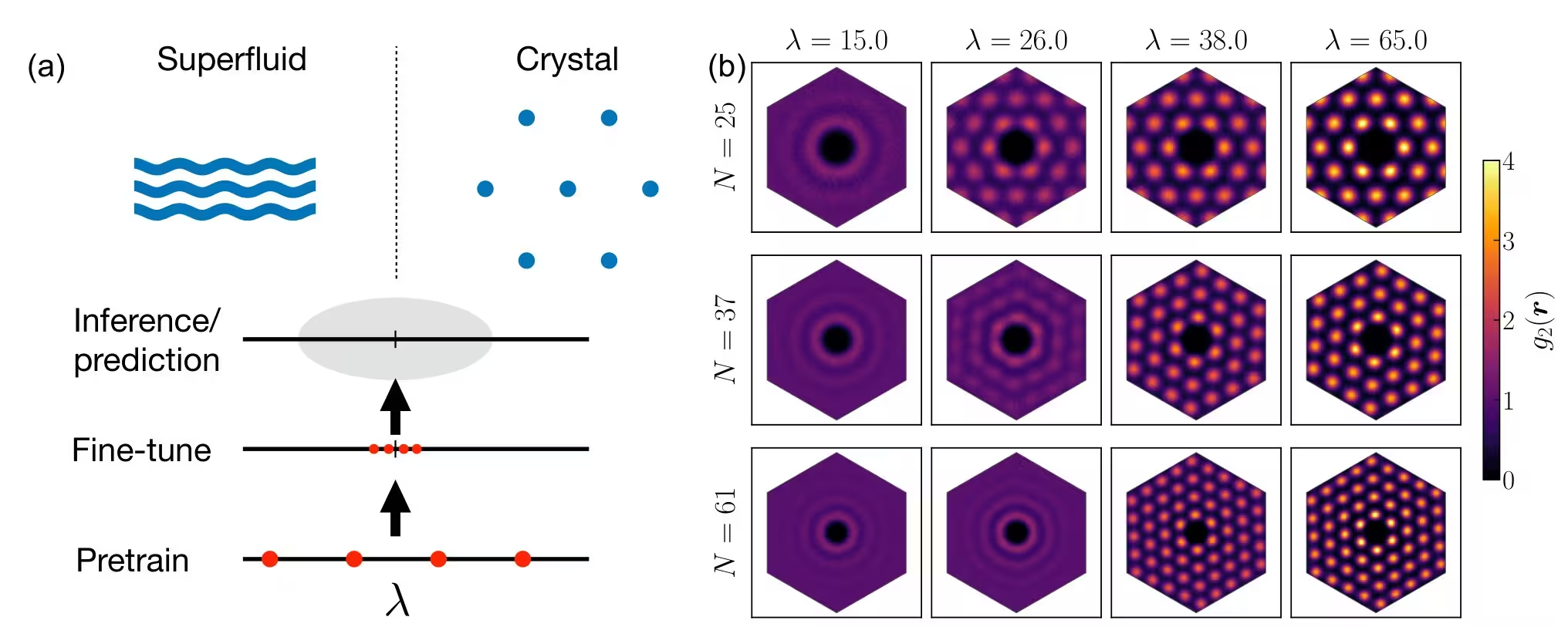
Quantum particles called bosons naturally tend to occupy the same quantum state, forming flowing fluids known as superfluids. However, under strong repulsive forces, these same particles can freeze into rigid, orderly crystal lattices. Simulating this transition usually demands separate calculations for every single adjustment in interaction strength, which consumes immense computational power.
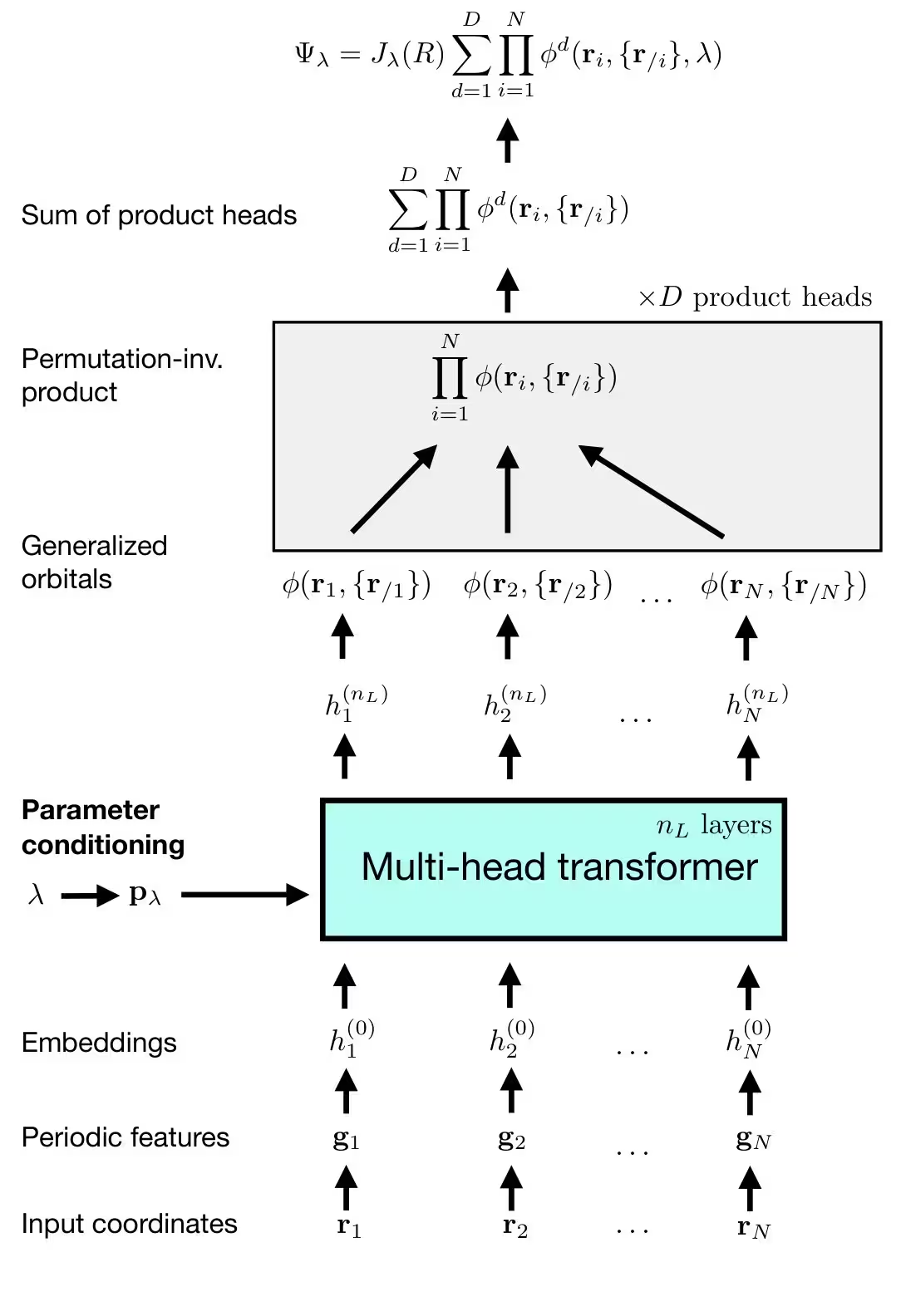
The newly proposed model, named Boseformer, treats interaction parameters as direct inputs to a multi-head transformer network. By optimizing the architecture simultaneously across a spectrum of interaction strengths, the team created a foundation model that generates continuous wavefunctions on demand. The network relies on permutation-equivariant streams, meaning the mathematical output remains completely unchanged no matter how particle coordinates are shuffled, perfectly matching the requirements of identical quantum bosons.
What Happens When Interparticle Repulsion Increases?
The researchers tested their architecture on a two-dimensional system of up to sixty-one particles interacting through inverse-cube repulsion forces, which mirror the dipole-dipole dynamics found in semiconductor bilayers. As the interaction parameter scaled past thirty, the system underwent a sharp transition from a smooth superfluid condensate into a triangular crystal lattice.
Analyses of the static structure factor revealed pronounced Bragg peaks that grew linearly with particle numbers in the crystalline phase, confirming long-range spatial order. Meanwhile, calculations of zero-momentum condensate occupation showed a steady drop to near zero as the crystal formed. The resulting energy values matched traditional Diffusion Monte Carlo benchmarks within one percent accuracy while providing explicit wavefunctions that make calculating any physical observable straightforward.
Are There Limitations to This Approach?
While the model successfully maps both phases without manual intervention, the sudden transition seen in nature is slightly smeared into a crossover within finite system simulations. The authors note that network capacity places a practical boundary on how sharp this phase boundary can appear. Furthermore, the current computational runs found no evidence of an intermediate supersolid phase where superfluidity and crystalline order coexist.
Despite these constraints, the ability to generate explicit wavefunctions across continuous parameters opens new pathways for studying complex quantum matter. Future developments will focus on scaling up particle numbers and applying the framework to broader classes of quantum Hamiltonians.
The study was posted to the arXiv preprint server on November 24, 2026.
This article has been fact checked for accuracy, with information verified against reputable sources. Learn more about us and our editorial process.
Last reviewed on .
Article history
- Latest version
Reference(s)
- Antonenko, Daniil. “Parametric neural-network wavefunctions across a bosonic phase transition.” arXiv.org <http://arxiv.org/abs/2611.33150v1>.
Cite this page:
- Posted by John Williams