Hidden Math Settings Alter Plasma Heating Rates in Solar Wind Simulations
New research reveals that standard computer models of space plasma turbulence are heavily sensitive to hidden tuning choices, altering how ions and electrons heat up.

Simulations of vast cosmic plasmas like the solar wind often run into heavy computational bottlenecks because particles rarely collide across distances spanning millions of kilometers. To solve this problem without draining supercomputing resources, researchers use fluid-moment models that approximate invisible heat flows through mathematical rules controlled by specific adjustment settings called closure parameters. Jago V. H. Edyvean and colleagues at Victoria University of Wellington tested how altering these hidden tuning settings changes the simulated heating behavior of ions and electrons across sixteen different computer experiments available on the arXiv preprint server.
How Does Changing Mathematical Closure Settings Alter Plasma Simulations?
Plasma models require approximations because tracking every individual particle creates an impossible computational load. By cutting off mathematical moment hierarchies at the pressure tensor level, scientists rely on closure parameters to represent heat flux divergence, which mimics how energy dissipates without direct collisions. The researchers discovered that these choices are not mere background adjustments. Instead, modifying the ion closure parameter ripples downward into lower-order equations, fundamentally altering how energy partitions between heavy ions and light electrons.
Why Do Lower Mass Ratios Hide True Plasma Physics?
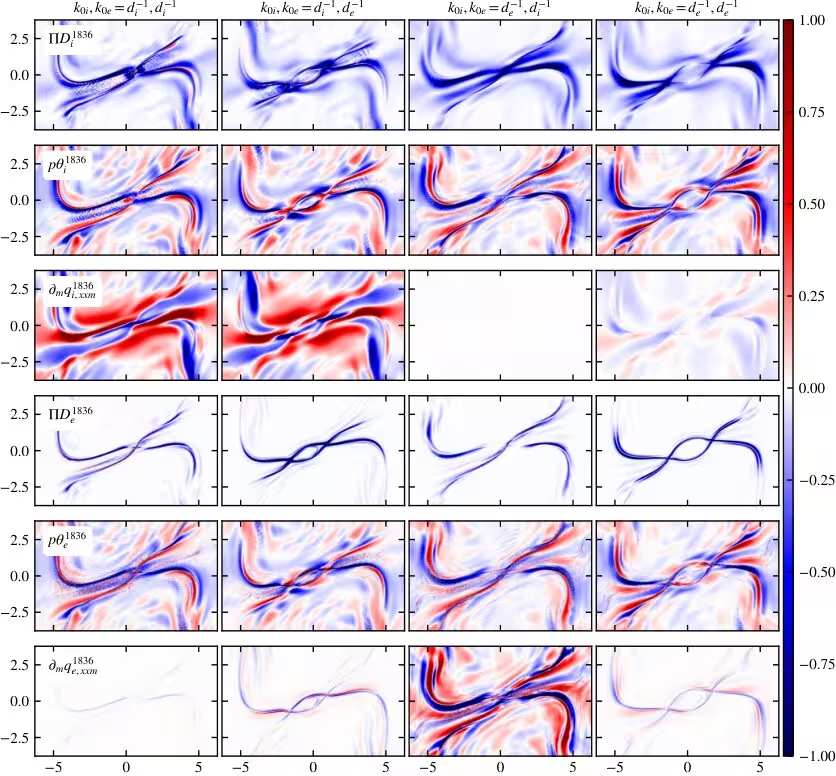
Running simulations with realistic proton-to-electron mass ratios requires immense processing power, leading many scientific teams to use artificially reduced mass ratios to speed up calculations. The study reveals that smaller mass ratios show massive discrepancies in energy heating rates, with electron heating varying by more than one hundred percent depending on the chosen closure values. As mass ratios approach the realistic value of eighteen hundred thirty-six, the system stabilizes and these variations begin to converge, proving that smaller test ratios can distort heating outcomes.
What Happens When Magnetic Reconnection Generates Turbulent Heat?
During turbulent decay and magnetic reconnection events, energy converts from bulk fluid flows into internal thermal energy through compressive and viscous-like processes. The analysis demonstrates that time-integrated compressive heating stabilizes early around two and a half eddy turnover times, meaning later-stage dissipation is primarily driven by viscous-like interactions as the system enters a near-incompressible state. Furthermore, changing the ion closure parameter shifts where heat-flux divergence is confined, directly influencing how ripples and plasmoids form near magnetic reconnection sites.
What Are the Limits of These Fluid-Moment Approximations?
While the findings provide crucial guidance for selecting optimal closure values in space plasma modeling, the authors emphasize that these fluid approximations still require thorough validation against fully kinetic particle simulations. Because electron scales remain extremely fine even in high-resolution runs, unmodeled relativistic effects and velocity-space limitations may account for residual errors. Future investigations utilizing advanced Hermite polynomial expansions will help untangle whether these heat-flux scales follow ion inertial lengths or particle gyro-radii more closely.
The study was posted to the arXiv preprint server on November 24, 2026.
This article has been fact checked for accuracy, with information verified against reputable sources. Learn more about us and our editorial process.
Last reviewed on .
Article history
- Latest version
Reference(s)
- Edyvean, Jago. “The effects of closure parameter on the properties of kinetic range plasma turbulence.” arXiv.org <http://arxiv.org/abs/2611.31769v1>.
Cite this page:
- Posted by Deepak Malhotra