Supportive Leadership May Buffer the Performance Costs of Workplace Attachment Avoidance
New research suggests that management styles prioritizing employee growth can weaken the link between avoidant personality traits and reduced workplace helpfulness.

Employees who prefer to rely solely on themselves rather than collaborate with colleagues often see their helpfulness and extra effort at work decline, but a specific leadership approach appears to buffer this drop. When workers who naturally keep an emotional distance from others perceive their managers as deeply supportive and focused on employee development, the negative impact on their job performance weakens significantly.
How Does Avoidant Attachment Lower Extra-Role Performance at Work?
Psychologists distinguish between task performance, which covers the core technical duties of a job, and contextual performance, which includes discretionary actions supporting the social and psychological environment. Contextual performance is further split into job dedication, meaning self-disciplined and persistent effort, and interpersonal facilitation, involving cooperative behavior and helpfulness toward coworkers. Previous studies have consistently identified adult attachment avoidance as a negative predictor of these contextual behaviors. Attachment avoidance involves discomfort with closeness, distrust of others, suppression of needs, and a heavy reliance on self-sufficiency.
To understand why this personality trait reduces helpful work behaviors, researchers draw on trait activation theory. This psychological framework proposes that stable traits do not affect behavior constantly, but instead require specific situational cues to activate them. In unsupportive environments, avoidant tendencies trigger behaviors that are evaluated less favorably by organizations, such as withdrawing from team goals or declining to assist peers. Finding ways to alter this connection is a major goal for organizational psychologists studying workplace dynamics.
Does Perceived Servant Leadership Act as a Situational Distractor?
To investigate whether leadership style can disrupt the link between avoidant attachment and reduced performance, researchers examined perceived servant leadership, a management approach that prioritizes follower growth, emotional healing, and ethical behavior over leader self-interest. Published in PLOS One, the study tested a model where this leadership style serves as a situational distractor or buffer.
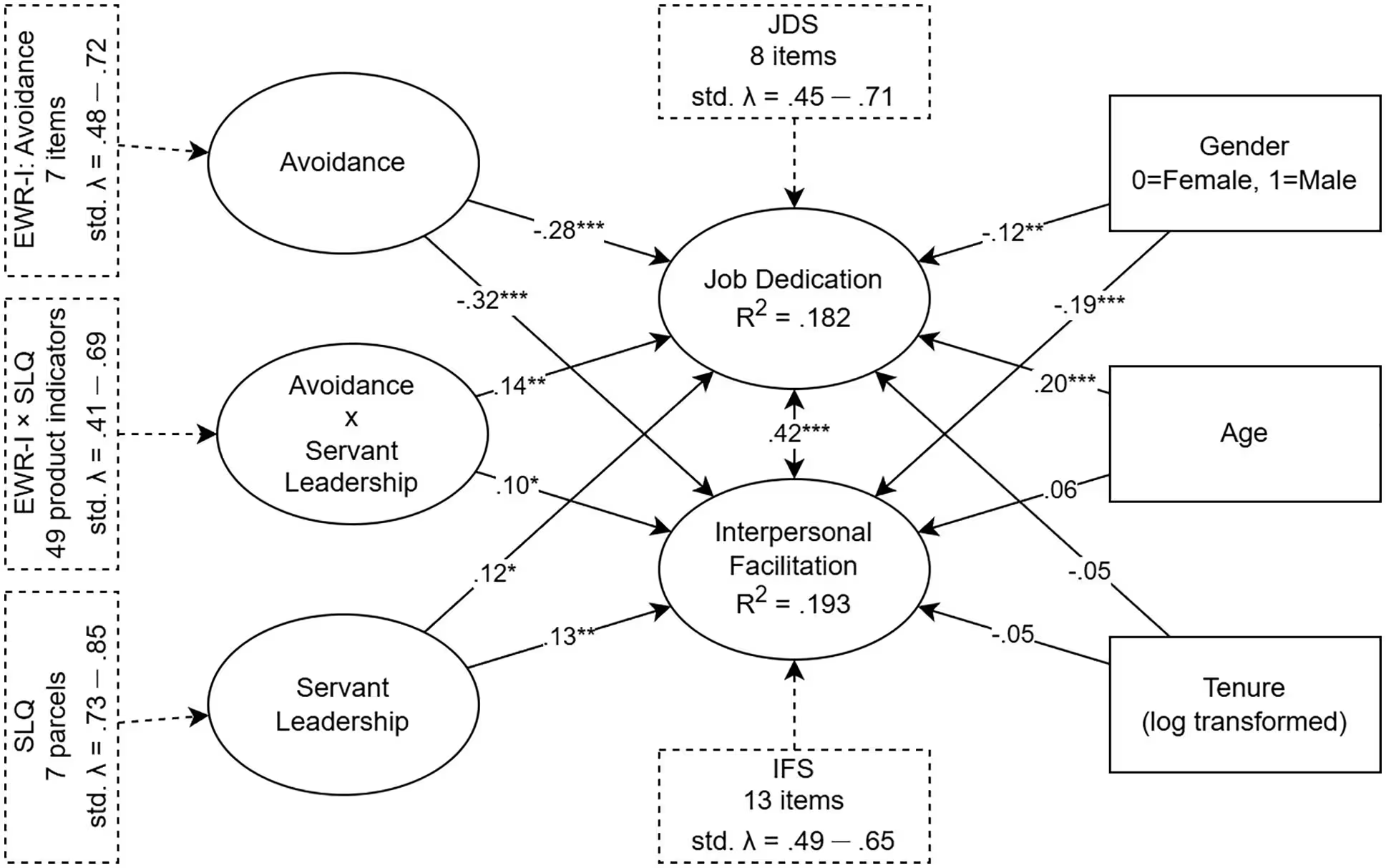
Lead author Martin Seitl and colleagues at Palacký University gathered data from five hundred thirty-one employed adults in the Czech Republic, aged nineteen to sixty-eight years, with an average organizational tenure of about eight years. Participants completed online self-report measures assessing their workplace attachment avoidance, perceived servant leadership of their direct supervisors, job dedication, and interpersonal facilitation, while controlling for age, gender, and organizational tenure.
What Did the Statistical Analysis Reveal About the Buffering Effect?
Structural equation modeling confirmed that attachment avoidance was negatively associated with both job dedication and interpersonal facilitation. At the same time, perceived servant leadership showed positive direct associations with both performance dimensions. Crucially, the statistical interaction between attachment avoidance and perceived servant leadership was positive and significant for both job dedication and interpersonal facilitation.
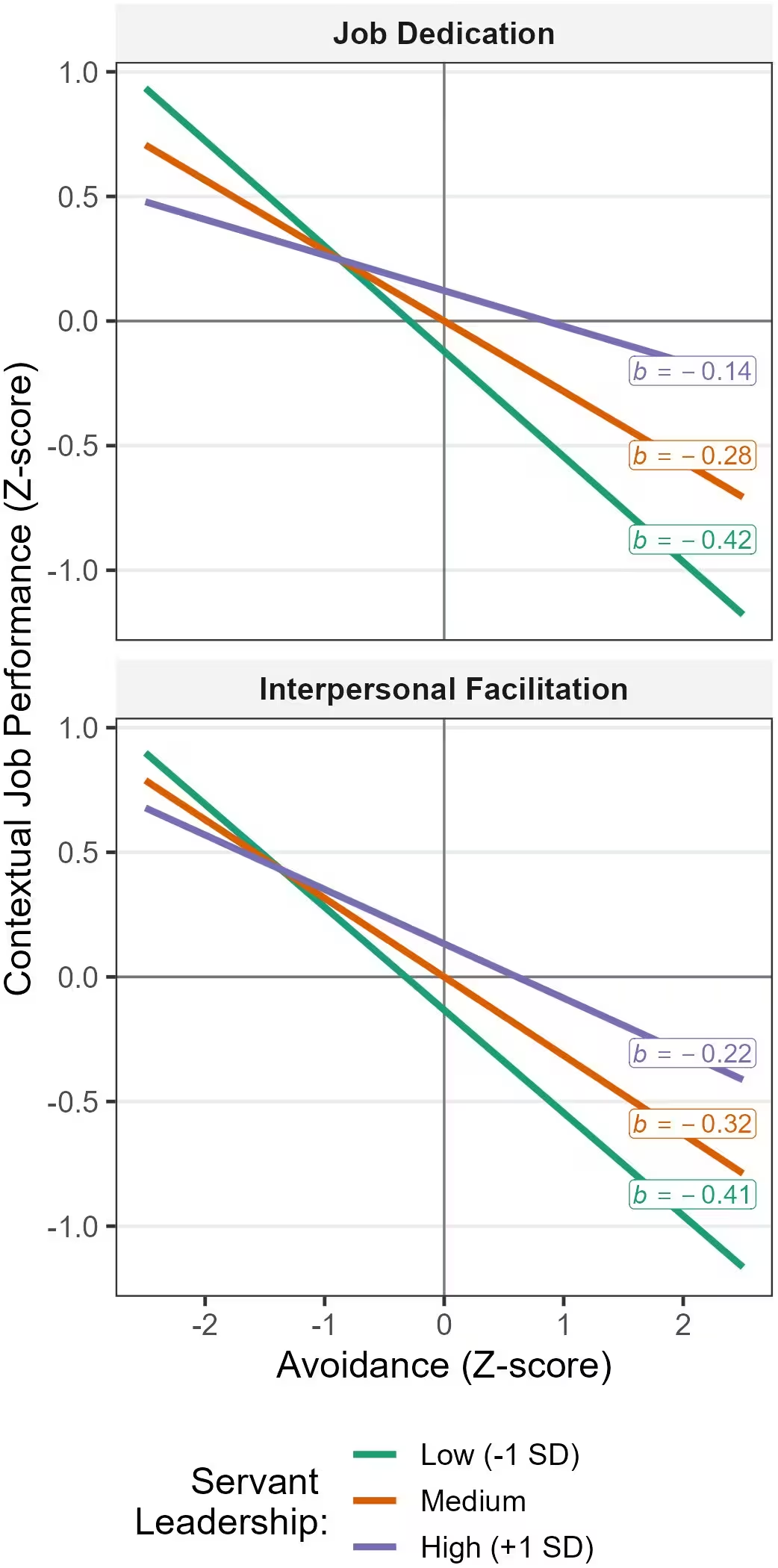
- The negative association between avoidance and job dedication was strongest when perceived servant leadership was low, but grew progressively weaker at higher levels of perceived leadership.
- A similar attenuation appeared for interpersonal facilitation, where high perceived servant leadership cushioned the performance-inhibiting expression of avoidant tendencies.
- The statistical models accounted for about eighteen percent of the variance in job dedication and nineteen percent in interpersonal facilitation.
Simple slope analyses demonstrated that while higher perceived servant leadership did not completely eliminate the negative relationship, it substantially reduced the performance penalty associated with avoidant attachment. The authors suggest that managers who provide predictable, nonintrusive support satisfy underlying needs for autonomy while offering a safe harbor, thereby reducing the chronic vigilance of avoidant employees.
What Are the Limitations and Future Directions of This Research?
Several methodological boundaries temper these conclusions. Because the project used a cross-sectional design with data collected from a single survey wave, researchers cannot establish definitive cause and effect, and reciprocal influences remain possible. All measures relied on employee self-reports, which are susceptible to common-method variance and social desirability, even though statistical diagnostics indicated that a single general factor could not account for the data.
Furthermore, to guarantee full anonymity and encourage candid responses, the survey did not record participants’ specific organizations or supervisor identities, precluding multilevel clustering analyses. Future investigations using longitudinal tracking, experimental designs, or multi-source ratings from supervisors and coworkers will be essential to test whether deliberate leadership interventions can dynamically alter contextual job performance over time.
The research was published in PLOS One on November 24, 2026.
This article has been fact checked for accuracy, with information verified against reputable sources. Learn more about us and our editorial process.
Last reviewed on .
Article history
- Latest version
Reference(s)
- Seitl, Martin., et al. “The buffering role of perceived servant leadership in the association between attachment avoidance and contextual job performance.” PLOS One, vol. 21, no. 11, November 24, 2026, pp. e0363465 Public Library of Science (PLoS), doi: 10.1371/journal.pone.0363465. <https://doi.org/10.1371/journal.pone.0363465>.
Cite this page:
- Posted by Jessica Martin