New Testing System Reveals How Much Manual Toothbrush Designs Differ in Cleaning Power
Standardized laboratory models show that stepped bristles require less force and reach deeper into interproximal spaces than flat-trimmed brushes.

A new standardized testing system reveals that manual toothbrushes can vary dramatically in their cleaning efficiency and ability to track curved tooth surfaces, according to experimental findings. Mami Endoh and colleagues at Kanagawa Dental University and other institutions developed an objective evaluation framework using specialized physical models to measure how effectively different toothbrush designs remove plaque from flat, concave, and convex surfaces.
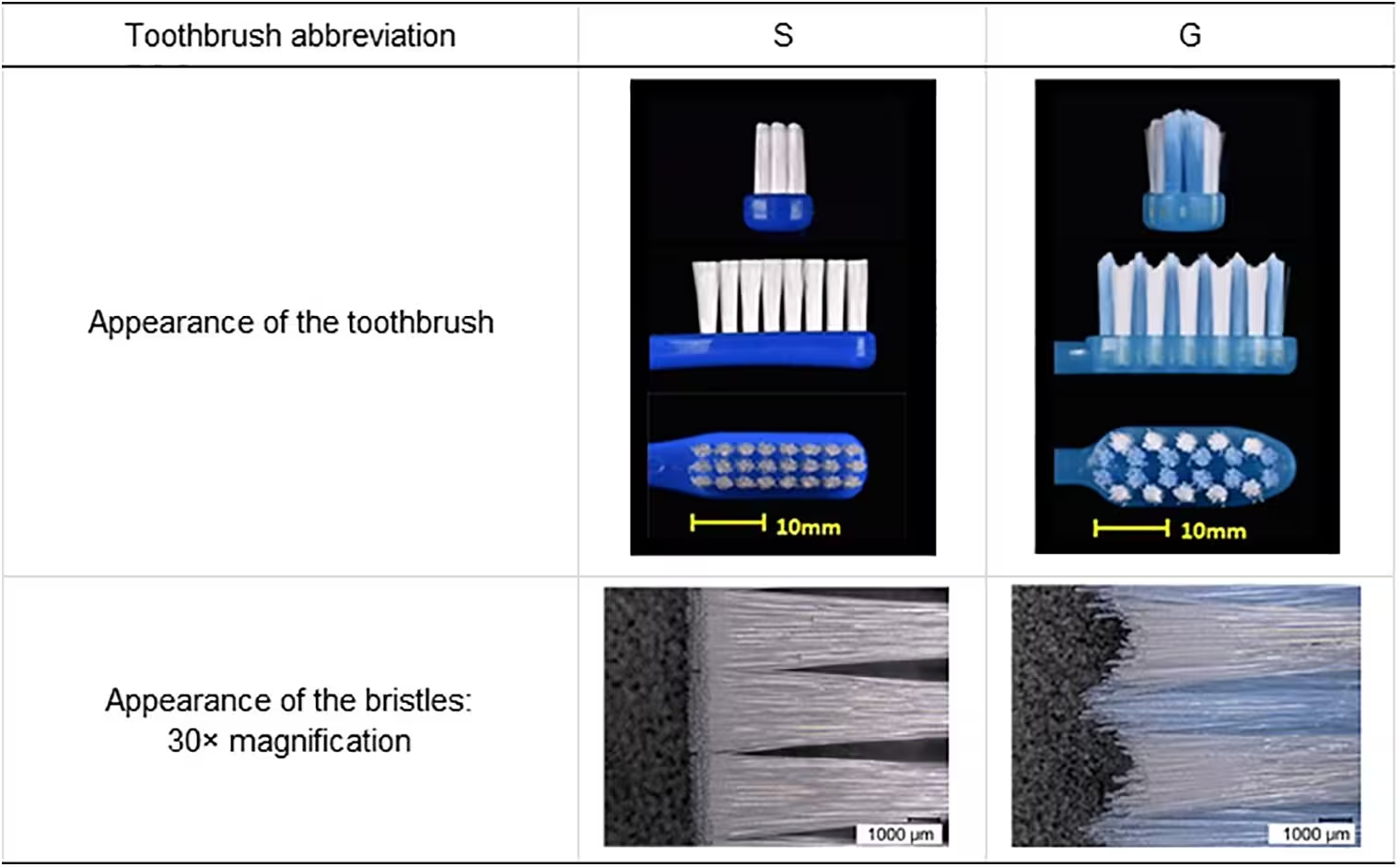
While millions of people rely on manual toothbrushes for daily dental hygiene, comparing the performance of different brush heads has historically been difficult due to a lack of unified testing standards. The researchers evaluated two commercially available manual toothbrushes using aluminum and stainless-steel models machined to mimic human tooth dimensions. One tested design was a simple-structured toothbrush with three rows of flat bristles, and the other featured four rows of stepped bristles arranged in a functional contour. The study is published in PLOS One.
How Do Standardized Models Measure Brushing Performance?
To quantify cleaning power without relying on human volunteers, the team used a magnetic tape method where industrial magnetic film is affixed to the test blocks. As the toothbrush head sweeps across the surface, the bristle tips peel away the magnetic layer, allowing researchers to measure the exact cleaned area and penetration depth. Testing was conducted at a standard frequency of two strokes per second and a constant force of two newtons, representing typical human brushing habits. The models were also tilted at zero, fifteen, and thirty degrees to simulate how different people angle their brushes against their teeth.
The experiments demonstrated clear performance differences between the two tested brush designs. The toothbrush with stepped bristles achieved significantly larger peeled areas on both smooth and interproximal surfaces across nearly all tested angles. For example, at a thirty-degree angle, the stepped-bristle design cleared a significantly larger area on the interproximal model, reaching deeper into simulated gaps between teeth than the flat-bristle model.
Why Does Brush Tracking Matter on Curved Teeth?
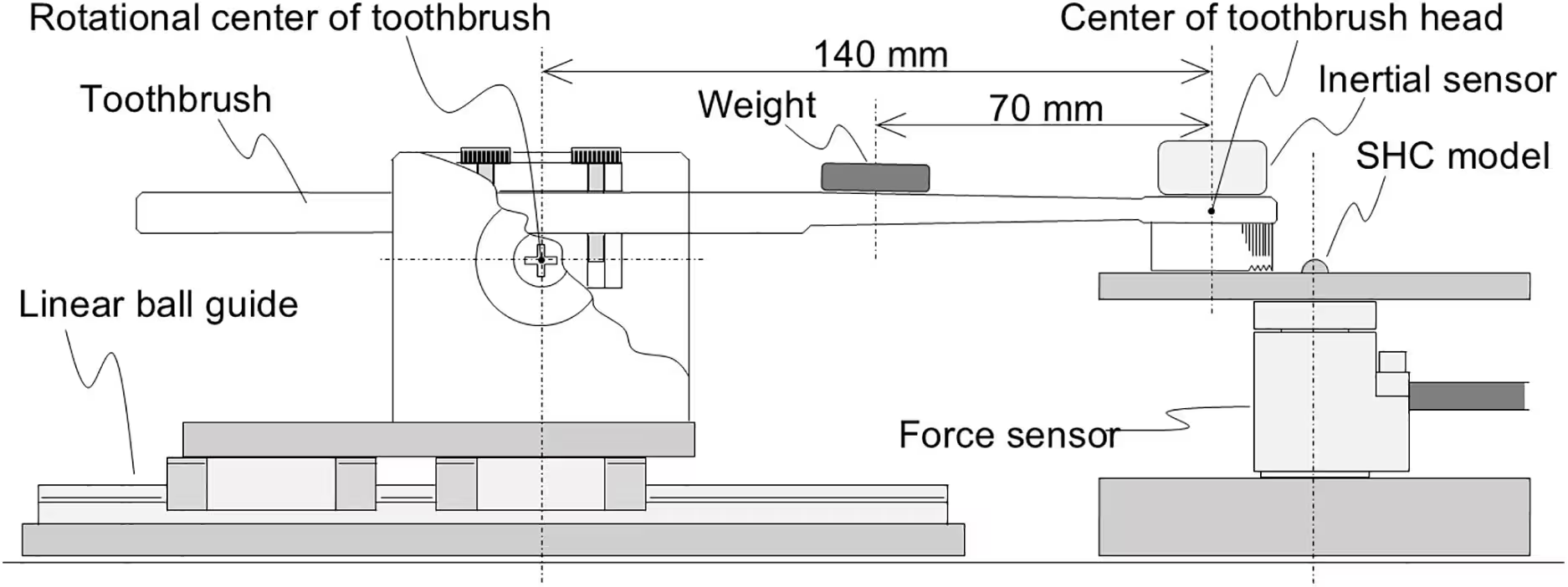
Cleaning curved tooth surfaces requires the bristles to maintain contact without bouncing off the enamel, a property known as followability. To measure this, the authors used a single half-cylinder model representing the convexity of a tooth, equipping the toothbrush handle with a six-axis inertial sensor to track head movements during brushing strokes.
When the applied brushing force is too low, bristle tips bounce off the curved surface and fail to clean effectively. The experiments revealed that the stepped-bristle toothbrush required a minimum force of about 1.25 newtons to maintain proper surface contact, whereas the simpler flat-bristle toothbrush required more than three times that force, at roughly 3.84 newtons. This indicates that complex bristle designs can accommodate lower brushing forces and varying user techniques more forgivingly than basic flat trims.
What Are the Limitations of the New Testing Method?
Despite providing quantitative metrics for toothbrush design, the authors note several limitations to their approach. The experiments relied on simplified in vitro models that cannot fully replicate the complex morphology of a complete human mouth or individual variations in saliva and soft tissue. Furthermore, the testing framework was designed exclusively for manual toothbrushes and cannot be directly applied to electric toothbrushes, which operate through different mechanical motions and head sizes.
The researchers also utilized a single brand of toothpaste with moderate abrasivity, meaning the results may not translate to low-abrasion or high-abrasion formulas. Because the study measured surrogate laboratory parameters rather than clinical outcomes in human patients, future clinical trials will be necessary to confirm whether these mechanical metrics directly correlate with reduced dental plaque and better periodontal health in everyday use.
The research was published in PLOS One on November 24, 2026.
This article has been fact checked for accuracy, with information verified against reputable sources. Learn more about us and our editorial process.
Last reviewed on .
Article history
- Latest version
Reference(s)
- Endoh, Mami., et al. “In vitro functional evaluation of toothbrushes using two standardized models of the smooth and interproximal surface model.” PLOS One, vol. 21, no. 11, November 24, 2026, pp. e0338683 Public Library of Science (PLoS), doi: 10.1371/journal.pone.0338683. <https://doi.org/10.1371/journal.pone.0338683>.
Cite this page:
- Posted by Aisha Ahmed