Human Brain Wiring Holds The Secret To Why Our Minds Avoid Excess Energy Dissipation At Rest
A new mathematical model reveals how hierarchical neural connections and structured stochastic driving keep idling brains in a low-dissipation state.
When human brains rest, their neural networks manage to maintain a remarkably low level of thermodynamic non-equilibrium, dodging the chaotic dissipation seen during intense cognitive tasks. A team of researchers has now uncovered how anatomical wiring shapes this quiet state, offering a fresh mathematical perspective on why our minds avoid burning excessive energy while idling.
Many complex systems, from bustling gene regulatory networks to active biological matter, operate far from thermal equilibrium. Stochastic driving forces, such as noisy synaptic inputs in neural tissue, constantly buffet these networks and generate persistent heat currents and time-reversal asymmetry. While scientists have long known that network topology acts as a structural control knob for these fluctuations, the exact mechanisms governing how wiring diagrams constrain non-equilibrium behavior remained unclear until now.
To decode these constraints, Dingjie Wu from Xi’an Jiaotong University and their colleagues developed a mathematical framework based on linear Langevin dynamics and microscopic reversibility. Their work is available on the arXiv preprint server, building upon an analysis of diffusion equations across complex network architectures. By deriving a mode decomposition for short-time cross-correlations and steady-state heat currents, the authors identified two primary sources of non-equilibrium behavior. These include fluctuations within individual intrinsic modes and correlated fluctuations operating between distinct modes.
How Do Network Topologies Control Energy Dissipation?
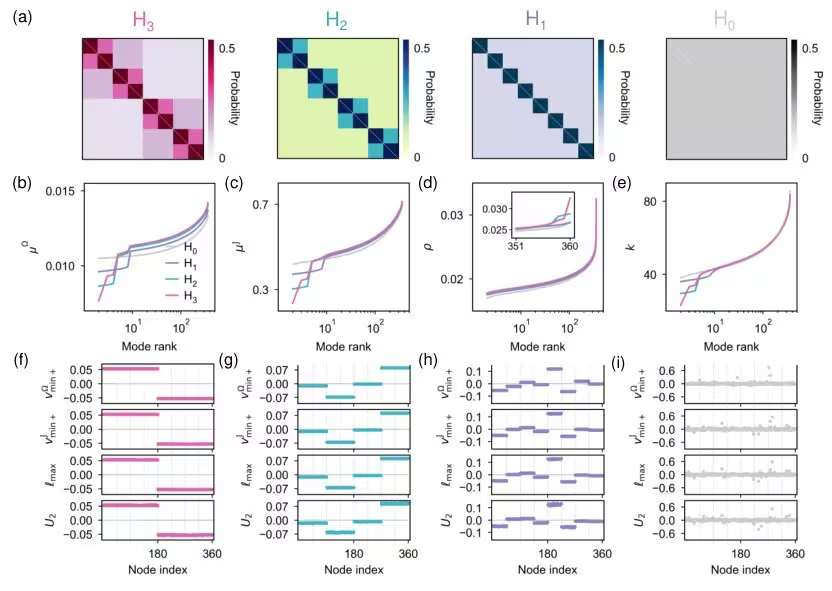
For reciprocal networks with independent local driving, the research team derived two novel non-equilibrium response operators acting as weighted Laplacians. These operators depend solely on the underlying network structure and remain completely independent of external stochastic driving patterns. Consequently, their mathematical spectra establish exact upper and lower bounds on global asymmetry intensity, alongside leading-order bounds for the entropy production rate near equilibrium.
When the investigators tested these operators on synthetic hierarchical modular networks and human structural connectomes from nine hundred and ninety-three participants in the Human Connectome Project, clear structural advantages emerged. Hierarchical organization, characterized by nested modules spanning multiple scales, significantly broadens the spectrum of response operators. Meanwhile, multiscale connection weights, where weak connections dominate alongside a small fraction of strong ties, help sustain large upper spectral bounds.
Why Does Resting Brain Activity Avoid High Dissipation?
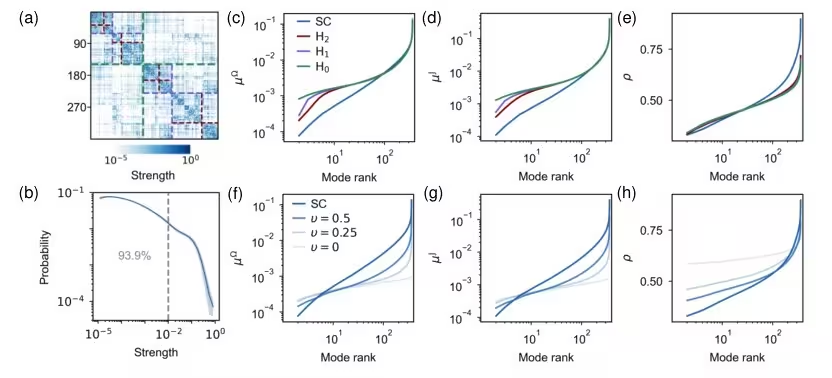
By analyzing resting-state functional magnetic resonance imaging data from the same participants, the researchers inferred the spatial distribution of stochastic driving forces across three hundred and sixty cortical brain regions. Their models revealed that spontaneous resting-state activity is sustained by specific, spatially heterogeneous driving patterns. Crucially, these optimal driving patterns preferentially align with intrinsic modes associated with smaller eigenvalues in the response operators.
When compared against randomized spatial shuffles of the same regional driving intensities, the inferred resting patterns consistently yielded lower global asymmetry intensity and a reduced entropy production rate. This preferential alignment explains why the human brain can maintain a subdued non-equilibrium state during rest. By recruiting specific intrinsic modes through structured neural driving, the central nervous system avoids excessive thermodynamic dissipation while preserving its capacity for rapid functional reconfiguration during demanding tasks.
The study was posted to the arXiv preprint server on November 24, 2026.
This article has been fact checked for accuracy, with information verified against reputable sources. Learn more about us and our editorial process.
Last reviewed on .
Article history
- Latest version
Reference(s)
- Wu, Dingjie. “Network topology imposes spectral constraints on collective nonequilibrium responses.” arXiv.org <http://arxiv.org/abs/2611.32130v1>.
Cite this page:
- Posted by Jessica Martin