Firefly Inspired Algorithm Predicts Lithium Ion Battery Aging in Record Time
Researchers combine insect navigation heuristics with deep learning to forecast battery lifespan with unprecedented accuracy.

When engineers test the longevity of lithium-ion power sources, they often have to wait months or even years for the cells to degrade naturally through repeated charge and discharge cycles. This slow testing timeline creates a major bottleneck for the development of electric vehicles and portable electronics. To bypass this frustrating wait, a team of researchers has turned to the flashing behavior of fireflies to fast-forward battery testing.
The novel predictive framework, published in PLOS One by Yufang Chu and colleagues from Yichun University, successfully forecasts how lithium-ion cells age under accelerated conditions. By combining a nature-inspired search heuristic with an advanced deep learning architecture, the team achieved remarkably low error margins that outperform traditional optimization techniques.
How Do Fireflies Inspire Better Battery Testing Algorithms?
The core innovation relies on the Firefly Optimization Algorithm, a mathematical technique that mimics how insects use flashing light signals to attract mates and navigate toward brighter companions. In computational terms, this natural blinking behavior helps the system perform a global search across complex solution spaces without getting trapped in local minimums. Traditional machine learning models often struggle to find the absolute best settings because they get stuck on suboptimal configurations.
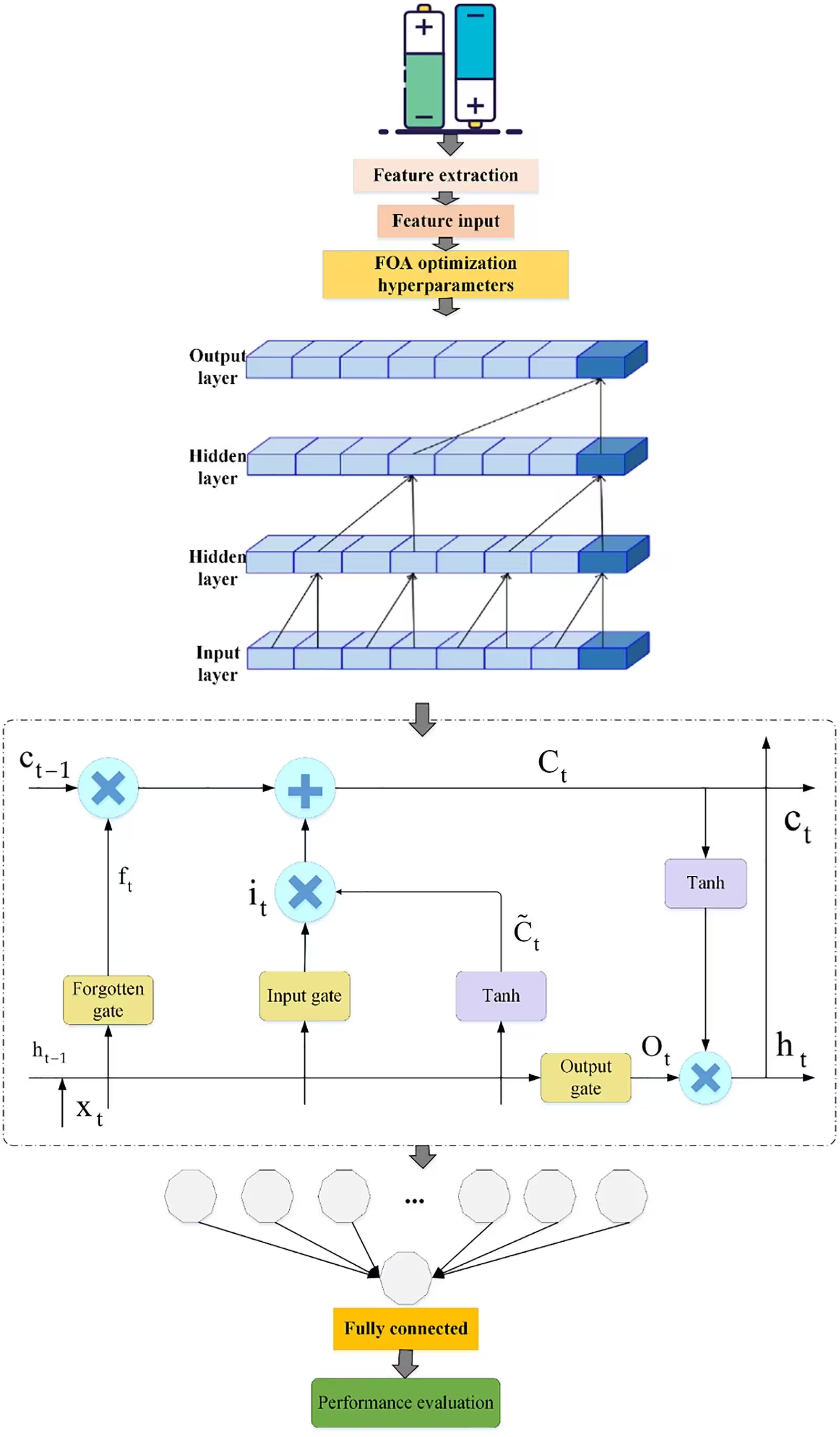
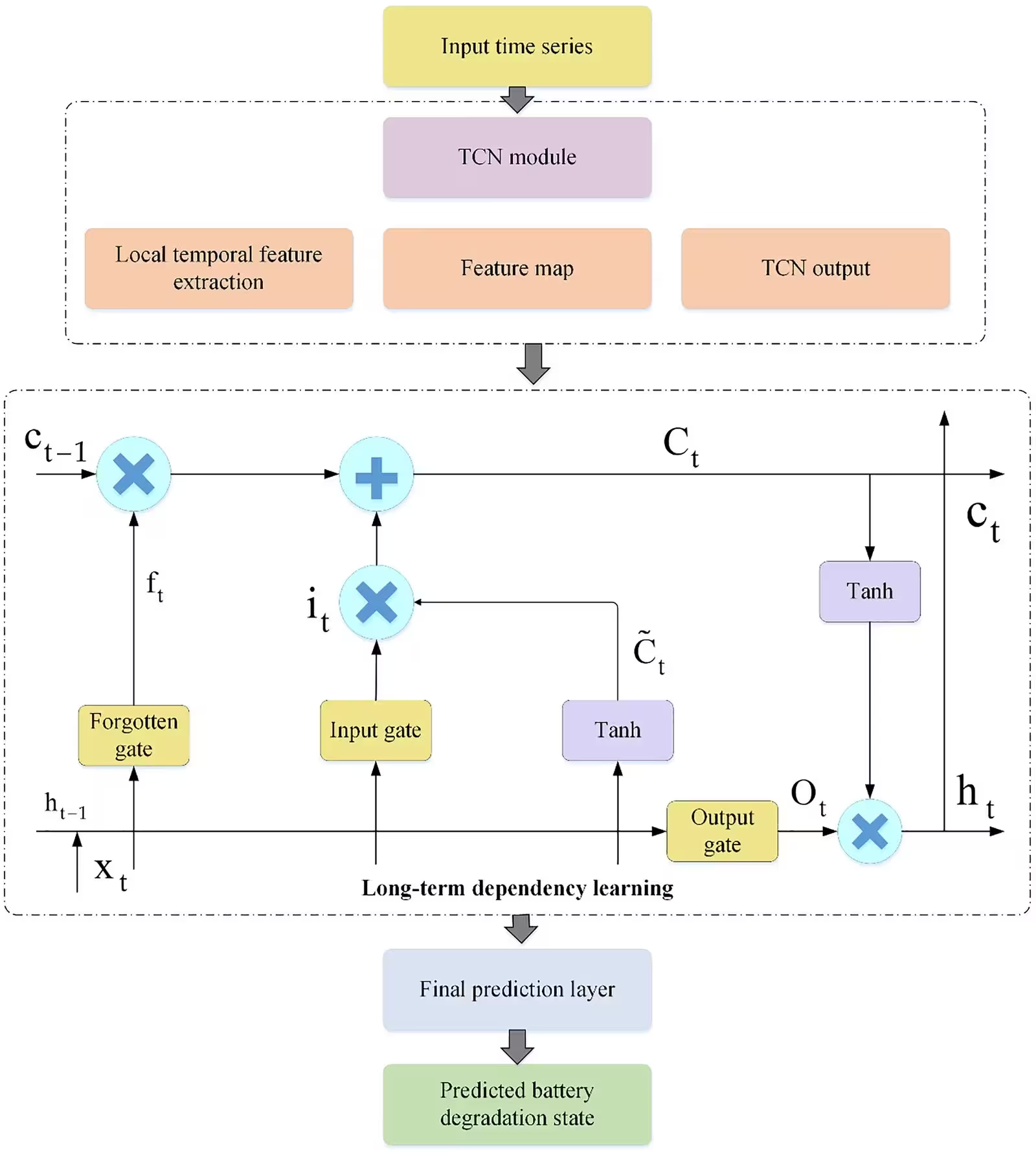
By pairing this insect-inspired algorithm with an enhanced deep learning network known as a Temporal Convolutional Network combined with a Long Short-Term Memory Network, the researchers created a system capable of parsing complex time-series data. The convolutional component extracts local features from the voltage and current data across extended time spans, while the memory units handle long-term dependencies in the degradation patterns. The optimization algorithm then fine-tunes critical hyperparameters, such as a convolution kernel size of eleven, one hundred twenty-eight hidden units, and a learning rate of zero point zero zero two five.
What Did the Accelerated Tests Reveal About Prediction Accuracy?
To evaluate how well the model works in practice, the authors tested it against benchmark datasets provided by the Center for Advanced Life Cycle Engineering and the National Aeronautics and Space Administration. The results demonstrate that the optimized setup generates degradation predictions that align closely with actual physical aging data under various accelerated test scenarios.
Across multiple evaluation metrics, the root mean square error remained below zero point zero five, while the mean absolute error stayed under zero point zero three. The coefficient of determination reached zero point nine seven five, indicating a very strong correlation between the predicted degradation trends and the real-world performance decline of the cells. When compared against other optimization methods such as Genetic Algorithms, Particle Swarm Optimization, and Simulated Annealing, the firefly-driven approach consistently yielded the lowest error rates and completed its hyperparameter tuning faster than competing techniques.
Why Does Faster Lifespan Prediction Matter for Future Energy Storage?
Predicting battery degradation accurately is essential for improving charging efficiency and preventing unexpected failures in electric vehicles and renewable energy grids. Because external factors like temperature, cycling depth, and charge rates heavily influence how fast a cell wears out, linear calculations are no longer sufficient for modern material science.
While the new model requires a slightly longer initial training duration due to its high-dimensional feature processing, its rapid testing phase and high accuracy offer a practical path forward. The researchers note that future work will need to expand beyond these specific benchmark datasets to include a wider variety of battery chemistries and explore automated feature engineering to further boost computational efficiency.
The research was published in PloS one on November 23, 2026.
This article has been fact checked for accuracy, with information verified against reputable sources. Learn more about us and our editorial process.
Last reviewed on .
Article history
- Latest version
Reference(s)
- Chu, Yufang., et al. “Utilization of the Firefly Optimization Algorithm in lithium-ion battery aging prediction: Accelerated testing and lifetime evaluation.” PLOS One, vol. 21, no. 11, November 23, 2026, pp. e0324867 Public Library of Science (PLoS), doi: 10.1371/journal.pone.0324867. <https://doi.org/10.1371/journal.pone.0324867>.
Cite this page:
- Posted by Zubair Ali