New AI Training Method Cuts Regional Dialect Bias in Vietnamese Content Moderation
Researchers introduce a dialect-aware benchmark and a dual-objective training framework to stop AI systems from penalizing local speech patterns.
When online content moderation systems judge text, they often stumble over local accents, slang words, and regional ways of speaking. A recent study reveals that standard hate speech detection models for Vietnamese tend to misclassify benign messages from specific parts of the country as toxic simply because they carry regional dialect markers. To solve this hidden fairness problem, researchers constructed a specialized dataset and developed a new training approach that prevents algorithms from relying on geographic cues.
How Regional Dialects Trigger Unfair Moderation
Language changes significantly from the northern, central, and southern regions of Vietnam, involving distinct vocabulary choices and expressive nuances. When artificial intelligence models are trained to flag hate speech without accounting for these variations, they often learn spurious correlations. A neutral pronoun or local expression common in one region can mistakenly activate the model’s toxicity filters. Prior fairness research in natural language processing has focused heavily on gender or race within English datasets, leaving low-resource languages with strong regional variations unexamined.
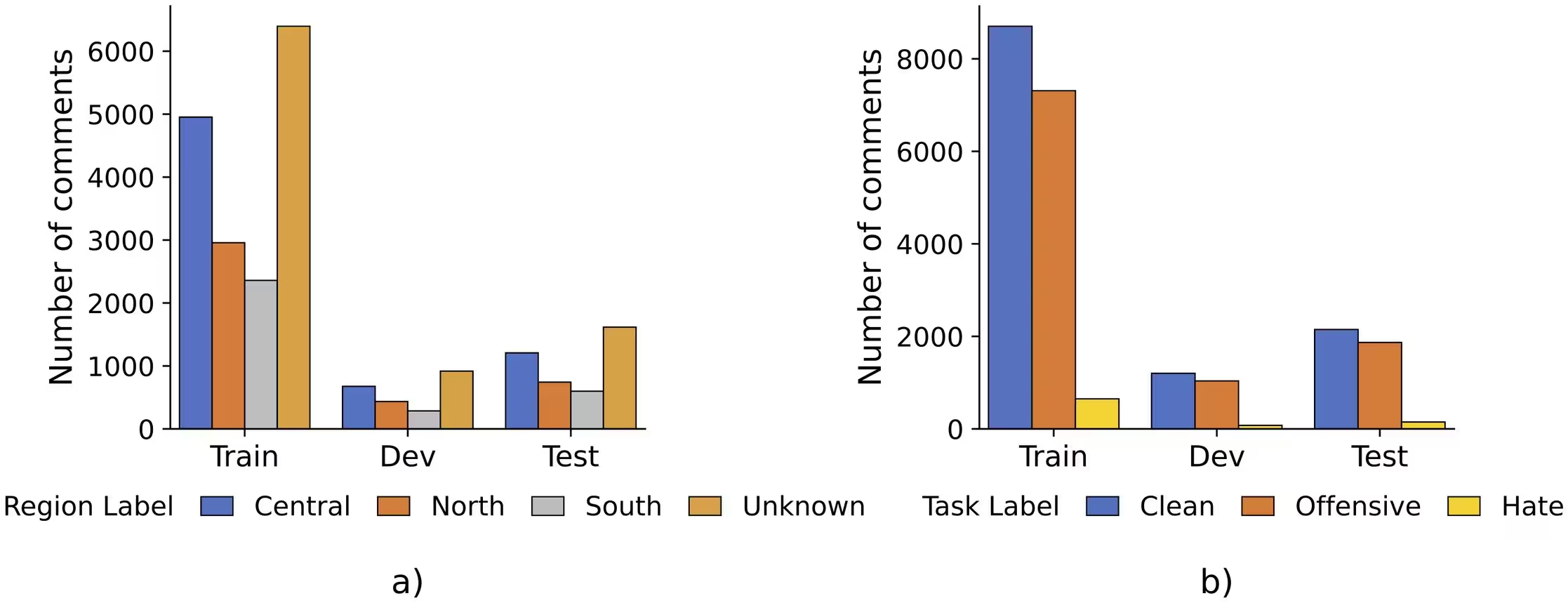
To investigate this issue, Trong-Chi Duong and colleagues at their institution built the Vietnamese Fair Hate Speech Detection dataset, a curated corpus of twenty-three thousand comments. The authors gathered text data from major online discussion forums and social platforms, assigning regional labels through a lexicon of region-specific terms. Toxicity labels were generated using an ensemble large language model majority-voting pipeline and validated by native human annotators, confirming high agreement across all dialect groups.
Why Contrastive Learning and Adversarial Debiasing Help
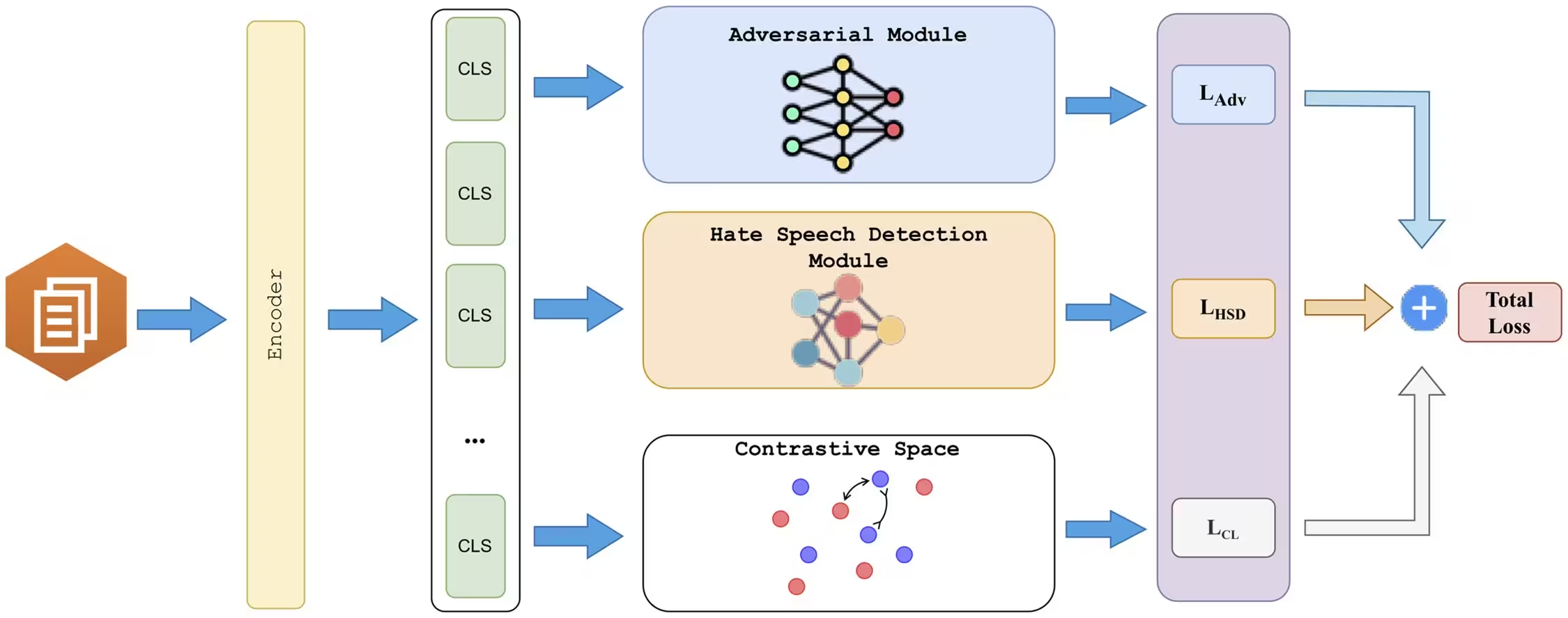
To reduce regional bias without sacrificing overall detection performance, the researchers introduced a framework called Contrastive Learning with Adversarial Fairness, or CLAF. This method combines supervised contrastive learning, which pulls comments with the same toxicity label closer together in the model’s mathematical space, with an adversarial region discriminator. The discriminator attempts to guess the geographic origin of a text from its hidden representation, while a gradient reversal layer forces the encoder to mask that geographic signal from the final prediction.
Interestingly, probing analyses conducted by the team showed that this debiasing strategy does not actually erase regional information from the middle layers of the model. Instead, the adversarial pressure successfully stops the final classifier from using geography as a shortcut. Detailed findings from this work are published in PLOS One, outlining the precise balance between classification accuracy and demographic fairness.
What Happens to Model Accuracy and Fairness Gaps
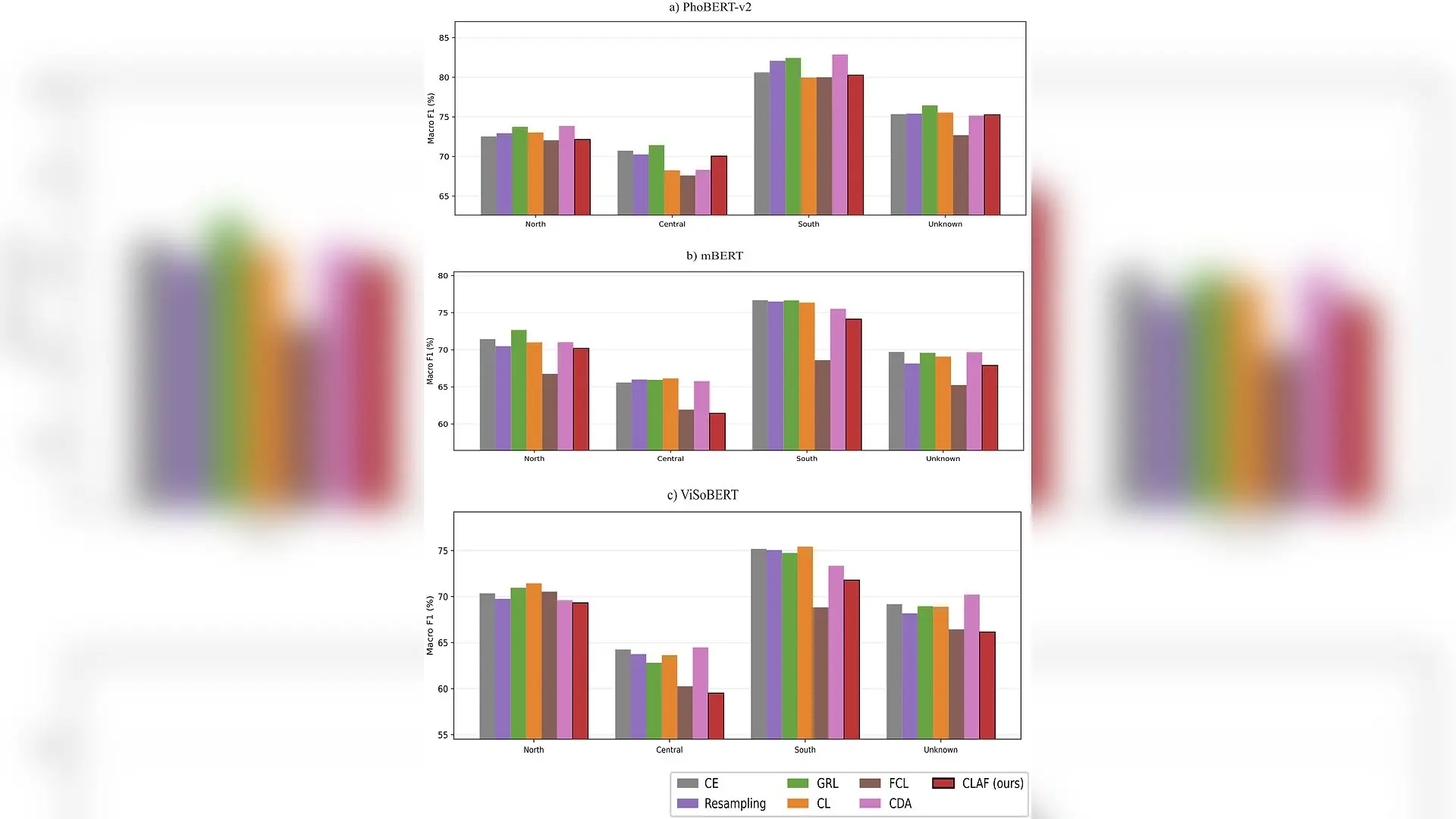
Across five different transformer backbones, the researchers measured performance using accuracy, macro F-score, statistical parity difference, and equal opportunity gaps. Standard fine-tuning models exhibited large regional disparities, with statistical parity differences hovering near thirty percentage points. Applying the CLAF framework reduced these regional disparities across every tested model, bringing fairness metrics down while incurring only a modest trade-off in macro F-score.
The study also highlighted persistent challenges, such as data scarcity in extreme hate speech categories and inherent performance differences across regions. Central Vietnamese comments, for instance, proved harder to classify accurately due to skewed training distributions and higher label noise. Furthermore, zero-shot evaluations on separate out-of-distribution datasets showed that fairness gains do not always transfer perfectly to new domains, underscoring the ongoing challenge of building universally fair moderation tools.
The research was published in PLOS One on November 24, 2026.
This article has been fact checked for accuracy, with information verified against reputable sources. Learn more about us and our editorial process.
Last reviewed on .
Article history
- Latest version
Reference(s)
- Duong, Trong-Chi., et al. “Mitigating regional bias in Vietnamese hate speech detection via contrastive learning with adversarial fairness.” PLOS One, vol. 21, no. 11, November 24, 2026, pp. e0363138 Public Library of Science (PLoS), doi: 10.1371/journal.pone.0363138. <https://doi.org/10.1371/journal.pone.0363138>.
Cite this page:
- Posted by Joseph Jackson