Victorian Children’s Books Used Simple Words But Adult Grammar
A quantitative study of nineteenth-century fiction reveals that children’s books required the same syntactic memory effort as adult novels.

Nineteenth-century books written for young readers contained simpler words than adult novels, but their sentence structures required the exact same mental effort to parse. A computer analysis of one hundred historical books reveals that the long-standing assumption of overall simpler prose in children’s literature is only partly true, separating vocabulary from grammar in a way researchers had rarely measured before.
How did nineteenth-century authors adapt stories for young readers?
Writing stories for developing minds has always involved a balancing act between accessibility and richness. Authors want young readers to follow the plot, but they also want to expand their linguistic horizons. To understand how Victorian writers navigated this tension, researchers Demei Yang and Shilong Tao examined the complete text collections of the CLiC corpus, a digital resource of nineteenth-century literature. Their findings were published in PLOS One, providing a detailed look at 71 children’s books and 29 adult novels.
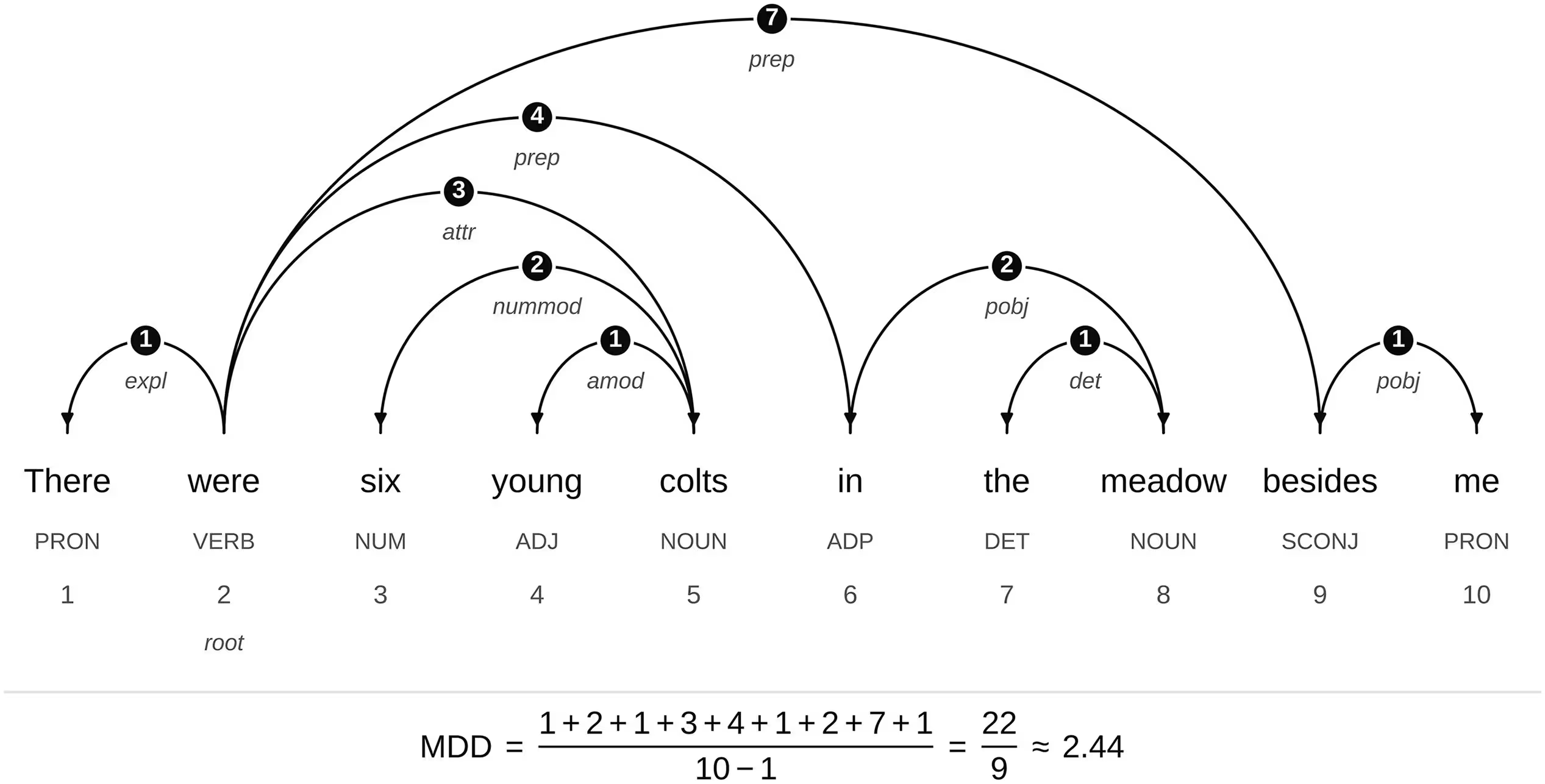
The study divided text complexity into two separate mathematical dimensions. Lexical variety was measured using the Moving-Average Type-Token Ratio, a method that tracks how many different word forms appear within a sliding window of text without being distorted by overall book length. Syntactic processing load was measured using mean dependency distance, which calculates the average linear distance between words that are grammatically linked in a sentence. The cognitive principle behind this second measure is straightforward: the further apart two related words are in a sentence, the longer the brain must hold the first word in working memory before integrating it with the second.
Why did vocabulary variety only appear over long passages?
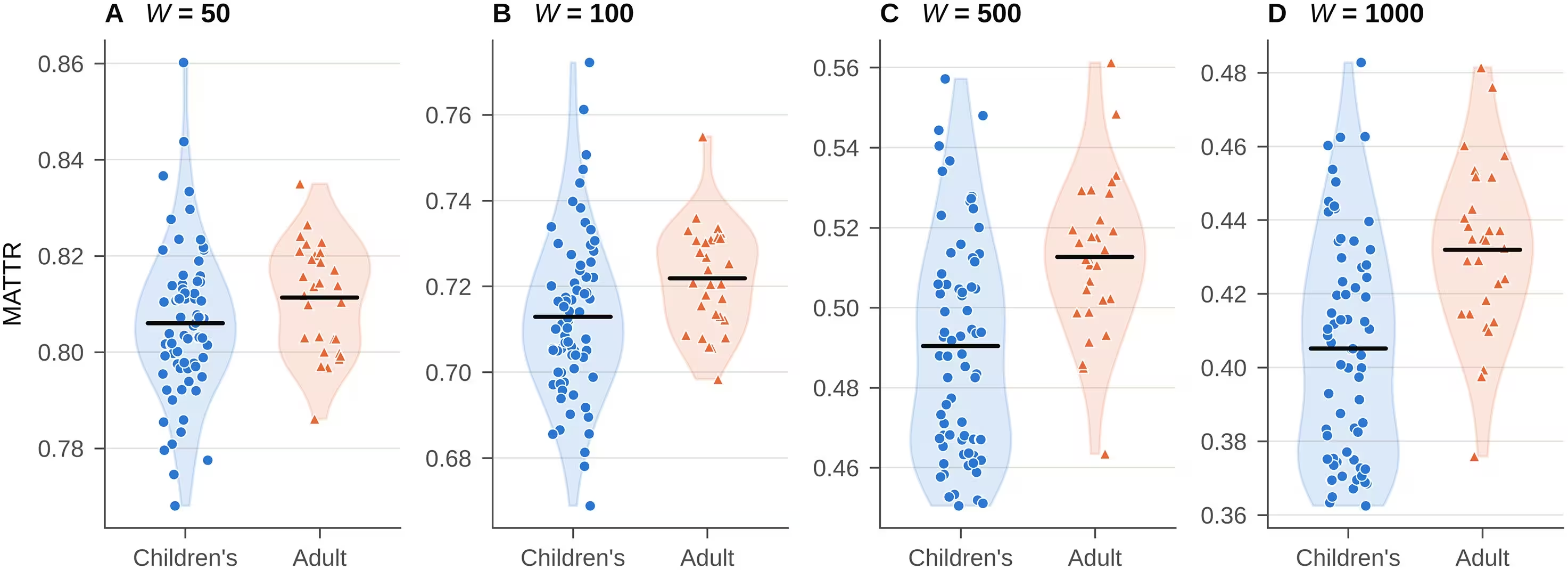
When looking at short spans of fifty or one hundred words, children’s books and adult novels introduced new word forms at almost identical rates. The local rhythm of language, driven by common grammatical words and frequent verbs, felt very similar across both genres. However, when the analysis widened to windows of 500 or 1,000 tokens, a clear gap emerged. Adult prose kept introducing new vocabulary at a steady clip, whereas children’s literature returned more frequently to words it had already used.
This scale-dependent difference suggests that children’s books did not necessarily pack fewer difficult words into a sentence. Instead, they covered a narrower range of topics, settings, and characters. Episodic adventure tales and school stories sat at the higher end of the children’s lexical range, while fairy tales and fables centered around a small cast of recurring figures sat at the lower end. The overall lexical difference between the two genres reflected the scope of the fictional world rather than the difficulty of individual terms.
What did dependency distance reveal about Victorian sentence structures?
On the syntactic front, the traditional idea of a scaled-down literary style disappeared entirely. Raw mean dependency distance was virtually identical between the two collections, averaging about 2.63 units for children’s books and 2.64 for adult novels. When the researchers adjusted for publication year, children’s literature actually showed slightly longer dependencies than adult fiction of the same decade. Once sentence length was accounted for, the two corpora were practically equivalent.
Young readers picking up a Victorian children’s book faced the same memory demands when connecting words to their grammatical heads as someone reading a canonical adult novel. Highly didactic children’s books from the era, which frequently interleaved stories with moral instruction and expository explanations, often featured long, embedded sentences that rivaled the most demanding adult prose. Furthermore, the analysis uncovered a broad historical trend shared by both genres, showing that dependency distances fell by about 0.04 units per decade across the nineteenth century primarily because sentences themselves grew shorter over time.
The research was published in PLOS One on November 24, 2026.
This article has been fact checked for accuracy, with information verified against reputable sources. Learn more about us and our editorial process.
Last reviewed on .
Article history
- Latest version
Reference(s)
- Yang, Demei., et al. “Lexical variety versus syntactic processing load in nineteenth-century children’s and adult literature.” PLOS One, vol. 21, no. 11, November 24, 2026, pp. e0363365 Public Library of Science (PLoS), doi: 10.1371/journal.pone.0363365. <https://doi.org/10.1371/journal.pone.0363365>.
Cite this page:
- Posted by Zubair Ali