High-Altitude Balloon Payload Achieves Precise Telescope Calibration Pointing
A momentum wheel system successfully held tight orientation limits during a stratospheric flight, and simulations suggest a second motor could eliminate pointing interruptions.
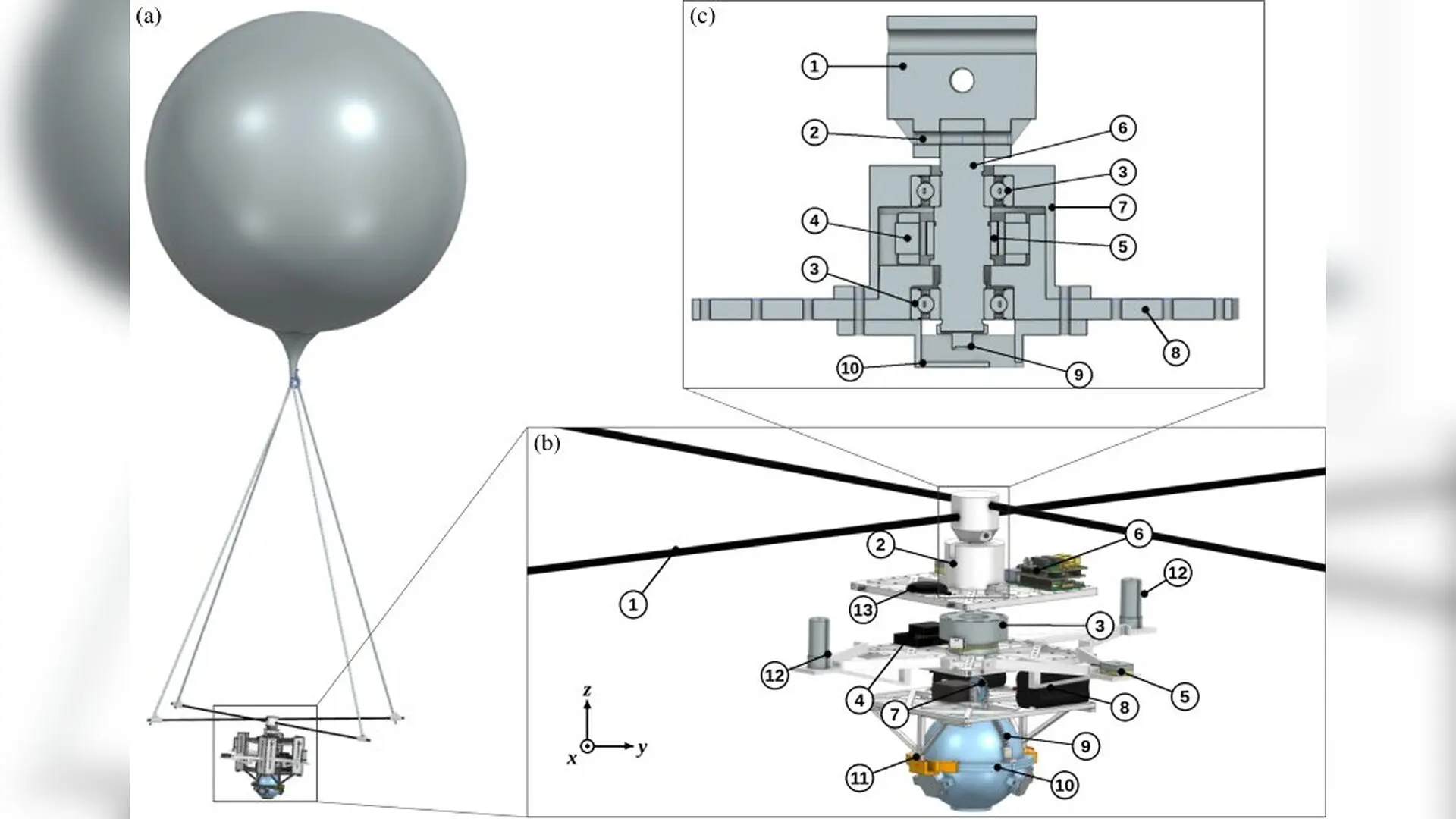
A lightweight high-altitude balloon payload managed to maintain stable pointing toward a ground target using a specialized momentum wheel control system, addressing a major challenge in astronomical calibration. The instrument was developed by a team of researchers led by Yorgo Abou Haidar and James Richard Forbes at McGill University, alongside colleagues at the University of Victoria, to provide precise calibration for ground-based telescopes.
Ground-based telescopes face severe limitations in measuring cosmic expansion and dark energy because tiny uncertainties in photometric calibration, or the measurement of light brightness, translate into massive errors in cosmological models. To solve this, the Airborne Laser for Telescopic Atmospheric Interference Reduction project, also known as ALTAIR, lifts an integrating sphere on a high-altitude balloon to float between 15 and 30 kilometers above the ground, acting as a well-characterized artificial star.
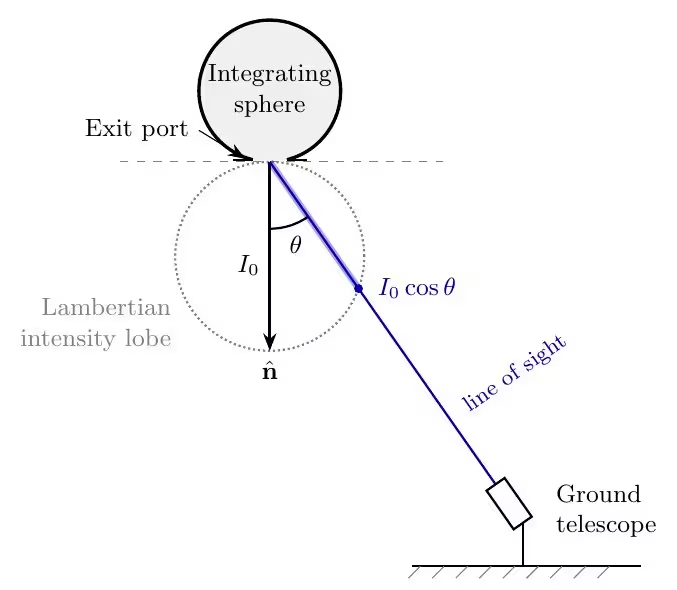
Because the light emerging from the sphere’s exit port behaves in a Lambertian manner, meaning its intensity drops off according to the cosine of the viewing angle, the payload must keep its orientation within eight degrees of the telescope line of sight to limit light intensity errors to less than 1 percent. Furthermore, the system must hold this orientation continuously for at least 30 seconds to allow the telescopes to capture multi-second exposure images. Detailed information about the design and flight configuration is available in a study published on the arXiv preprint server.
How Do You Point a Floating Balloon Payload Without Thrusters?
Controlling the orientation of a payload suspended from a high-altitude balloon is notoriously difficult due to swirling winds, atmospheric turbulence, and the swinging motion of the flight train. To combat pendulating movements, the team utilized carbon-fiber rods that tie the payload directly to the balloon neck, increasing structural inertia and coupling the system together. This passive stabilization successfully reduced the root-mean-square tilt angle to 10.1 degrees during flight tests.
For active azimuth control, the researchers installed a brushless DC motor equipped with a custom flywheel acting as a momentum wheel. By accelerating or decelerating this wheel, the payload experiences a counter-torque that rotates its heading. Attitude determination is handled by an on-board flight controller using three inertial measurement units, a magnetometer, and dual Global Navigation Satellite System antennas mounted on external arms to track carrier-phase signals and calculate precise headings.
What Happens When the Momentum Wheel Reaches Its Limits?
During a test flight on May 27, 2026, the balloon reached a maximum altitude of 23.5 kilometers after an hour and 35 minutes. The momentum wheel alone successfully achieved 53 separate intervals lasting at least 30 seconds where the pointing error stayed within the eight-degree boundary, delivering an overall root-mean-square pointing error of 3.7 degrees across those windows. The longest uninterrupted pointing window lasted 7 minutes and 55 seconds with a pointing error of 5 degrees.
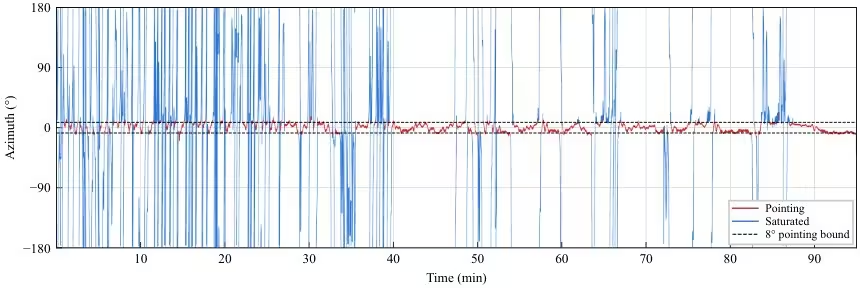
However, the flight data also highlighted a persistent limitation of using a momentum wheel by itself. As the wheel continually counteracts wind disturbances, it eventually reaches its maximum speed limit or slows to zero, entering a saturated state where it loses control authority and requires a reset maneuver. To overcome this, the authors designed an active desaturation architecture incorporating a second motor at the connection point between the payload and the flight train.
Can a Pivot Motor Unlock Multi-Hour Pointing Windows?
The proposed pivot motor acts against the massive inertia of the balloon and flight train, allowing the momentum wheel to gradually dump its stored angular momentum without disrupting the target alignment. Numerical simulations incorporating high-fidelity wind disturbance models derived from real flight data indicate that adding this pivot motor prevents wheel saturation entirely during standard flights.
Monte Carlo simulations comparing the wheel-only setup against the dual-actuator system demonstrated that 46 out of 50 simulated runs with the pivot motor remained within the pointing bounds for more than 97.5 percent of the mission duration. By contrast, the single-motor configuration inevitably saturated in every run, limiting continuous observation time. The research team plans to integrate the pivot motor into upcoming flight tests to demonstrate continuous momentum management and pave the way for extended astronomical observations from the stratosphere.
The study was posted to the arXiv preprint server on November 25, 2026.
This article has been fact checked for accuracy, with information verified against reputable sources. Learn more about us and our editorial process.
Last reviewed on .
Article history
- Latest version
Reference(s)
- Haidar, Yorgo. “Azimuth Pointing and Momentum Management for a Lightweight High-Altitude Balloon Payload.” arXiv.org <http://arxiv.org/abs/2611.34817v1>.
Cite this page:
- Posted by John Williams