Ancient Star Population Discovered Plunging Through Milky Way Core
New kinematic mapping reveals that chaotic stars in the galactic bar are the long-sought inner counterpart to the solar neighbourhood Splash.
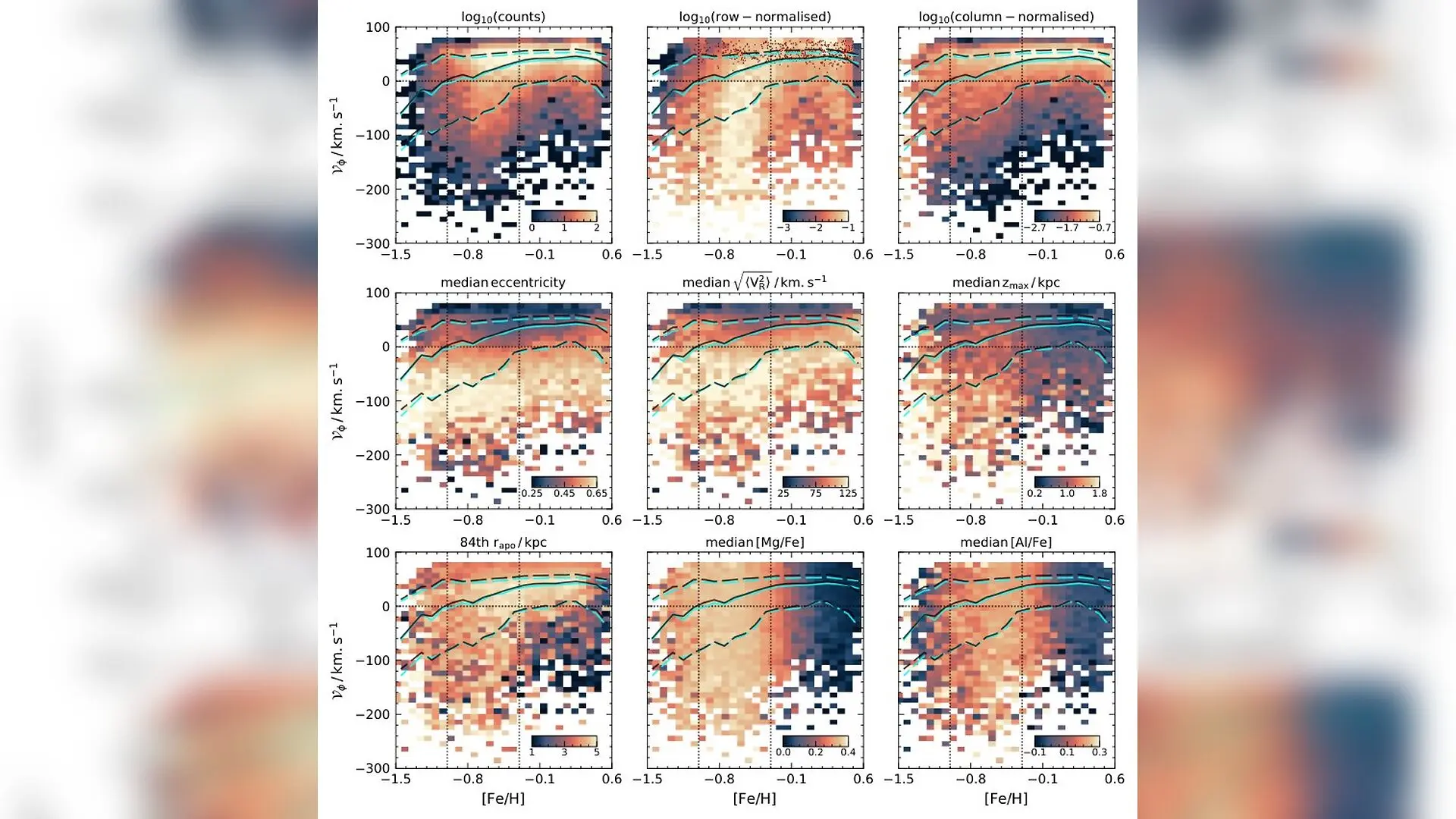
A hidden population of ancient stars plunging on erratic, high-speed orbits through the heart of the Milky Way has been uncovered by astronomers. Accounting for about thirty percent of stars in the galaxy’s central five kiloparsecs with specific chemical signatures, this inner galactic remnant appears to be the long-sought central counterpart to the solar neighbourhood’s famed Splash population.
To untangle the chaotic stellar motions in the inner five thousand parsecs of the galaxy, where a massive rotating stellar bar dominates gravitational dynamics and twists stellar paths, researchers turned to advanced computer models and massive observational datasets. The study was published on the arXiv preprint server by Aakash Pandey and Ortwin Gerhard from the Max Planck Institute for Extraterrestrial Physics in Germany.
By combining high-resolution spectroscopic data from the Apache Point Observatory Galactic Evolution Experiment, known as APOGEE, with precise astrometry from the European Space Agency’s Gaia satellite and distance measurements, the authors mapped the full six-dimensional phase-space coordinates of over sixty thousand red giant stars. Because standard angular momentum is not conserved inside a barred galaxy, the team utilized a novel, radius-weighted time-averaged bar-frame angular momentum parameter. This mathematical adjustment successfully stripped away local variations along individual stellar orbits, revealing clear dynamical boundaries between stars trapped in standard bar-following paths and those moving on retrograde or dynamically hot trajectories.
The analysis revealed a pronounced extension of stars possessing negative rotational values within a metallicity window spanning from minus one to minus zero point three. These stars exhibit extreme orbital eccentricities, large vertical excursions reaching up to one and a half kiloparsecs above the galactic plane, and elevated velocity dispersions. Detailed chemical abundance tracking showed that these erratic stars share identical magnesium-to-iron and aluminum-to-iron ratios with the standard bar-supporting population, pointing directly to a common birthplace in the ancient galactic disc.
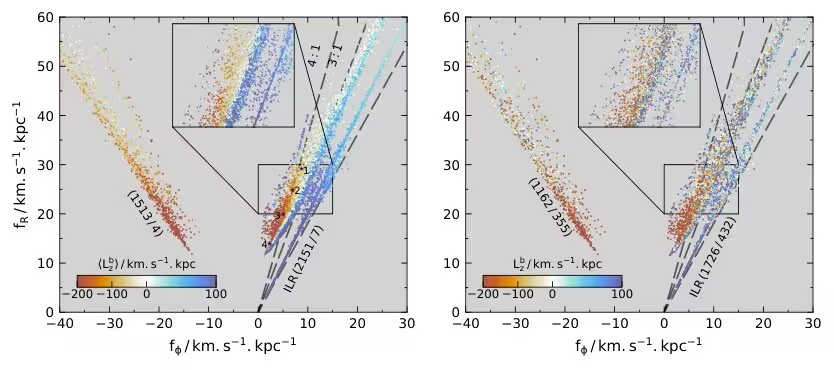
When comparing their metallicity distribution function with stars found in the solar vicinity, the researchers noted a striking alignment. The dominant Gaussian component of these central retrograde stars matches the solar-neighbourhood Splash population almost perfectly. Because this stellar group extends deep into the bar region while maintaining a spheroidal density profile distinct from the peanut-shaped boxy bulge, the authors conclude that the Milky Way does not harbor an old classical bulge. Instead, the old bulge consists of ancient thick-disc stars that were scattered into chaotic inner orbits by ancient galactic collisions.
The origin of this central Splash points strongly toward the early cosmic history of our galaxy, specifically its ancient merger with a dwarf satellite known as Gaia-Sausage-Enceladus. Cosmological simulations indicate that such ancient minor mergers heavily heat proto-discs, kicking a substantial fraction of early disc stars onto plunging, low-angular-momentum orbits. The authors suggest that the energetic disruption from this satellite collision occurred roughly ten billion years ago, violently scattering stars while simultaneously triggering powerful bursts of star formation that shaped the early architecture of the Milky Way.
The study was posted to the arXiv preprint server on November 25, 2026.
This article has been fact checked for accuracy, with information verified against reputable sources. Learn more about us and our editorial process.
Last reviewed on .
Article history
- Latest version
Reference(s)
- Pandey, Aakash. “The Splash population confined to the Milky Way bar region.” arXiv.org <http://arxiv.org/abs/2611.34890v1>.
Cite this page:
- Posted by Karan Das