AI Models That Draw Pictures To Help Solve Puzzles Actually Perform Worse
Testing 13 model pairs revealed that generative visual helpers frequently introduce hallucinations, destroy chart data, and reduce overall problem-solving accuracy.
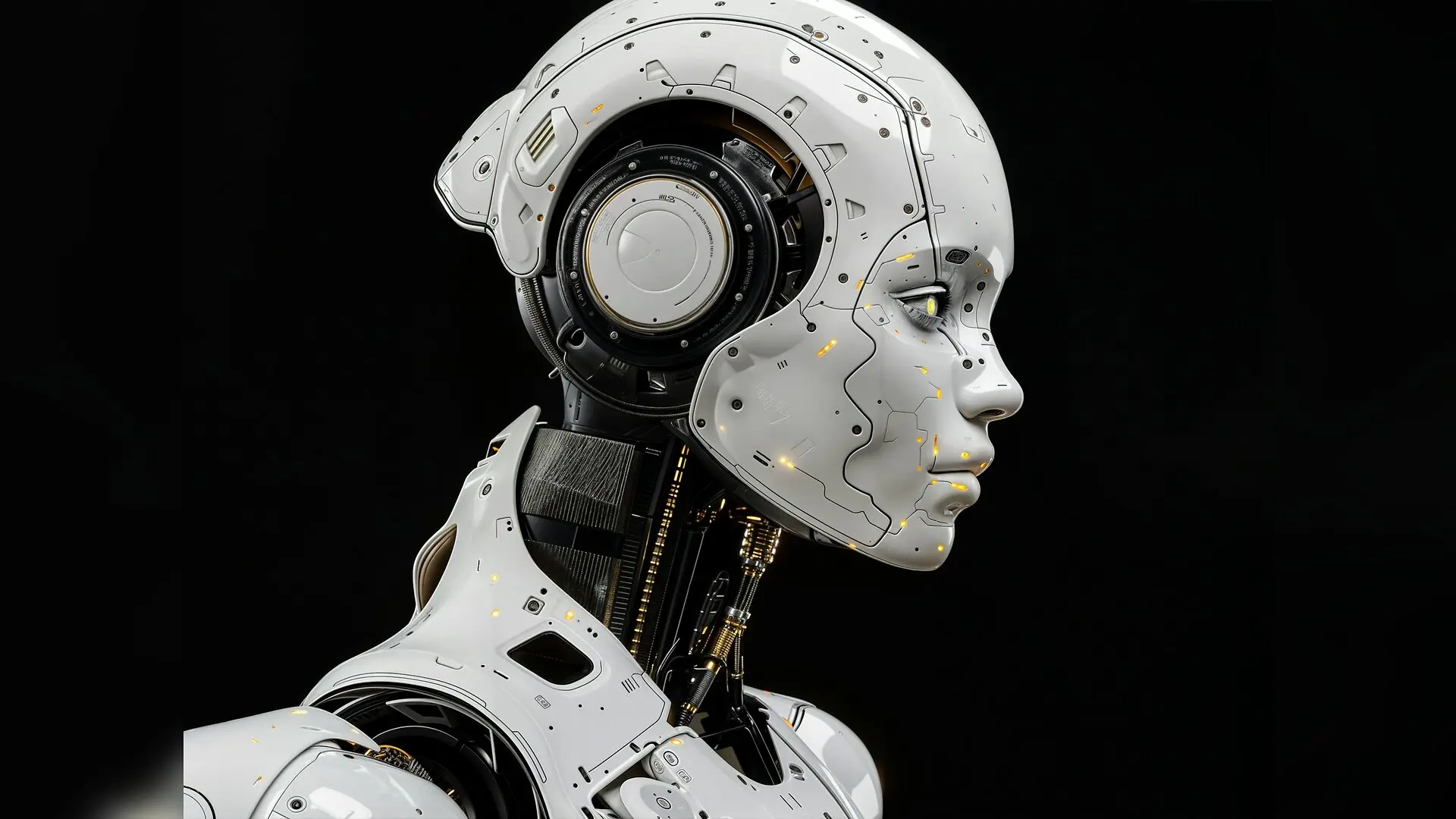
Giving advanced artificial intelligence models the ability to draw and edit pictures to help them solve tricky visual puzzles actually lowers their overall accuracy by an average of about 3.7 percentage points, according to a large empirical evaluation. While humans routinely use imagination and rough sketches to reason through complex geometry or spatial arrangements, testing this same concept in computer vision systems reveals that generative helpers frequently introduce misleading details or wipe out crucial evidence entirely.
The study, led by researchers at Princeton University and Meta, was published on the arXiv preprint server and evaluated 13 distinct vision-language model and generator pairings across nine standard benchmarks spanning ten tasks. In human problem-solving, drawing an extra line on a diagram or picturing a rotated object helps clarify abstract concepts. The research team sought to find out whether artificial intelligence models could achieve similar breakthroughs by using a two-step reasoning framework where a vision-language model first writes a descriptive hint of an image it needs, an external tool generates that helper image, and the model then inspects both the original and generated pictures together to reach a final conclusion.
Why Do Artificial Intelligence Drawing Tools Fail So Often?
When researchers tested 13 modular pipelines across 130 distinct evaluations, they found that generating helper images lowered accuracy in 106 of those tests. Even powerful models such as Gemini 3.0 Flash, which scored high on text-only baselines, saw performance drop significantly when paired with image generators like Nano-Banana. Across almost every tested pipeline, accuracy declined on at least six out of ten tasks, and in 12 of the 13 pipelines, the decline affected at least eight tasks.
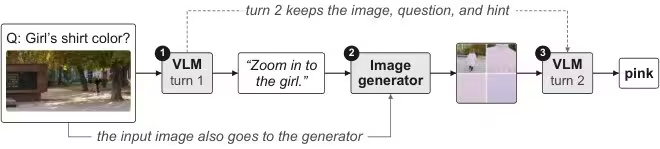
To understand the breakdown, the authors analyzed failed examples and categorized them by the specific step that went wrong. They found that 66 percent of errors stemmed from a bad initial hint written by the reasoning model, 28 percent resulted from a faulty generated image, and only 6 percent were pure inference errors in the final answer. On chart comprehension tasks and high-resolution visual search benchmarks, image generators frequently lost fine details required to answer correctly. Meanwhile, on spatial and puzzle tasks, the models often requested generic crops or zooms that missed the exact information needed.
Can Simple Cropping Beat Advanced Image Generators?
When investigating visual search tasks involving small objects in high-resolution pictures, the researchers discovered that traditional digital manipulation vastly outperformed generative AI. On a visual search benchmark known as VSTAR, when models requested a specific crop or zoom, taking the original pixels and resizing them via bicubic interpolation achieved an accuracy of about 72 percent. By contrast, letting an AI generator draw an edited version of the same region dropped accuracy down to about 51 percent.
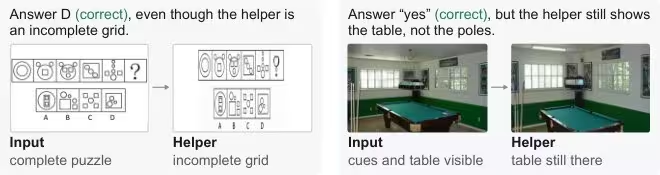
The only area where image generation consistently helped was on a specific compatibility subset of a spatial benchmark called RoboSpatial, where accuracy rose by up to 23.8 percentage points in 12 out of 13 pipelines. Because those questions asked hypothetical spatial arrangement questions, such as whether an object would fit inside a designated space, drawing the object directly into the scene provided a helpful visual depiction. However, for configuration questions concerning the scene as it actually existed, generation performance dropped in almost every pipeline.
What Happens When Models Make Repeated Edits?
The team also tested whether giving models multiple chances to refine their drawings through test-time scaling would improve results. When they extended the process to allow up to ten consecutive image edits with a fixed hint on tasks like chart comprehension and math-geometry, the models stayed below their original text-only baselines at every checkpoint. Although longer text reasoning and chain-of-thought prompting can boost performance on certain text-based tasks, layering generated images on top of reasoning modes did not close the gap, sometimes even amplifying visual noise and hallucinations.
The study was posted to the arXiv preprint server on November 25, 2026.
This article has been fact checked for accuracy, with information verified against reputable sources. Learn more about us and our editorial process.
Last reviewed on .
Article history
- Latest version
Reference(s)
- Yu, Xueyang. “Can image generation help visual reasoning? An empirical study.” arXiv.org <http://arxiv.org/abs/2611.34935v1>.
Cite this page:
- Posted by James Whitmore