Visual Learning Transforms Artificial Number Sense By Untangling Count And Proportion
Researchers reveal that training computer vision models on natural and synthetic images reorganizes internal neural geometry to resolve conflicting quantitative cues.
When humans and animals estimate quantities, they often rely on a primitive number sense that emerges long before formal mathematics is ever taught. Yet advanced artificial intelligence models frequently struggle with basic counting and quantitative reasoning tasks, even after viewing millions of images. A new study reveals that ordinary visual learning transforms this basic raw quantity sensitivity by reorganizing how information is arranged in artificial neural networks, separating numerical counts from proportional measurements so that the system can use them independently.
The research, published on the arXiv preprint server by Yechan Cho and colleagues at the Korea Institute of Science and Technology alongside international collaborators, investigates how twelve different computer vision architectures represent number and proportion. While previous work showed that units sensitive to numbers appear spontaneously in randomly initialized networks that have never been trained, the authors wanted to discover whether subsequent visual experience does more than just sharpen those individual detectors.
How Does Visual Learning Reshape Internal Neural Geometry?
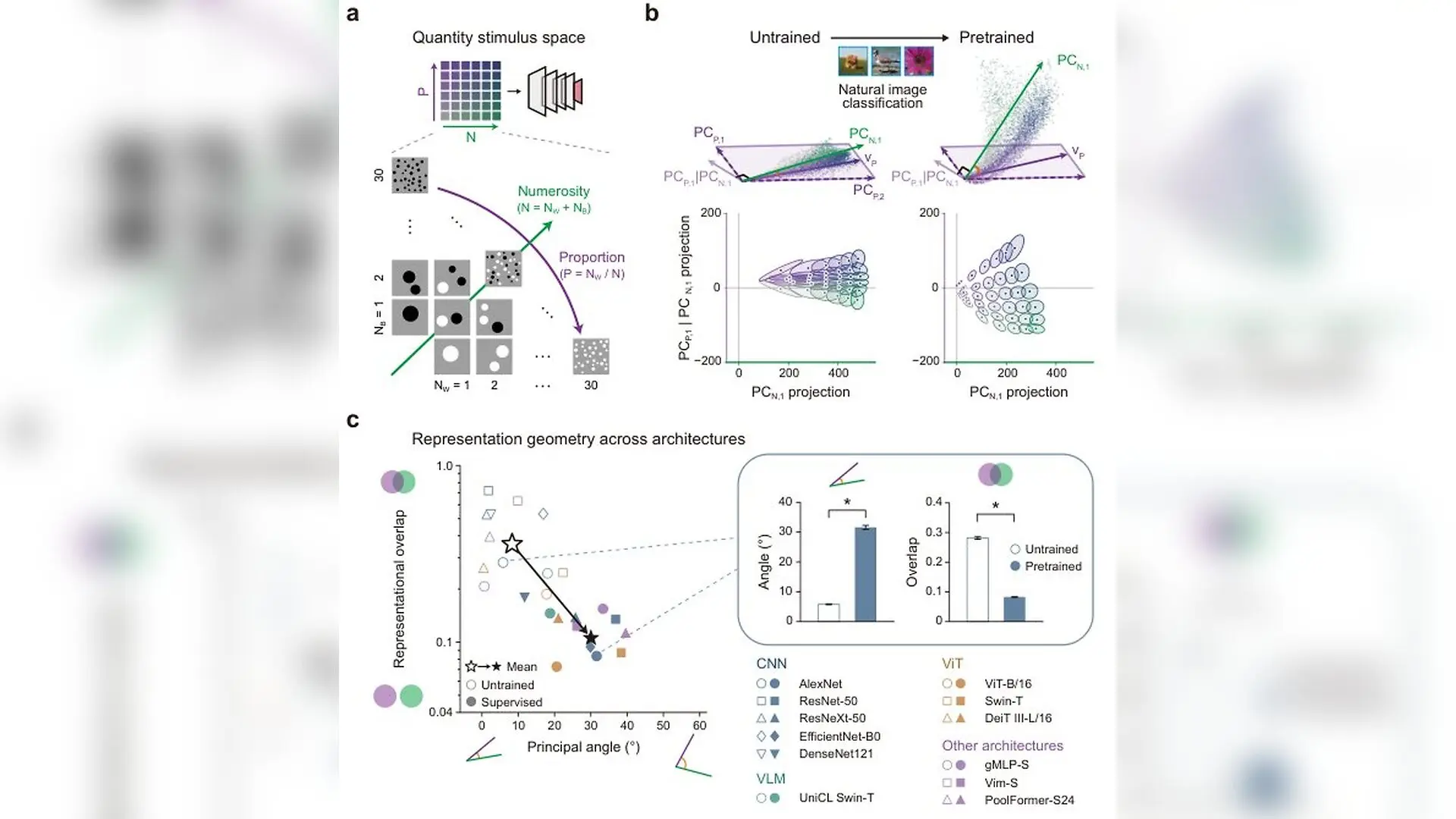
To understand how networks process quantities, the research team analyzed the internal activation patterns of twelve distinct models, ranging from traditional convolutional neural networks to modern vision transformers and vision-language encoders. They fed the networks eighteen thousand images containing varying numbers of black and white dots, where the total count represented numerosity and the white fraction represented proportion. By applying principal component analysis to the responses, the team mapped the internal dimensions dedicated to each quantity.
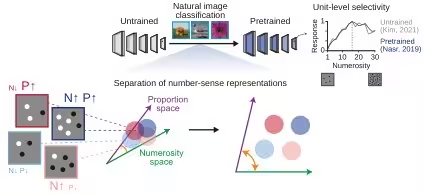
The analysis revealed that untrained networks and pretrained networks both possessed individual units capable of detecting basic counts. However, visual training fundamentally altered the population-level geometry. Specifically, natural-image pretraining significantly widened the angle between the numerical subspace and the proportional subspace while simultaneously reducing the statistical overlap between their response distributions across all twelve tested models.
Why Do Conflicting Cues Challenge Both Humans and Machines?
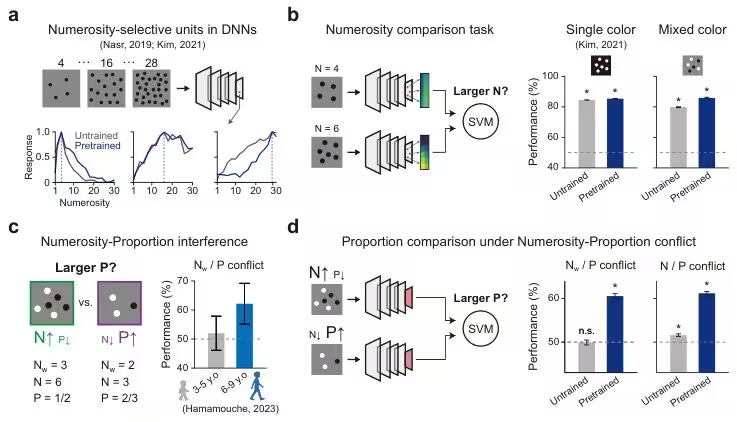
In cognitive psychology, proportional reasoning tests show that human children struggle when absolute counts conflict with proportions, such as when a larger group of items represents a smaller overall fraction. Children gradually learn to resolve these competing cues as they develop. To test if AI models face a similar hurdle, the researchers adapted a conflict paradigm using two-color dot arrays where numerosity and proportion pointed to opposite answers.
When tested on these conflicting scenarios, untrained networks performed near chance levels at about fifty percent accuracy, failing to isolate proportion from absolute count. In contrast, pretrained networks maintained above-chance performance by successfully separating the two dimensions. Direct geometric manipulations confirmed this causal link, showing that reducing representational overlap directly improved decoding accuracy, while widening the angle between the subspaces made the quantity readouts functionally independent.
Does This Reorganization Require Natural Images or Category Labels?
The study further tested whether this geometric disentangling depends entirely on supervised learning with categorical labels or natural photographs. The authors examined networks trained via self-supervised learning methods without category labels, finding that these models still developed well-separated quantity representations. Even when trained on restricted developmental visual diets featuring gradually maturing acuity and contrast, the models maintained robust quantity separation.
Furthermore, training models on structured synthetic images, ranging from simple geometric shaders to complex visual distributions, showed that rich visual structure alone is sufficient to untangle number sense. Conversely, training models with shuffled labels degraded the internal geometry, demonstrating that meaningful visual learning is required to organize these latent dimensions. The findings provide a geometric framework for understanding how exposure to environmental structure refines incidental information into robust tools for downstream reasoning.
The study was posted to the arXiv preprint server on November 25, 2026.
This article has been fact checked for accuracy, with information verified against reputable sources. Learn more about us and our editorial process.
Last reviewed on .
Article history
- Latest version
Reference(s)
- Cho, Yechan. “Learning from Natural Images Untangles Number Sense.” arXiv.org <http://arxiv.org/abs/2611.33615v1>.
Cite this page:
- Posted by Jessica Martin