New Algorithm Lets Brain-Inspired Computers Learn Without Costly Step-by-Step Training
By separating learning clocks from computing steps, researchers trained spiking neural networks with twenty times less memory and high stability.
When artificial intelligence systems try to mimic the brain’s remarkable energy efficiency, they often run into a major training bottleneck. Researchers have long trained spiking neural networks by calculating weight adjustments across every single simulated millisecond, a process that becomes unstable and computationally expensive as simulations get finer. To overcome this hurdle, scientists at the Institute of Molecular Biology and Biotechnology in Greece have developed a new training algorithm that separates the clock of learning from the clock of computing. The method, detailed in a study published on arXiv, demonstrates that spiking neural networks can learn reliably by calculating updates from total spike counts rather than individual voltage jumps.
How Does Decoupling the Clocks Change Neural Network Training?
Traditional training relies on backpropagation through time, a technique that differentiates a network simulation step by step. Because brain-inspired chips run on electrical pulses known as spikes, standard algorithms must track the exact membrane potential of every neuron at every timestep. This creates an extremely long chain of mathematical derivatives, which frequently collapses or destabilizes when applied to complex, time-varying data like spoken audio commands.
The new approach, named ChronoProp by lead author Michalis Pagkalos and senior researcher Panayiota Poirazi, takes inspiration from biological brains that operate in continuous time while learning over much broader temporal windows. Instead of tracking every micro-fluctuation, ChronoProp measures how many times a neuron fires within a fixed time bin and links that count directly to its input current using a pre-measured response curve. This eliminates the need to differentiate membrane potentials through time, shortening the mathematical chain and keeping network training stable.
Why Do Recurrent Networks Benefit Most From the New Method?
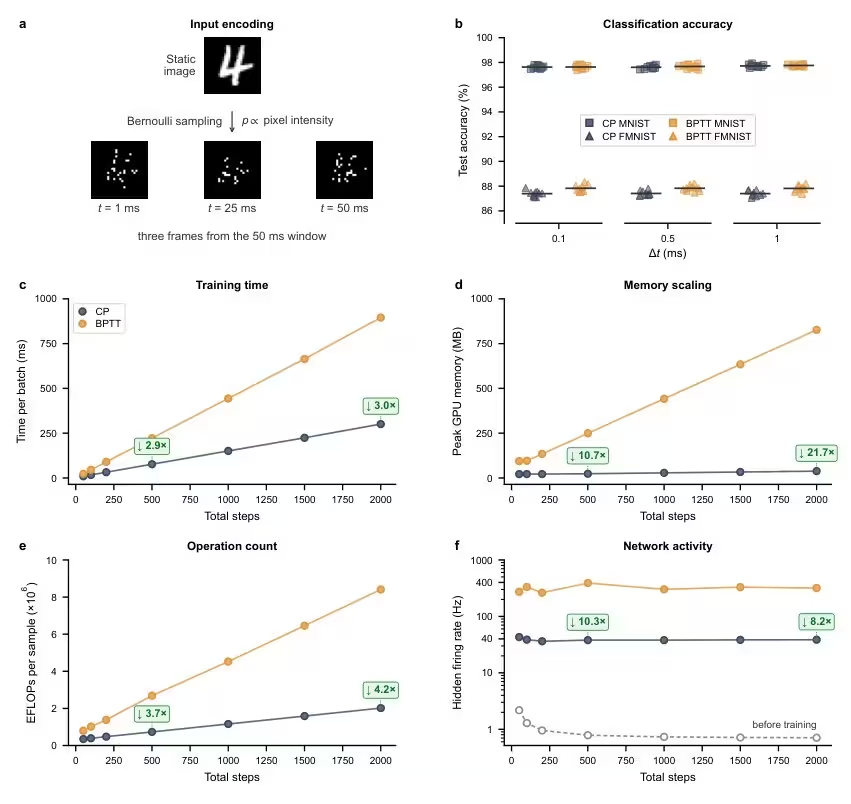
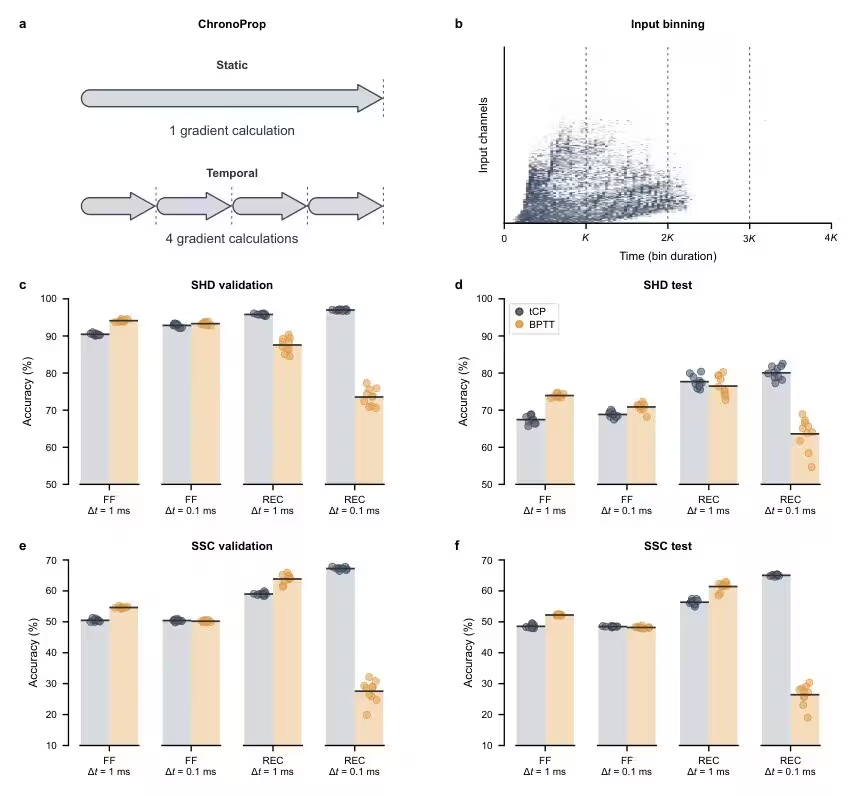
When tested on image classification benchmarks, the method achieved accuracy comparable to standard training while using up to twenty times less GPU memory and training three times faster at high-resolution timesteps. The advantages became even more pronounced when the researchers evaluated recurrent networks on spoken word datasets, where time-dependent features are critical. At a fine timestep of 0.1 milliseconds, standard training struggled with long loops and failed to learn effectively, whereas the new count-based approach achieved up to eighty percent accuracy on challenging audio tasks.
The authors also demonstrated that the technique can adapt to more complex biological structures, such as neurons featuring adaptive currents or multi-compartment dendrites. By simply measuring an additional variable to construct a two-dimensional response plane, the network successfully integrated richer biophysical properties without destabilizing the training process.
Can Brain-Inspired Chips Overcome Physical Hardware Flaws?
Beyond training speed, physical neuromorphic chips often suffer from imperfections such as noisy membrane voltages, imprecise weight programming, and variations in time constants across different physical components. Because the new algorithm relies on aggregate spike counts rather than exact voltage histories, networks trained with this approach retained significantly higher accuracy under simulated hardware defects than conventionally trained models.
While standard backpropagation remains useful for simple feedforward networks with short calculation chains, the new technique opens up stable training pathways for complex, continuous-time neuromorphic hardware. By loosening the ties between simulation steps and learning updates, the work brings artificial intelligence a step closer to the power efficiency seen in biological organisms.
The study was posted to the arXiv preprint server on November 25, 2026.
This article has been fact checked for accuracy, with information verified against reputable sources. Learn more about us and our editorial process.
Last reviewed on .
Article history
- Latest version
Reference(s)
- Pagkalos, Michalis. “Decoupling the clocks of learning and computing in spiking neural networks.” arXiv.org <http://arxiv.org/abs/2611.34381v1>.
Cite this page:
- Posted by Jessica Martin