New Biophysics AI Framework Fixes Hidden Data Flaws in Protein Mutation Predictions
By injecting physical metrics into pretrained protein language models, scientists bypassed hidden training leaks to accurately predict how mutations alter molecular binding.
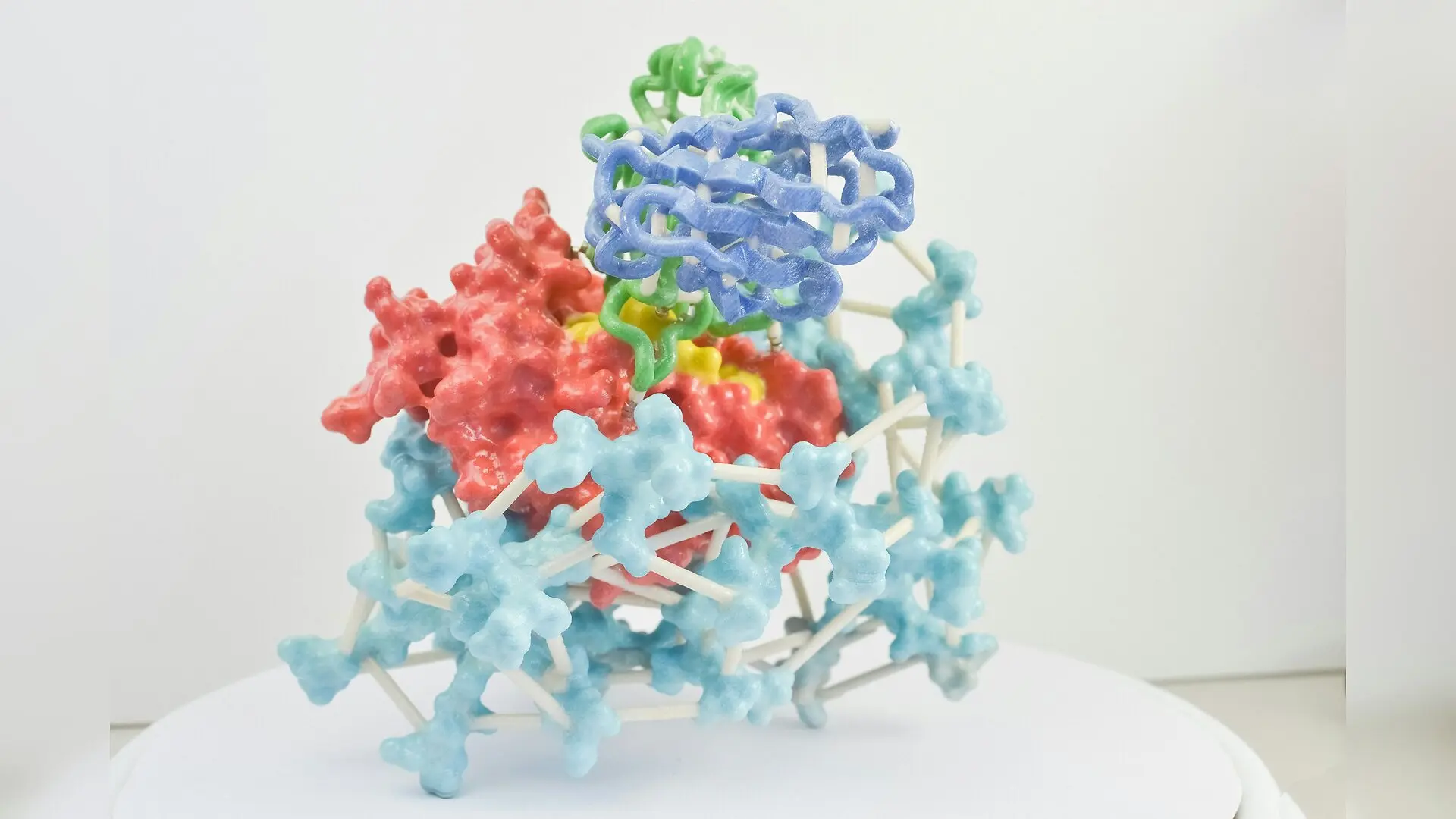
Predicting how specific genetic mutations alter the strength of protein binding is notoriously difficult, yet a new artificial intelligence framework successfully sharpens these molecular forecasts by incorporating basic physics. Researchers have discovered that standard training benchmarks for protein binding are riddled with hidden sequence overlaps that inflate predictive accuracy.
Why Do Common Protein Benchmarks Fall Short Under Stricter Tests?
Computational biology relies heavily on machine learning to predict changes in binding free energy, known as delta delta G, when amino acids mutate. However, leading models often struggle to generalize when tested on entirely new proteins because their training and testing sets share high sequence similarity, a flaw known as data leakage. Jonathan Feldman and colleagues at Harvard Medical School set out to measure this hidden redundancy within the SKEMPI2 dataset, which is the field’s most widely used collection of curated protein complexes containing 345 structures and 7,085 mutational variants.
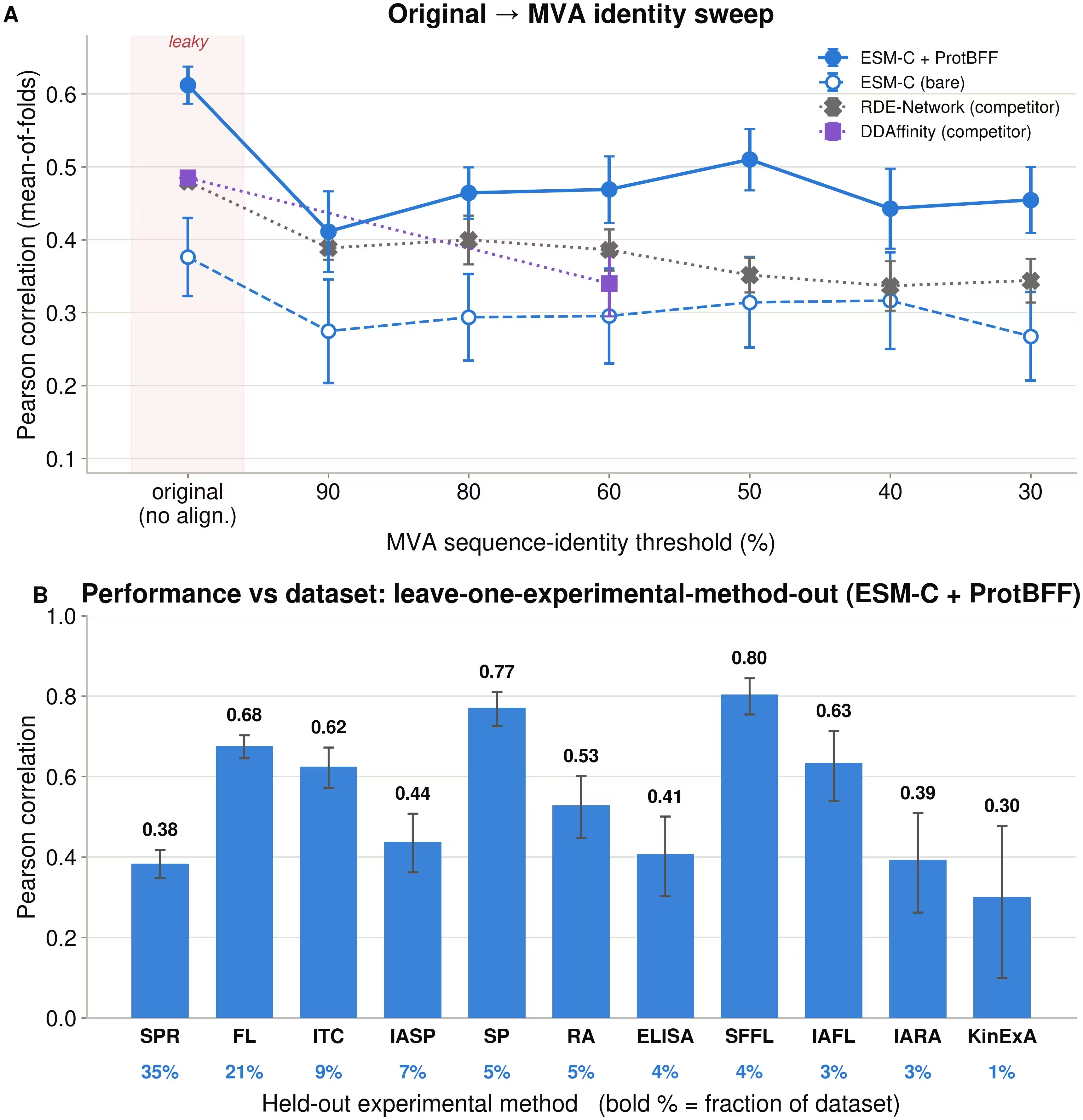
To expose the extent of this problem, the team applied an extremely stringent evaluation split called MVA-60, which ensures that no mutated chain in a test complex shares more than sixty percent sequence identity with any chain in the training split. As reported in the study published in PLOS Computational Biology published in PLOS Computational Biology, this rigorous partitioning caused performance across every tested artificial intelligence predictor to decline precipitously. When the shortcut of high sequence similarity was removed, traditional models that previously looked highly accurate revealed a much larger generalization gap.
How Does the ProtBFF Framework Inject Physical Insights Into Language Models?
To overcome this limitation without building entirely new architectures from scratch, the researchers created the Protein Biophysical Feature Framework, abbreviated as ProtBFF. Instead of forcing deep learning models to learn biophysical rules purely from biased data, ProtBFF acts as a modular add-on that reweights residue-level embeddings using five explicit biophysical scores. These metrics include the interface propensity score, residue burial, dihedral angle deviation, solvent-accessible surface area, and the local distance difference test score which measures atomic conformational changes.
By scaling the internal vector representations of proteins with these structural metrics, the framework amplifies residues that are physically critical for binding while down-weighting less relevant parts. A cross-embedding multihead attention mechanism then integrates these diverse physical perspectives before an attention pooling layer reads out the final energy prediction. This design requires minimal additional parameters, making it nimble enough for data-limited scenarios.
What Happens When Physics-Informed Encoders Face Homology-Controlled Benchmarks?
The research team tested ProtBFF across five different pretrained protein encoders, including sequence-only language models and structure-aware architectures, using ten-fold cross-validation on the strict MVA-60 split. Every single encoder improved its predictive correlation when combined with ProtBFF. For instance, the specialized protein structure model ProSST saw its Pearson correlation jump from 0.276 to 0.451, allowing it to surpass older specialized predictors. Among all tested encoders, ESM-C achieved the highest Pearson correlation at 0.469, while SaProt reached the highest Spearman correlation at 0.437.
Systematic ablation studies revealed which physical components drove these improvements. Neutralizing all biophysical scores reduced model performance significantly, while neutralizing the underlying protein embeddings caused a near-total collapse in accuracy. Among the five physical metrics, the interface score contributed the largest performance gain, followed closely by the local distance difference test score, proving that combining multiple complementary physical signals is essential.
Can These Enhanced Models Adapt to Viral Mutations and Antibody Design?
Beyond standard benchmark datasets, the authors evaluated whether ProtBFF-enhanced models could adapt to low-data binding tasks involving viral receptors and neutralizing antibodies. Testing on deep mutational scanning data of the SARS-CoV-2 spike receptor-binding domain interacting with the human ACE2 receptor and antibodies like LY-CoV555 and REGN10987 revealed strong few-shot learning capabilities. With access to only ten percent of the training data, the enhanced models achieved high predictive accuracy, pointing toward practical utility in rapid pandemic response and antibody engineering where experimental data is initially scarce.
The research was published in PLOS Computational Biology on November 25, 2026.
This article has been fact checked for accuracy, with information verified against reputable sources. Learn more about us and our editorial process.
Last reviewed on .
Article history
- Latest version
Reference(s)
- Feldman, Jonathan., et al. “Biophysically grounded deep learning improves protein–protein ΔΔG prediction.” PLOS Computational Biology, vol. 22, no. 11, November 25, 2026, pp. e1014965 Public Library of Science (PLoS), doi: 10.1371/journal.pcbi.1014965. <https://doi.org/10.1371/journal.pcbi.1014965>.
Cite this page:
- Posted by John Williams