Physicists Find Quenching Quantum Noise Can Outperform Amplified Signals
By quieting quantum jitter rather than amplifying responses, researchers show how synchronized spin systems can achieve high precision without slowing down.
Physicists have uncovered a new way to measure tiny physical forces with extreme precision by quieting quantum jitter rather than shouting louder. Instead of relying on a system to react wildly near a tipping point, researchers showed that suppressing background quantum noise can make internal properties of a many-particle system remarkably clear. The findings, published in arXiv, point to a fresh strategy for quantum sensing in arrays of atoms and ions.
How Can Quenching Quantum Noise Beat Standard Limits?
Quantum sensors usually boost their sensitivity by driving a system near a phase transition, which is a dramatic transformation in collective behavior similar to water freezing into ice. Near this critical boundary, physical observables become exceptionally sensitive to tiny changes in external fields or coupling strengths. This heightened responsiveness is known as enhanced susceptibility. Yet, this approach often comes with a frustrating catch, because the same critical fluctuations that create a large signal also inject massive amounts of measurement noise into the experiment.
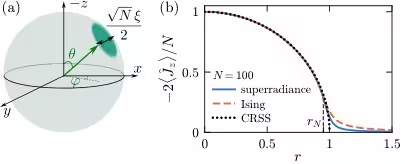
Nikita Leppenen and colleagues at the Weizmann Institute of Science in Israel investigated a complementary mechanism that bypasses this limitation. Rather than hunting for a booming signal, they analyzed correlated states of four hundred spin-half particles known as coherently radiating spin states. These collective quantum states exhibit a second-order transition at a specific critical threshold. The authors demonstrated that while estimating one parameter of the system benefits from the usual enhanced response despite higher noise, estimating a second, phase-related parameter benefits from heavily suppressed quantum noise without needing any amplified response at all.
What Happens When You Measure Different Quadratures of a Many-Body System?
To understand the two pathways, the team examined how different observables behave in these synchronized spin assemblies. When estimating the normalized drive strength of the system, measuring the atomic population inversion yields a large susceptibility signal. This amplified response provides a clear metrological advantage even though random fluctuations along that specific measurement axis grow larger near the critical point.
Conversely, when estimating the internal phase parameter of the collective state, the signal itself does not grow. Instead, the team found that the measurement uncertainty shrinks dramatically because the observable aligns with the squeezed quadrature of the quantum state. In quantum mechanics, squeezing reduces the variance in one property by shifting the uncertainty into the orthogonal direction. Both approaches ultimately yield the same estimation error scaling of four hundred particles raised to the power of minus two thirds, improving over the standard quantum limit.
Why Does This Approach Avoid Traditional Slowing Down?
A major bottleneck in critical quantum metrology is a phenomenon called critical slowing down, where the energy gap between the ground state and excited states closes as the system grows larger. This collapse forces experimentalists to prepare states agonizingly slowly to prevent unwanted excitations. In this new study, however, the authors calculated both analytically and numerically that the relevant energy and dissipative gaps actually open up as particle numbers increase in these collective configurations.
By analyzing driven-dissipative cavity setups and globally interacting trapped-ion Ising models, the researchers showed that preparation times do not blow up with system size. In the superradiant cavity scenario, the collective decay through a fast-decaying cavity mode stabilizes the critical state efficiently. In the trapped-ion platform, all-to-all interactions mediated by collective motion allow the system to reach the critical regime quickly.
What Are the Practical Limits of This Technique?
While the theoretical framework demonstrates robust scaling improvements, translating these concepts into physical hardware involves distinct experimental challenges. Controlling atom-cavity detuning, laser drive phases, and collective decay rates with high fidelity requires precise engineering. Any residual decoherence or uncontrolled environmental noise could wash out the delicate quantum correlations required for noise suppression.
The authors suggest that these mechanisms could soon be harnessed to sense tiny shifts in optical cavity lengths, atomic coupling rates, or local electric fields. By exploiting squeezed states that arise naturally at critical thresholds, physicists can bypass the need for external interferometers or complex squeezed light sources, opening new doors for ultra-precise quantum technology.
The study was posted to the arXiv preprint server on November 25, 2026.
This article has been fact checked for accuracy, with information verified against reputable sources. Learn more about us and our editorial process.
Last reviewed on .
Article history
- Latest version
Reference(s)
- Leppenen, Nikita. “Complementary mechanisms of critical quantum metrology.” arXiv.org <http://arxiv.org/abs/2611.34916v1>.
Cite this page:
- Posted by Farah Siddiqui