Physicists Reveal How Vacancy Clustering Blurs Magnetic Waves in Iron
A novel computational framework shows that the spatial arrangement of missing atoms dictates whether magnetic ripples remain sharp or degrade.
Tiny missing atoms inside magnetic materials alter their internal wave ripples in unexpected ways, depending entirely on how those atomic voids cluster together. Physicists have long struggled to model how missing atoms or structural distortions alter collective magnetic ripples known as magnons, which dictate properties like heat transport and magnetization.
A research team led by Alex Moorhouse at Columbia University has developed a computational framework that overcomes this long-standing barrier by combining machine learning potentials with advanced mathematical unfolding techniques. The study is available on the arXiv preprint server available on the arXiv preprint server, outlining how spatial arrangements of atomic vacancies reshape magnetic behavior.
How Do Atomic Voids Disrupt Magnetic Waves?
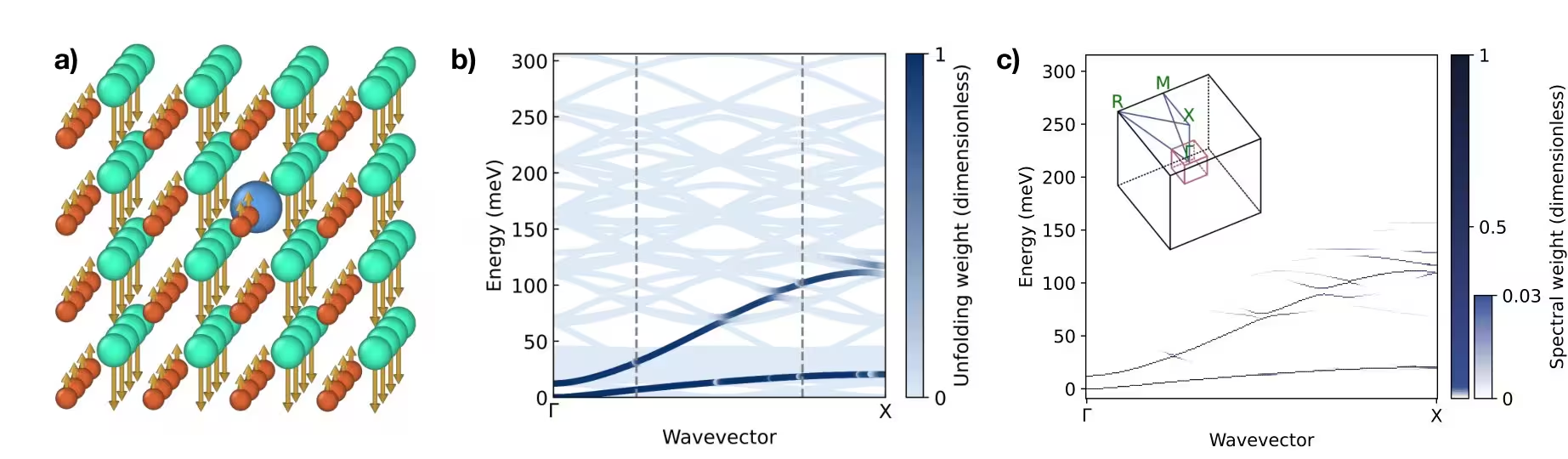
Magnons act like quantum ripples sweeping through a crystal lattice, carrying energy and information across the material. When a pristine crystal contains defects like missing atoms or dopants, these imperfections scatter the magnetic ripples and blur their defined energy states. Accurately capturing this phenomenon requires calculating how atomic positions, magnetic moment sizes, and interaction strengths intertwine across thousands of atoms.
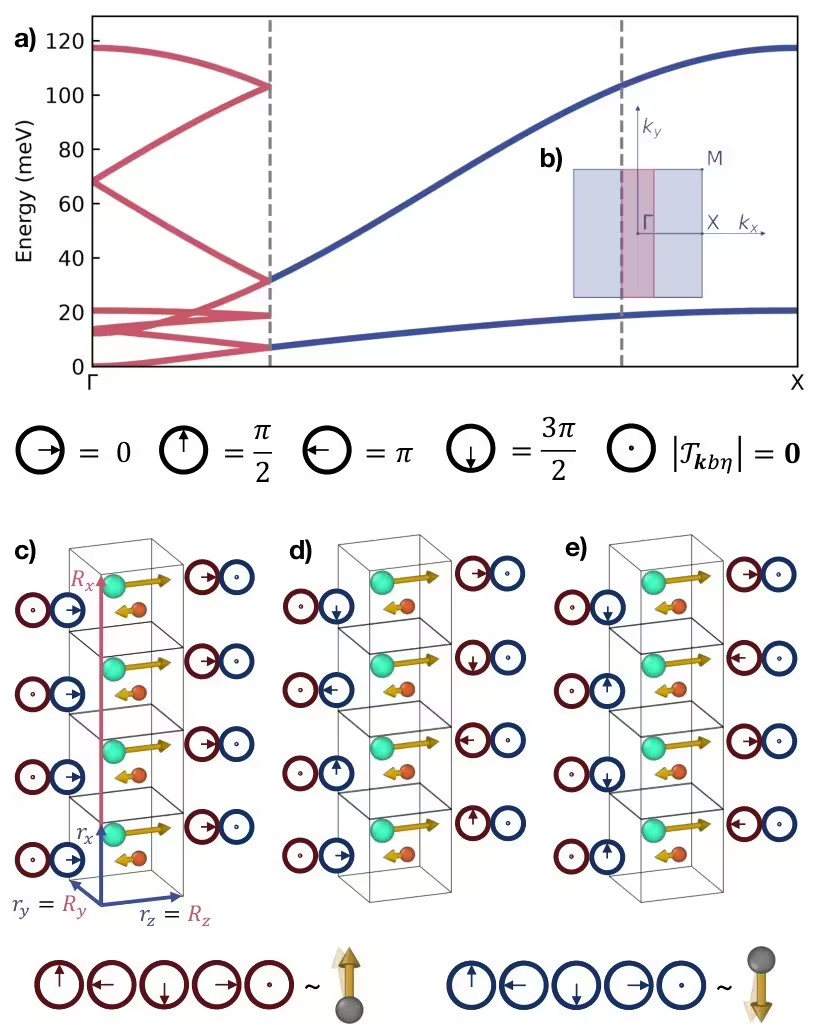
Traditional simulation methods typically assume that defects are distributed completely at random or rely on simplified approximations that ignore local atomic environments. To handle complex disordered structures without losing quantum accuracy, Moorhouse and colleagues introduced a new optimization algorithm called Coupled Optimization of SpIN Environment, or COSINE. This algorithm exploits the natural symmetry points of a crystal lattice to group equivalent atomic environments, allowing computer simulations to run up to seven times faster than conventional per-atom methods while achieving a thirty percent larger drop in energy.
Why Does Clustering Change Material Stiffness?
To test their framework, the team modeled body-centered cubic iron containing a three percent vacancy concentration under different spatial distributions. When vacancies were distributed in a completely uncorrelated random pattern, high-energy magnons suffered severe blurring, spreading out across the energy spectrum and losing their sharp definition. However, when the same number of vacancies were organized into correlated clusters following an inverse power law distribution, the magnon spectral function remained remarkably well-resolved.
The researchers also evaluated the directional spin stiffness, a key macroscopic metric related to the Curie temperature at which a material loses its magnetism. The analysis revealed that heavily clustered vacancy patterns yielded the lowest stiffness values, dropping from three hundred thirty-one down to three hundred nine milli-electronvolts squared per square angstrom. This indicates that the exact spatial pattern of disorder matters just as much as the sheer concentration of defects.
What Limits This New Computational Approach?
While the combination of machine-learned interatomic potentials and paraunitary band unfolding successfully bridges the gap between atomic defects and macroscopic observables, the method relies heavily on the accuracy of the underlying potential model. The current spin-informed machine-learning potential for iron is restricted by a finite radial cutoff of four and a half angstroms, limiting exchange interaction predictions up to sixth-nearest neighbors. Furthermore, the framework currently focuses primarily on perturbative disorder around known crystal symmetries, meaning highly amorphous or glass-like magnetic states will require further algorithmic expansion.
Where Will These Simulations Lead Next?
The ability to map out how nanoscale clustering degrades or preserves magnon coherence opens new pathways for designing advanced metallic alloys and radiation-resistant steels. Because the underlying mathematical infrastructure applies to any system governed by a full bosonic Hamiltonian, the authors note that the framework can theoretically extend beyond magnetism to study polaritons, triplons, and Bose-Einstein condensates in disordered environments.
The study was posted to the arXiv preprint server on November 25, 2026.
This article has been fact checked for accuracy, with information verified against reputable sources. Learn more about us and our editorial process.
Last reviewed on .
Article history
- Latest version
Reference(s)
- Moorhouse, Alex. “Magnons in solids with correlated atomic and nanoscale disorder.” arXiv.org <http://arxiv.org/abs/2611.34926v1>.
- Posted by Nida Rehman