New Star Model Unites Electric Fields and Modified Gravity to Explain Neutron Star Interiors
Researchers successfully simulate the extreme densities and pressures of neutron stars using a novel dual-layer core-envelope framework.
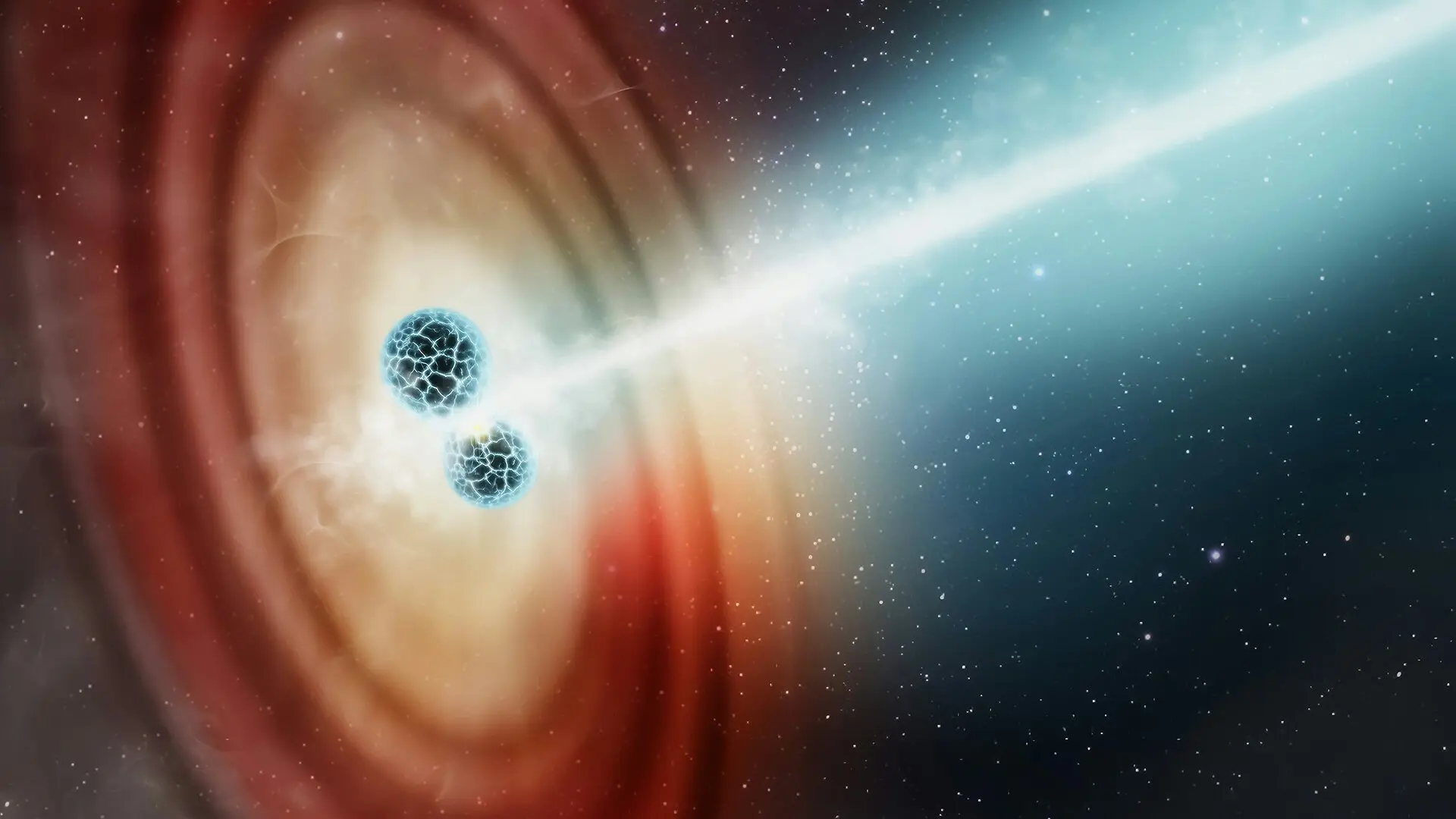
Compact neutron stars can now be modeled with unprecedented precision by blending electric fields, radiation, and modified gravity into a single framework. A team of researchers has successfully constructed a theoretical core-envelope model that accounts for the extreme pressures and densities found deep inside these stellar remnants. The new calculations reveal how anisotropic fluid pressures and curvature corrections work together to maintain stable equilibrium in ultra-dense environments.
Neutron stars represent the crushed, dead cores of massive stars that have exhausted their nuclear fuel and collapsed under their own gravity. Their interiors feature densities that far exceed ordinary matter, turning them into natural laboratories for testing the limits of physics. Previous theoretical models typically examined electric charges, fluid anisotropy, or modified gravity in isolation. By uniting these elements, the researchers aimed to build a more realistic representation of what actually happens inside a neutron star.
The study, published in PLOS One by Ayesha Khalid and colleagues from various academic institutions, focuses on two specific compact objects known as SAX J1808.4 minus 3658 and 4U 1608 minus 52. The researchers modeled the stellar interior as having two distinct zones. The deep core is treated using a polytropic equation of state, which links pressure and density in a non-linear way, while the surrounding envelope follows a simpler linear equation of state. This dual-layer approach allows the model to capture different matter properties across the star while ensuring the boundaries match up smoothly.
How Does Modified Gravity Shape the Interior of a Neutron Star?
To account for deviations from standard general relativity, the researchers incorporated the Starobinsky model of gravity, which adds a squared term of the Ricci scalar curvature to the equations. They also factored in a strong electric field generated by charge separation, where lighter electrons are pushed toward the surface while heavier ions remain behind. Radiation density and local pressure anisotropy, meaning pressures that differ in radial and tangential directions, were likewise woven into the generalized Einstein-Maxwell field equations.
When the team applied their framework to SAX J1808.4 minus 3658 with a mass of about 0.9 solar masses and 4U 1608 minus 52 with a mass of about 1.74 solar masses, they tested several physical conditions to check the model’s validity. They found that both density and pressure profiles decrease monotonically from the center outward, reaching zero at the outer boundary. The central densities reached roughly three times ten to the power of fifteen grams per cubic centimeter for both stars, accompanied by immense central radial pressures.
What Keeps These Extreme Stellar Objects From Collapsing?
A crucial test for any stellar model is whether it satisfies the laws of causality and energy conditions. The team calculated that the radial and tangential sound speeds remained below the speed of light throughout the star, satisfying standard causality requirements. Furthermore, the configurations obeyed all major energy conditions, including the null, weak, strong, and dominant energy conditions, confirming that the matter distribution remains physically realistic.
To evaluate stability against small radial perturbations, the researchers calculated the radial adiabatic index, finding it stayed above the critical threshold of four-thirds across both the core and envelope regions. Finally, the generalized Tolman-Oppenheimer-Volkoff equilibrium equation demonstrated that gravitational pull, hydrostatic pressure gradients, anisotropic forces, and electric forces balance each other out precisely to maintain a stable, static state.
While the model successfully passes these theoretical checks, the authors note that it remains restricted to static, spherically symmetric configurations using specific equations of state. Future investigations will need to explore dynamic scenarios, rotating frameworks, and alternative modified gravity theories to gain an even deeper understanding of these exotic cosmic bodies.
The research was published in PLOS One on November 24, 2026.
This article has been fact checked for accuracy, with information verified against reputable sources. Learn more about us and our editorial process.
Last reviewed on .
Article history
- Latest version
Reference(s)
- Khalid, Ayesha., et al. “Stable charged core–envelope configurations in f(R) gravity.” PLOS One, vol. 21, no. 11, November 24, 2026, pp. e0362461 Public Library of Science (PLoS), doi: 10.1371/journal.pone.0362461. <https://doi.org/10.1371/journal.pone.0362461>.
Cite this page:
- Posted by Karan Das