New Mathematical Workflow Cuts Concrete Stress Test Requirements By One Thousand Times
A novel non-intrusive computational workflow cuts structural simulation costs while accurately reconstructing skewed failure probabilities.

When engineers test the safety of concrete bridges and buildings, they rarely look at just a single predictable scenario. Two concrete pillars with identical blueprints can react differently under extreme loads due to tiny variations in material strength, steel reinforcement, and wall thickness. To capture these hidden risks, researchers usually rely on Monte Carlo simulation, a brute-force statistical method that runs thousands of computerized stress tests until a reliable risk profile emerges. That thoroughness comes at a massive computational price, often requiring days of heavy supercomputer processing for detailed structural models. Marzieh Allahyari and Masoud Soltani have now implemented an alternative workflow that slashes the required number of computer runs by up to a thousand times while still predicting structural failure rates with remarkable accuracy. published in PLOS One, their study demonstrates a modular software pipeline that pairs a mathematical shortcut called the Multiplicative Dimension Reduction Method with an advanced entropy-based probability reconstruction technique.
How Can Mathematical Shortcuts Replace Thousands of Computer Stress Tests?
Running a single nonlinear finite-element analysis, which is a computer simulation that divides a building into thousands of interconnected mathematical blocks to track cracking and yielding, can take minutes or hours. Repeating that simulation ten thousand times for a full probabilistic assessment is often too slow for everyday engineering work. The researchers bypassed this bottleneck by using a dimension-reduction strategy. Instead of sampling every random variable in every possible combination across the entire input space, the algorithm evaluates the structural model along specific one-dimensional cut lines centered around the average material properties. By taking strategic samples along these axes, the method captures how each variable affects the final outcome without needing to map the entire multidimensional grid.
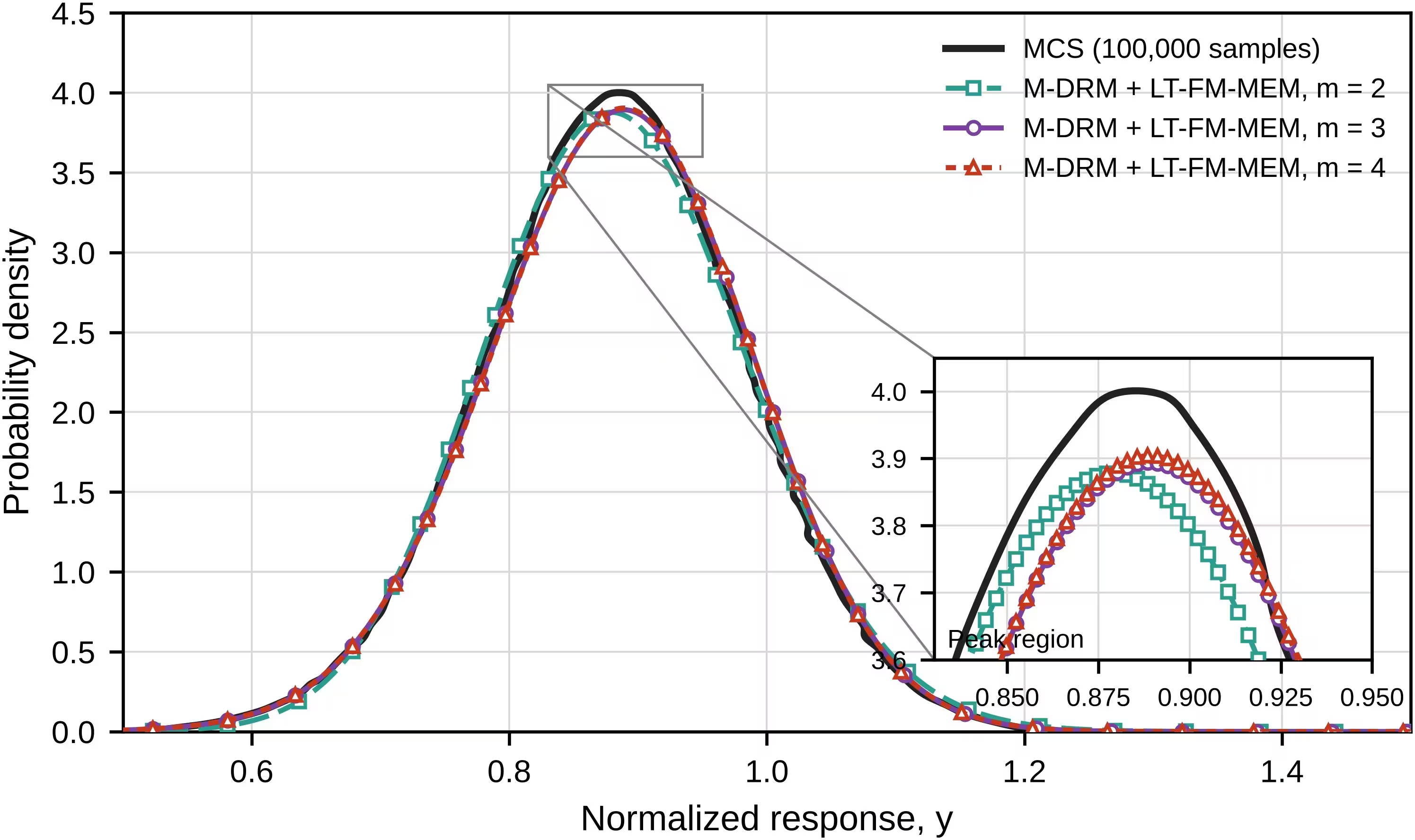
The core innovation lies in how these cut-line evaluations are stitched back together. Ordinary approximations often assume that structural responses follow a neat bell-shaped normal curve, which fails when concrete cracks and steel reinforcement yields because the resulting structural behavior becomes heavily skewed and unpredictable. To solve this, the authors integrated the Laplace-transform fractional-moment maximum entropy method. This probabilistic engine takes the limited moment data gathered from the cut-line evaluations and reconstructs the full probability density function and cumulative distribution function without forcing the data into a preconceived bell curve. Because the entire pipeline communicates with the structural solver through standard input and output files, the underlying finite-element solver requires no modifications to its source code.
What Happens When Concrete Structures Are Put to the Test?
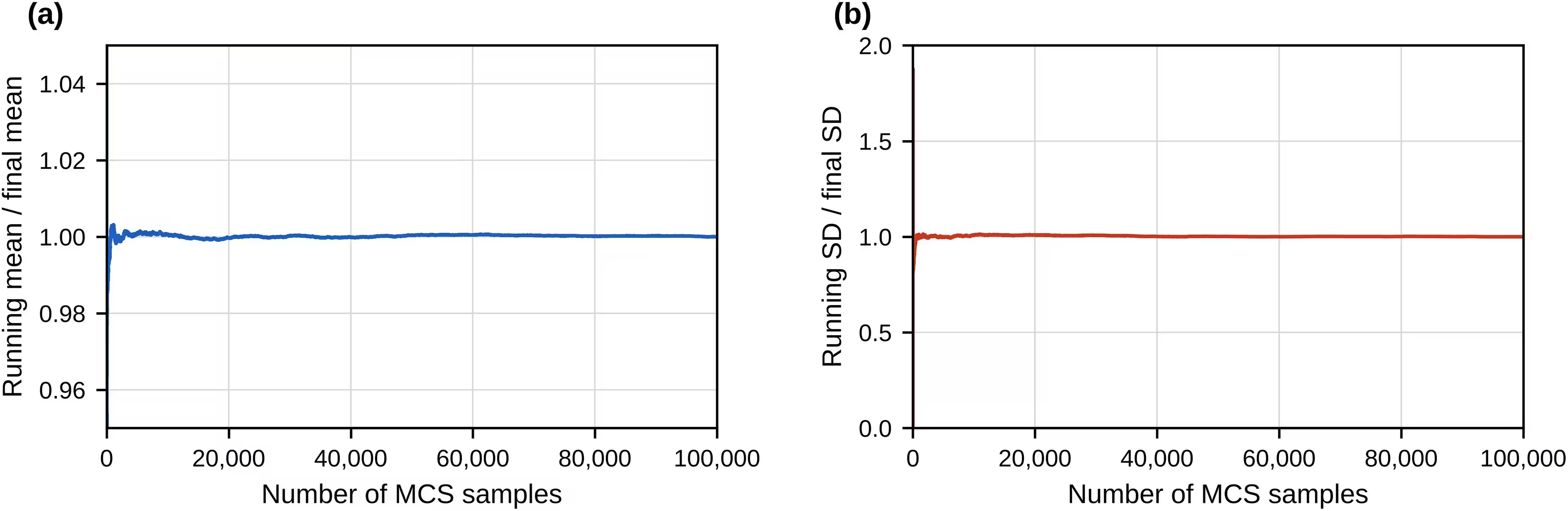
The team validated their non-intrusive workflow across three distinct structural benchmarks, starting with a simply supported I-section beam and scaling up to a reinforced-concrete cantilever column and a two-story, one-span reinforced-concrete frame known as the Vecchio-Emara frame. For the I-beam benchmark with eight random input variables, the dimension-reduction approach required only fifty-seven deterministic model evaluations compared to one hundred thousand samples for the Monte Carlo reference, representing an analysis-count reduction of about seventeen hundred times. Even with this massive drop in computational effort, the reconstructed probability distributions matched the reference curves closely, yielding a Kolmogorov-Smirnov distance of about zero point zero zero six and a ninety-fifth quantile error of under zero point three percent.
When applied to the reinforced-concrete cantilever column and the Vecchio-Emara frame, the workflow successfully tracked how material and geometric uncertainties propagate through cracking, stiffness degradation, and reinforcement yielding. The authors compared their results against First-Order Second-Moment methods, a simpler local linearization technique that often breaks down when structural stiffness changes abruptly. While the local approximation struggled to capture the skewed tails of deeply nonlinear responses, the combined dimension-reduction and maximum-entropy workflow accurately resolved the asymmetric probability distributions at large top displacements and high base-shear levels.
Which Structural Uncertainties Matter Most for Building Safety?
A major practical benefit of the new pipeline is its ability to isolate how different input uncertainties contribute to overall structural dispersion. By running separate scenarios where only concrete compressive strength, only longitudinal steel yield strength, or only member cross-section dimensions were allowed to vary, the researchers quantified the relative impact of each source. For the Vecchio-Emara frame at a controlled lateral displacement of four and a half centimeters, concrete compressive strength produced the narrowest response dispersion with a force coefficient of variation of about one point eight percent. Section dimensions produced an intermediate dispersion of about three point two percent, while steel yield strength generated the widest dispersion with a coefficient of variation reaching about four percent.
When evaluated in reverse at a fixed force level of thirty thousand kilograms of force, the resulting displacement coefficients of variation were roughly twenty-nine point six percent for concrete strength, thirty-one point three percent for section dimensions, and fifty-two point four percent for steel yield strength. These numerical differences highlight that once a reinforced-concrete frame cracks and enters the post-yield range, the variability of the reinforcing steel dominates the global response. The authors emphasize that this ranking is case-specific to the tested frame geometry and loading protocol, yet the workflow itself provides a general tool for structural engineers to determine which material parameters require the most rigorous laboratory testing.
What Are the Current Limits of This Probabilistic Approach?
Despite its efficiency, the method relies on several baseline assumptions that bound its practical applicability. The probabilistic formulation assumes that basic input variables are mutually independent unless bound by established physical equations, meaning that complex statistical correlations between material properties are not explicitly modeled. Furthermore, the current study focused strictly on static monotonic loads, leaving cyclic degradation, seismic ground motions, and dynamic collapse path dependence for future research. The authors note that dimension-reduction approximations can lose accuracy if a structure exhibits highly non-monotonic behavior or sudden failure-mode switching where cut-line assumptions break down. Nevertheless, the workflow provides an efficient bridge between expensive full simulations and practical reliability-based design.
The research was published in PLOS One on November 24, 2026.
This article has been fact checked for accuracy, with information verified against reputable sources. Learn more about us and our editorial process.
Last reviewed on .
Article history
- Latest version
Reference(s)
- Allahyari, Marzieh., et al. “An efficient framework for uncertainty propagation in nonlinear reinforced concrete analysis using multiplicative dimension reduction and laplace-transform maximum entropy.” PLOS One, vol. 21, no. 11, November 24, 2026, pp. e0362859 Public Library of Science (PLoS), doi: 10.1371/journal.pone.0362859. <https://doi.org/10.1371/journal.pone.0362859>.
Cite this page:
- Posted by Rabia Shah