X-Ray Scans Reveal How Mineral Dehydration Drives Sudden Fault Embrittlement
Real-time imaging shows that crystallizing mineral networks can trigger brittle fault failure without requiring trapped water pressure.
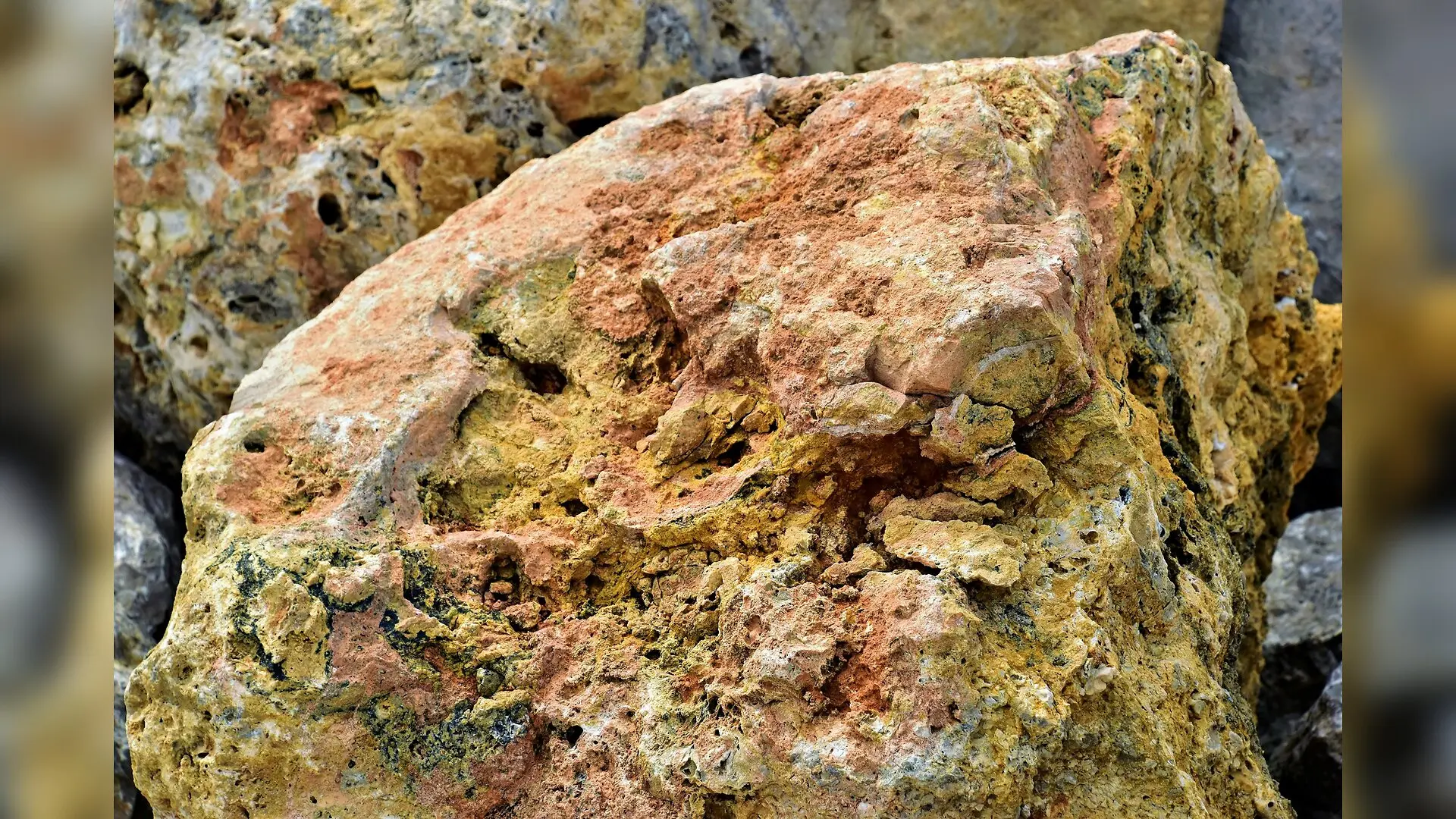
When underground mineral rocks lose their trapped water under extreme heat and pressure, they undergo a structural transformation that shifts their behavior from smooth, flowing creep to sudden brittle fracture. Researchers tracking this process in real time have discovered that the changing physical framework of the rock itself, rather than just rising water pressure, drives this violent mechanical shift. The findings offer a fresh look at how deep geological faults lock up and trigger seismic activity.
Earth scientists have long debated why dehydrating fault zones experience sudden embrittlement, which many models attribute strictly to an accumulation of trapped pore water pushing outward. To test how mineral replacement alters a shearing fault zone under controlled conditions, Nick Harpers and colleagues at RWTH Aachen University conducted a high-resolution direct shear experiment published in Nature Communications. The team compressed a cohesive powder paste made of gypsum and water between aluminum sliders to simulate a natural fault gouge inside a specialized X-ray transparent triaxial apparatus.
How Does Mineral Dehydration Transform a Shearing Fault Zone?
The research team utilized time-resolved synchrotron-based microtomography, capturing three-dimensional X-ray scans roughly every fourteen minutes alongside high-resolution imaging to monitor microstructural changes. As the temperature inside the apparatus stepped up from sixty to one hundred fifteen degrees Celsius, the gypsum began to dehydrate, transforming into a mineral known as hemihydrate while constantly shearing at a rate of zero point two micrometers per second. Using digital volume correlation, a technique that tracks gray-level textures across volumetric scans to measure internal displacement and strain, the researchers mapped how the deforming material responded to the chemical change.
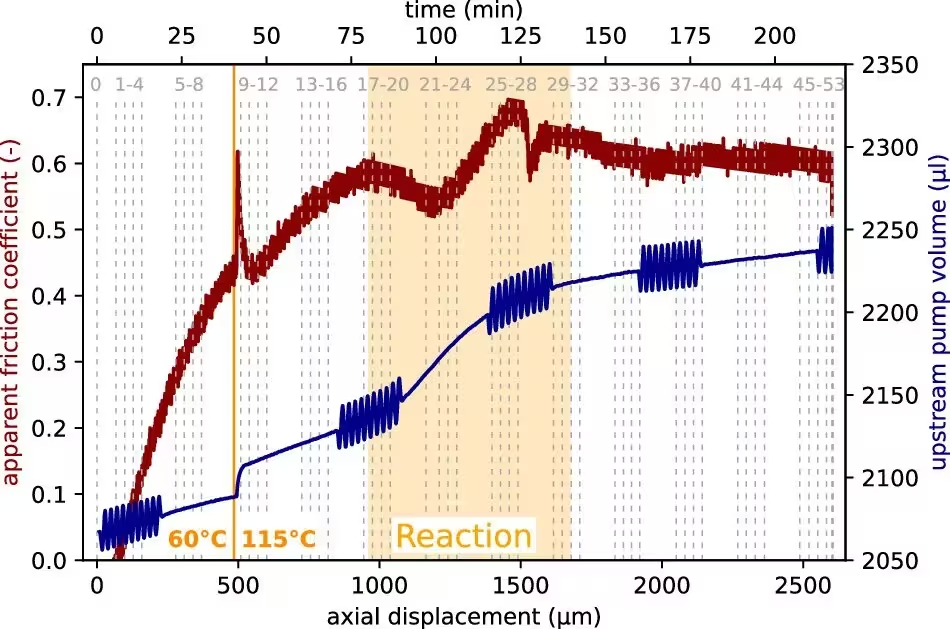
Before heating, the saturated gypsum gouge accommodated displacement uniformly across its entire three-millimeter thickness through distributed granular flow. Once the temperature increase triggered the chemical reaction, however, gypsum grains were progressively replaced by elongated hemihydrate needles and new pore space. These microscopic needles interlocked to form a stiff, load-bearing framework that suppressed granular slip and increased the overall stiffness of the sample. Strain no longer distributed evenly, instead concentrating within the remaining weaker gypsum ahead of the advancing reaction front.
What Happens When the Reaction Front Reaches the Boundary?
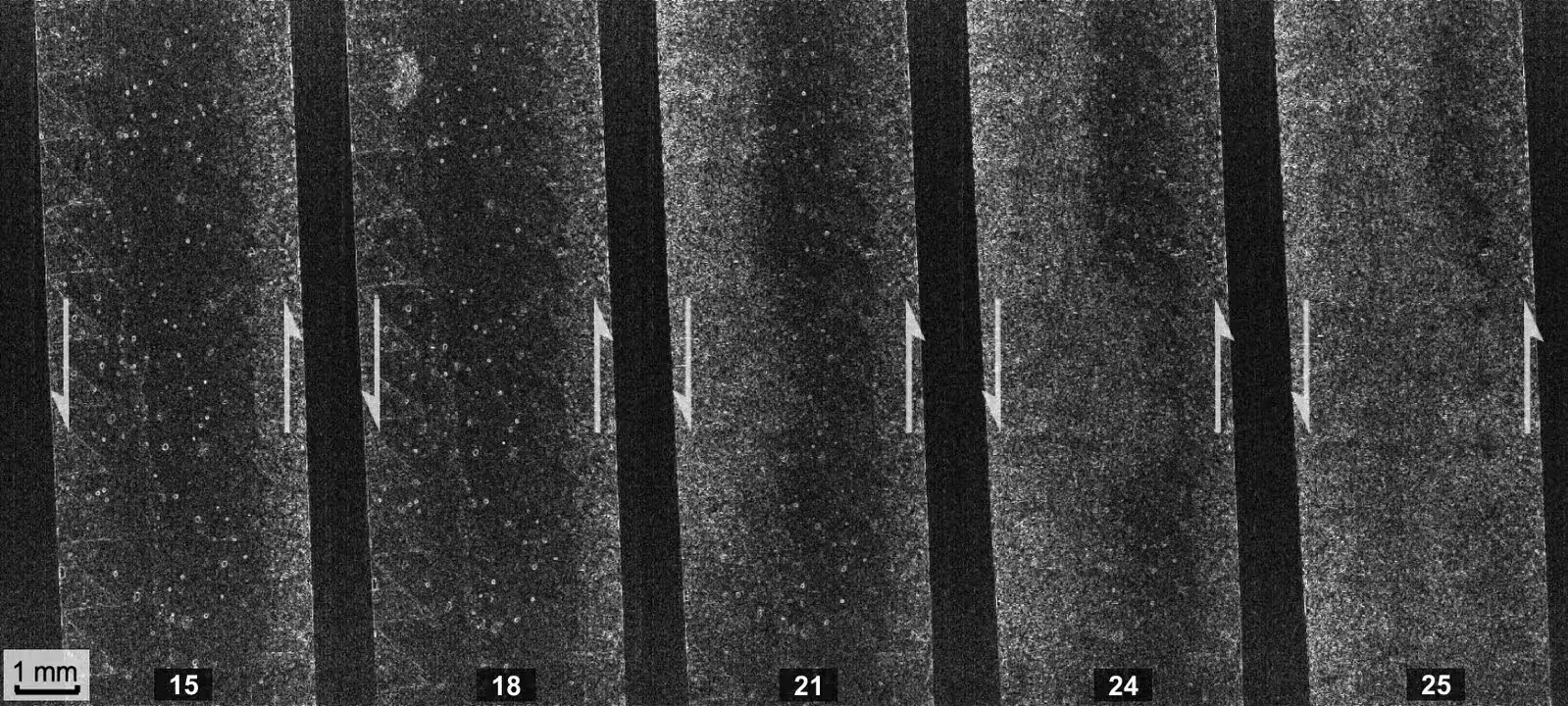
As the transformation front propagated across the gouge layer toward the stationary slider, the system underwent a major rheological transition. The newly formed hemihydrate framework began to lock against the relative movement of the sliders, focusing stress into the rigid mineral skeleton until it could no longer accommodate shear smoothly. Instead of flowing, the framework failed through discrete fracturing of the needle crystals and localized pore collapse, developing a throughgoing shear band inclined at an angle of roughly thirty degrees to the shear plane.
The high-resolution strain data revealed that these early fractures exhibited net dilational volumetric strain, meaning they opened parallel to the shear direction while closing perpendicular to it. With ongoing displacement, deformation subsequently transferred to a slider-parallel compaction band that accommodated most of the final slip. Despite the drained boundary conditions of the experiment, which prevented large fluid overpressures from building up, the material still suffered pronounced embrittlement and localization. The observations suggest that mineral replacement alone is sufficient to drive fault rocks from stable creep into brittle failure.
Why Do These Microscopic Shifts Matter for Deep Earthquakes?
While the experiments used gypsum as a laboratory analog, the physical mechanisms observed carry broad implications for natural fault zones in subduction settings where water-rich serpentine minerals break down at depth. In those tectonic environments, the release of structurally bound water is widely thought to trigger intermediate-depth earthquakes through dehydration embrittlement. The new data indicate that fluid-pressure buildup and structural framework reorganization operate simultaneously in nature, providing multiple pathways from stable sliding to seismic rupture.
The authors note that the mechanical consequences depend heavily on how rapidly the reaction progresses relative to ongoing deformation. Slow dehydration allows stress to dissipate uniformly within weaker mineral phases, whereas rapid reaction progress favors sharp strain localization and stress concentrations within stiffer frameworks. By directly visualizing these dynamics in four dimensions, the study bridges the gap between chemical reactions and macroscopic fault mechanics, refining how geologists understand the hidden triggers of deep tectonic instability.
The research was published in Nature communications on November 20, 2026.
This article has been fact checked for accuracy, with information verified against reputable sources. Learn more about us and our editorial process.
Last reviewed on .
Article history
- Latest version
Reference(s)
- Harpers, Nick., et al. “A framework-driven pathway to dehydration embrittlement in gypsum fault gouge.” Nature Communications, vol. 17, no. 1, November 20, 2026 Springer Science and Business Media LLC, doi: 10.1038/s41467-026-79093-5. <https://doi.org/10.1038/s41467-026-79093-5>.
Cite this page:
- Posted by Michael Ellison