Bird Communities With Higher Species Diversity Share Richer Predator Warnings
Controlled playback experiments and field surveys across China reveal that richer animal communities significantly amplify life-saving public information.

When forest bird communities grow more diverse, their alarm calls and anti-predator warnings become louder and richer, revealing that biodiversity directly powers the flow of life-saving information across different species. A comprehensive field and experimental study shows that mixed-species communities do not merely hoard survival skills, but actively amplify public warnings when more animal neighbors are present to share what they know. The research, carried out across vast geographic and habitat gradients in China, bridges a long-standing gap between classical plant ecology and modern behavioral science.
How Does Animal Biodiversity Shape Forest Communication Networks?
For more than thirty years, ecologists have studied the relationship between species variety and ecosystem health using the framework of Biodiversity-Ecosystem Functioning. Most of this literature has focused on grassland plants, demonstrating that communities with high species variety achieve greater productivity and stability because different species complement one another and reduce direct competition. Until recently, however, this principle had rarely been tested on behavioral ecology or the invisible networks of information that animals rely on to navigate daily threats. Researchers wanted to know if having more species around also means sharing better, faster public warnings about approaching predators.
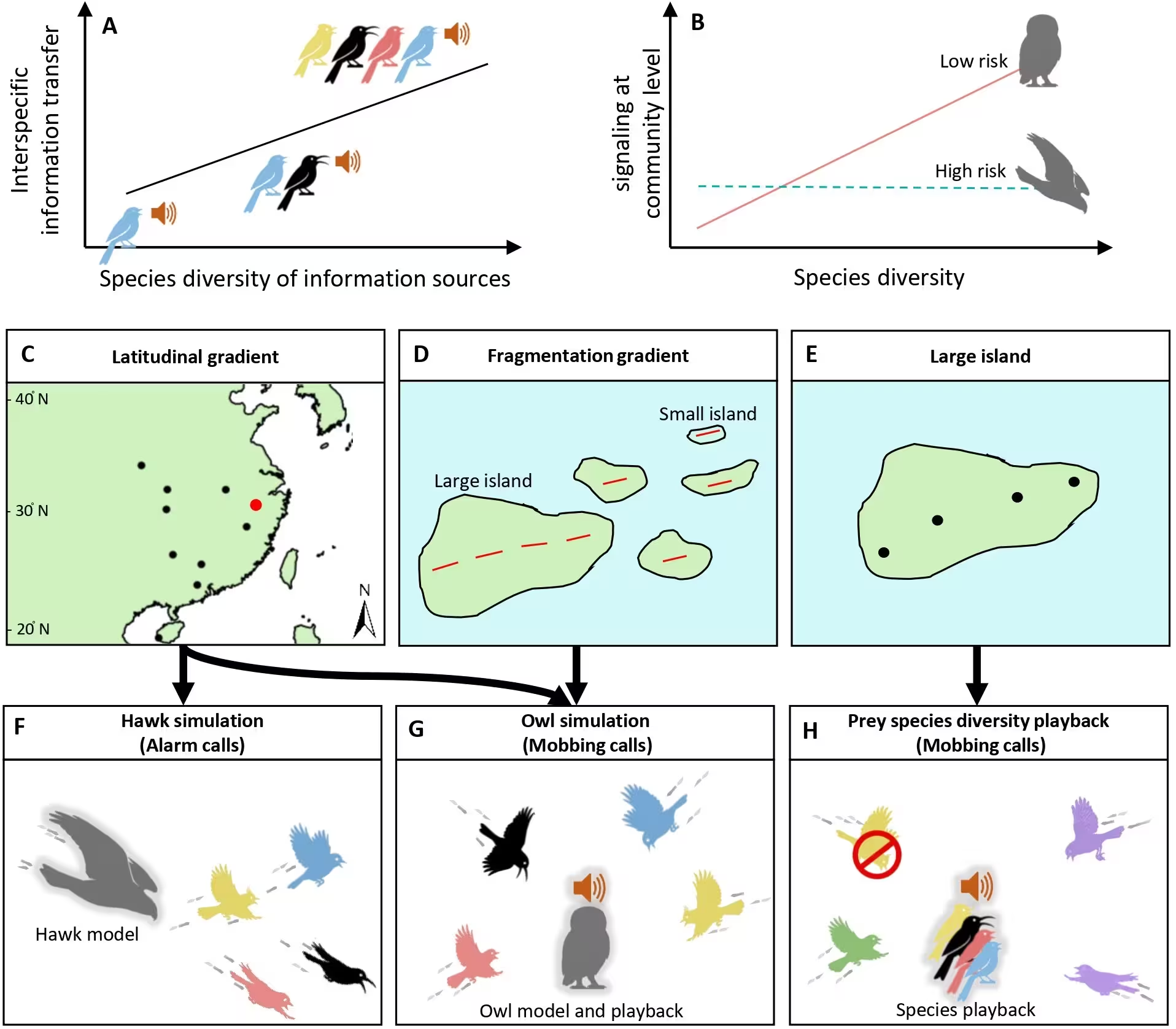
To find out, a team led by scientists from Xi’an Jiaotong-Liverpool University and other institutions set out to measure how bird communities react to simulated predators. As detailed in a study published in PLOS Biology, the authors explored two distinct environmental gradients. The first was a sprawling latitudinal transect spanning one thousand six hundred and fifty kilometers from tropical biomes in Hainan to temperate forests in Shaanxi. The second was a forest fragmentation gradient located in the Thousand Island Lake reservoir system in Zhejiang Province, where islands vary widely in total land area and resident species counts.
What Happens When Scientists Trigger Predator Alarms in the Wild?
Across more than two years of intensive fieldwork, the team conducted hundreds of predator simulation trials using lifelike models of dangerous raptors and owls. To test high-risk scenarios, they used a slingshot to propel a plastic hawk model toward mixed-species bird flocks, recording the rapid and subtle alarm calls that cause flock members to scatter. To test low-risk scenarios, they placed stationary models of the Collared Owlet, a small tree-dwelling owl, alongside audio playbacks of its calls, prompting birds to gather and harass the perceived threat in a collective defense behavior known as mobbing.
The observational data revealed a striking pattern across both spatial gradients. As species richness increased in a given location, nearly all measured response variables increased as well. In mobbing assemblages, more diverse sites exhibited a higher number of vocalizing species, more participating individual birds, greater call rates, faster response latencies, and broader acoustic frequency ranges. Even in high-risk alarm contexts, where overall calling rates were roughly ten times lower and heavily dominated by a nuclear flock leader called Huet’s Fulvetta, higher species diversity still correlated positively with more vocal species and broader frequency ranges.
Can Playback Experiments Prove That More Species Mean Better Warnings?
Observing correlations in the wild is one thing, but proving causation requires direct experimentation. To test whether species diversity truly drives information flow, the researchers conducted a massive manipulative playback experiment on the largest island in the Thousand Island Lake reservoir. They selected the eight most frequent mobbing species from their earlier surveys and constructed audio exemplars containing one, two, four, or eight species calling together. To separate different underlying mechanisms, they built these playback files using two distinct methods. In standardized trials, the total call rate was held constant at one hundred and four calls per minute regardless of species count. In non-standardized trials, the overall call rate naturally increased as more species were added to the mix.
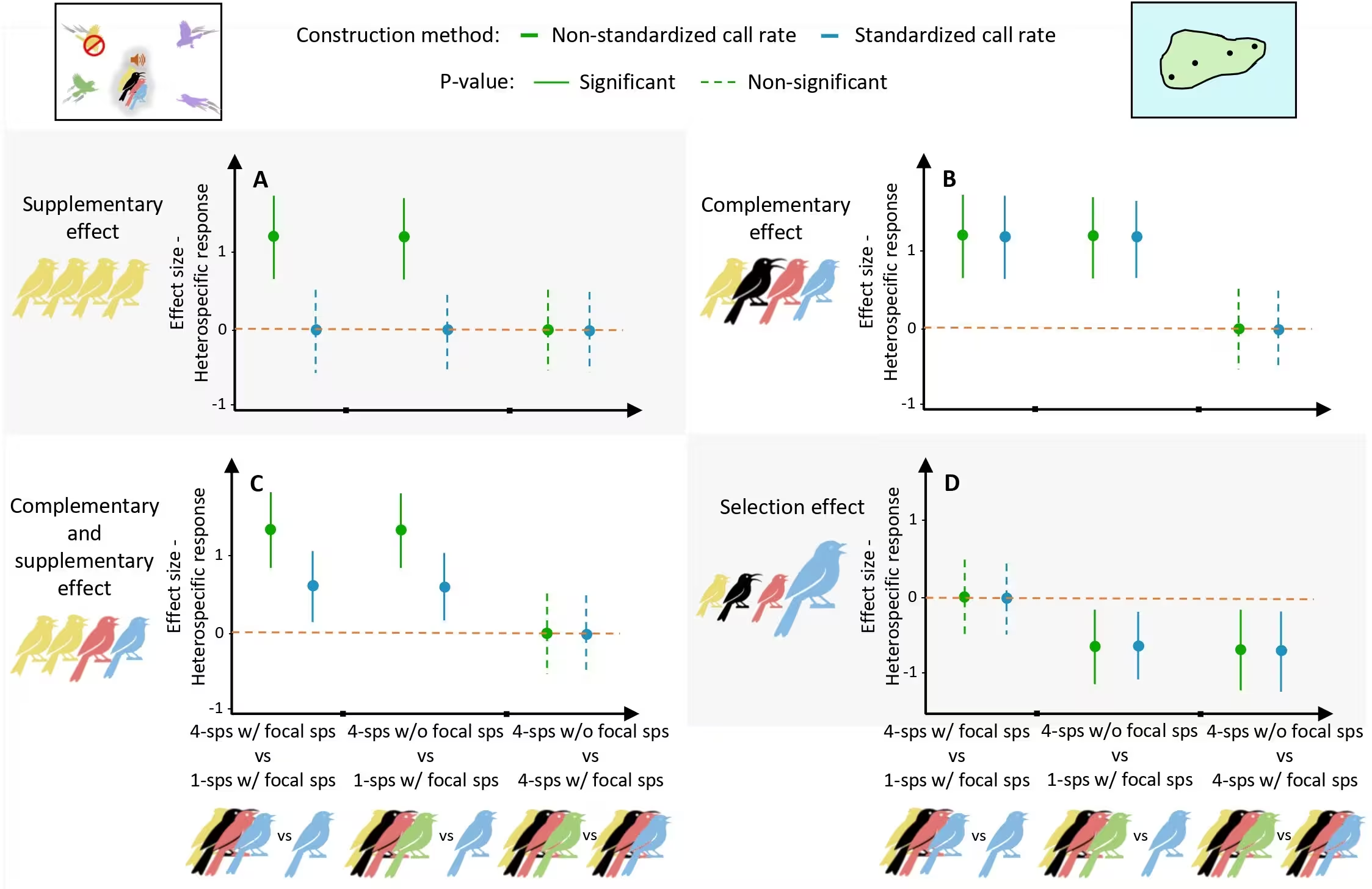
The playback trials demonstrated that increasing species richness significantly strengthens interspecific information transfer. When listening to more diverse acoustic cues, bird communities responded with more vocal species, higher individual participation, and wider frequency ranges. Furthermore, the non-standardized trials showed that higher call rates boosted responses even further at higher species richness levels, pointing to a combination of complementary acoustic properties and supplementary signaling quantity.
What Are the Limits of These Findings for Conservation Science?
The team found very little evidence for a selection effect, meaning that the increased information flow was not simply driven by the presence of a single keystone informant species. Instead, the results support both complementarity, where diverse acoustic traits broadcast warnings to a wider audience of listeners, and supplementary effects, where more animals simply generate more collective noise. The authors emphasize that these findings carry urgent implications for conservation biology. In fragmented landscapes where human activity strips away local wildlife, remaining animals lose their vital social information networks. Without reliable public warnings, creatures are forced to rely on personal exploration, which drains precious energy and exposes them to greater predation risk.
The research was published in PLOS Biology on November 24, 2026.
This article has been fact checked for accuracy, with information verified against reputable sources. Learn more about us and our editorial process.
Last reviewed on .
Article history
- Latest version
Reference(s)
- Kumar, Agnishikhe., et al. “Species diversity increases information flow about predation in bird communities.” PLOS Biology, vol. 24, no. 11, November 24, 2026, pp. e3003805 Public Library of Science (PLoS), doi: 10.1371/journal.pbio.3003805. <https://doi.org/10.1371/journal.pbio.3003805>.
Cite this page:
- Posted by Vikram Desai