Diver Finds 30,000 Ancient Roman Coins That Could Lead to a Lost Shipwreck
Archaeologists have unearthed a massive, historically significant hoard of ancient coins off the coast of Sardinia, though their origins remain a mystery.
A routine dive near the seagrass meadows off the coast of Arzachena, Sardinia, transformed into a major archaeological event when a recreational diver noticed a metallic shimmer on the seabed. What began as a singular observation led to the recovery of a massive cache of late Roman bronze coins, estimated to number between 30,000 and 50,000 pieces. Nearly three years after the initial discovery on May 25, 2023, the hoard remains the subject of ongoing analysis, legal scrutiny, and unresolved questions regarding its historical origin.
An Exceptional Numismatic Cache
The sheer volume of the discovery has drawn significant attention from cultural authorities. Italy’s ministry of culture has classified the find as one of the most significant numismatic recoveries in recent years, noting that the coins are in an unusually well-preserved state despite centuries of submersion. As Luigi La Rocca, the director general of archaeology, fine arts, and landscape for the region, noted in an official statement, the find underscores the vast historical treasures still hidden within the Mediterranean seafloor.
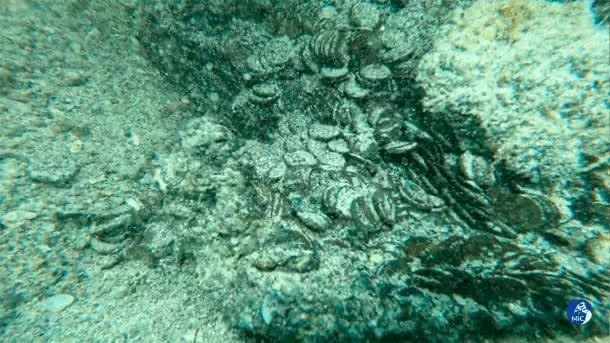
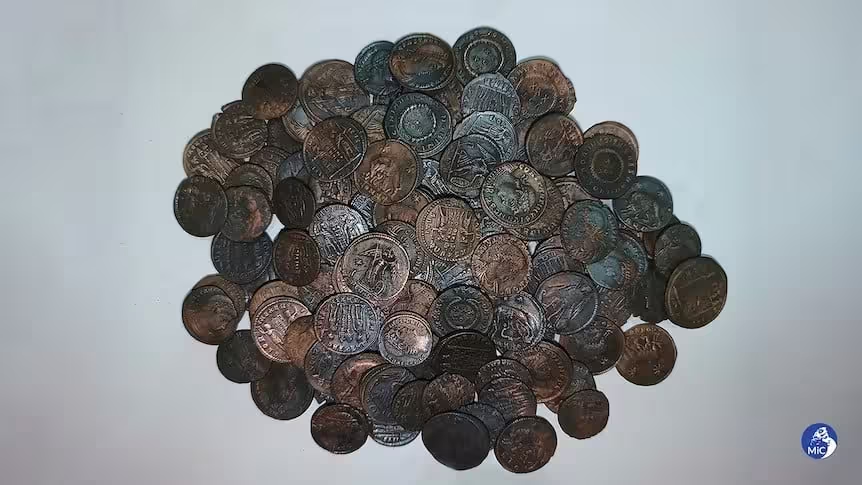
The artifacts, identified as Roman folles, date back to the early 4th century CE. While initial estimates placed the currency within a 324 to 340 CE timeframe, further analysis conducted in Sassari in December 2023 refined this, suggesting the coins were deposited no later than 345 CE. The exceptional condition of the bronze pieces has provided researchers with a unique opportunity to study the circulation of currency during the transition between the Roman and Byzantine eras.
Lingering Mysteries of the Seafloor
The scattered distribution of the coins across two distinct underwater zones, accompanied by fragments of Roman amphorae, strongly suggests the remains of a shipwreck. However, investigators have yet to confirm this hypothesis, and a formal scientific publication detailing the wreck site has not been released. The absence of a definitive structural link between the coins and a hull means that the maritime disaster theory remains a compelling, though currently unproven, interpretation of the site.
Legal Disputes and Public Exhibition
Beyond the archaeological implications, the discovery has triggered complex legal challenges. On January 5, 2026, the TAR Sardegna regional court rejected a claim for a finder’s reward submitted by the diver. The presiding judges determined that the use of a metal detector in an area already designated as an archaeological protection zone invalidated the legal requirements for a “chance discovery.”
Despite previous indications that portions of the collection would be moved to the civic museum in Arzachena for public display, the artifacts remain largely inaccessible as of mid-2026. While the hoard represents a significant chapter in Sardinian history, the administrative and scientific processes surrounding its preservation and display continue to unfold.
“The finding highlights the richness and importance of the archaeological heritage that our seabed, traversed by men and goods since the earliest times, still guards and preserves,” stated La Rocca.
This article has been fact checked for accuracy, with information verified against reputable sources. Learn more about us and our editorial process.
Last reviewed on .
Article history
- Latest version
Reference(s)
- “Luigi La Rocca dirigera la Direction générale de l'archéologie, des beaux-arts et du paysage et la Surintendance du PNRR..” <https://www.finestresullarte.info/fr/actualites/luigi-la-rocca-dirigera-la-direction-generale-de-l-archeologie-des-beaux-arts-et-du-paysage-et-la-surintendance-du-pnrr>.
- “Archeologia, scoperto in Sardegna enorme deposito di monete del IV secolo d.C..”, November 4, 2023 Ministero per i Beni e le Attività culturali e per il Turismo <https://cultura.gov.it/comunicato/25470>.
Cite this page:
- Posted by Vikram Desai