Why Traditional Ocean Wave Models Might Be Missing A Crucial Memory Effect
A newly derived equation shows that dampening forces and wave interactions are intertwined through a memory term, offering better stability for marine forecasts.

Ocean surface waves undergo a constant struggle between energy inputs like wind, energy redistribution through nonlinear interactions, and dampening forces like whitecapping or sea-ice friction that can span over three hundred meters in peak wavelength. For decades, computer models forecasting sea states have treated these energy-draining factors as independent add-ons happening separately from wave-to-wave interactions. Now, a team of researchers from the University of East Anglia, the University of Huddersfield, the Technion, and the GSI Helmholtzzentrum fuer Schwerionenforschung has rigorously derived a new equation showing that dampening and nonlinear energy exchanges are actually deeply intertwined through a persistent memory effect.
Writing in a study available on the arXiv preprint server, Rhys Ransome and colleagues point out that traditional ocean wave models rely on an additive approach where damping terms are simply tacked onto conservative wave equations. To test whether this separation holds up under scrutiny, the authors started from the fundamental equations of weakly nonlinear water waves, which describe how ocean surfaces evolve across distances of several wavelengths over periods of about fourteen seconds. By deriving a generalized kinetic equation that rigorously couples external damping with nonlinear wave interactions from the very beginning, the team uncovered an exponential memory term that controls how past states fade away under the influence of dissipation.
How Does Memory Reshape the Frequency Spectrum of Ocean Waves?
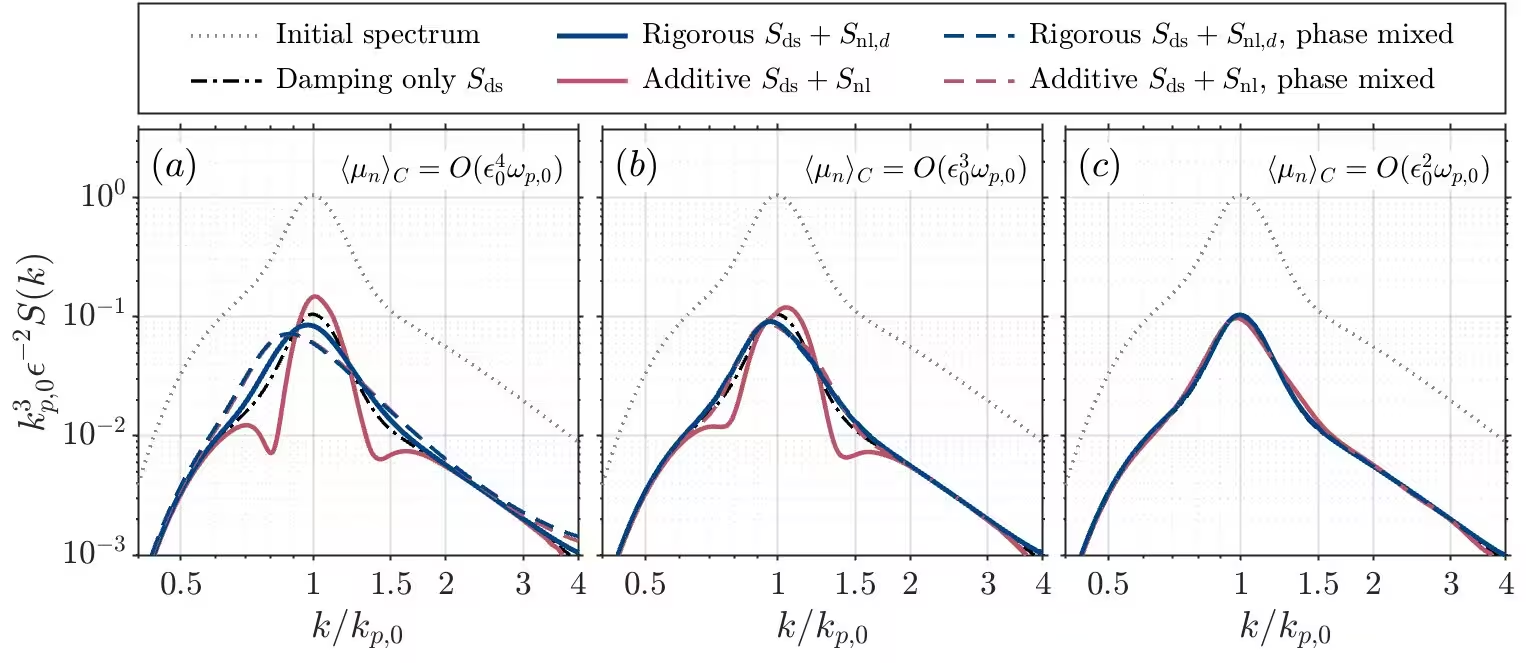
When the researchers ran numerical simulations using one thousand and twenty-four discrete wave modes across a finite domain, they discovered that the newly derived formulation does not significantly alter total wave-energy dissipation compared to older models. However, it creates a noticeable difference in how energy is distributed across various wave frequencies, particularly under weak damping conditions. Traditional additive formulations often generate unphysical, multiply peaked spectra with sharp local minima unless artificial adjustments are introduced. By contrast, the rigorously derived damping term produces a broader spectrum with a lower peak and smoother transitions.
The study reveals that this smoothing behavior stems from a memory integral that naturally incorporates an exponential decay factor governed by the damping rate. In older models, the lack of this dissipative correction in the nonlinear term forces researchers to use ad hoc fixes like periodic phase-mixing to prevent numerical blow-ups. Phase-mixing involves artificially resetting wave phase correlations every fifty peak periods, a technique that mimics the de-correlating effects of real-world wave breaking but alters the resulting spectral evolution. The team found that their new equation maintains robust numerical stability without requiring such artificial fixes, pointing toward a cleaner way to simulate complex marine environments.
What Happens When Damping Varies Across Different Frequencies?
The team also tested their equation against more realistic scenarios where energy dissipation depends strongly on wave frequency, such as when waves propagate into marginal ice zones where damping scales with the square of the radian frequency. Under these frequency-dependent conditions, traditional additive models produced severe gaps in wavenumber space and erratic spectral spikes. The new generalized kinetic equation avoided these unphysical behaviors, yielding stable, continuous energy distributions that matched expected physical regimes much more closely.
While the current work focuses on damping rather than wind forcing, the authors suggest that implementing these consistently derived kinetic equations could greatly improve operational marine forecasts and coupled Earth system models. By removing the need for arbitrary numerical stabilizers, researchers can better capture the subtle interplay between energy loss and nonlinear wave coupling in extreme weather and polar regions.
The study was posted to the arXiv preprint server on November 24, 2026.
This article has been fact checked for accuracy, with information verified against reputable sources. Learn more about us and our editorial process.
Last reviewed on .
Article history
- Latest version
Reference(s)
- Ransome, Rhys. “A consistent generalised kinetic equation for damped ocean waves.” arXiv.org <http://arxiv.org/abs/2611.32589v1>.
Cite this page:
- Posted by Vikram Desai