Adding Specific Antirheumatic Drugs to Methotrexate Therapy Correlates With Elevated Lung Disease Risk
An analysis of healthcare records reveals that certain secondary medications added after initial methotrexate treatment are linked to higher rates of lung inflammation.
Patients with rheumatoid arthritis who added specific immune-modulating drugs to their initial methotrexate therapy experienced a higher cumulative incidence of lung inflammation and scarring compared to matched control groups. Rheumatoid arthritis is a chronic autoimmune disease characterized by painful joint destruction that can also trigger severe systemic complications, including interstitial lung disease, a condition involving dangerous inflammation and fibrotic lesions in the lung tissue. While methotrexate serves as the standard first-line treatment, physicians frequently prescribe secondary disease-modifying antirheumatic drugs when initial therapy proves insufficient to control joint symptoms. Because these secondary medications modulate the immune system in different ways, researchers have long debated whether adding them to a treatment regimen alters pulmonary safety for vulnerable patients.
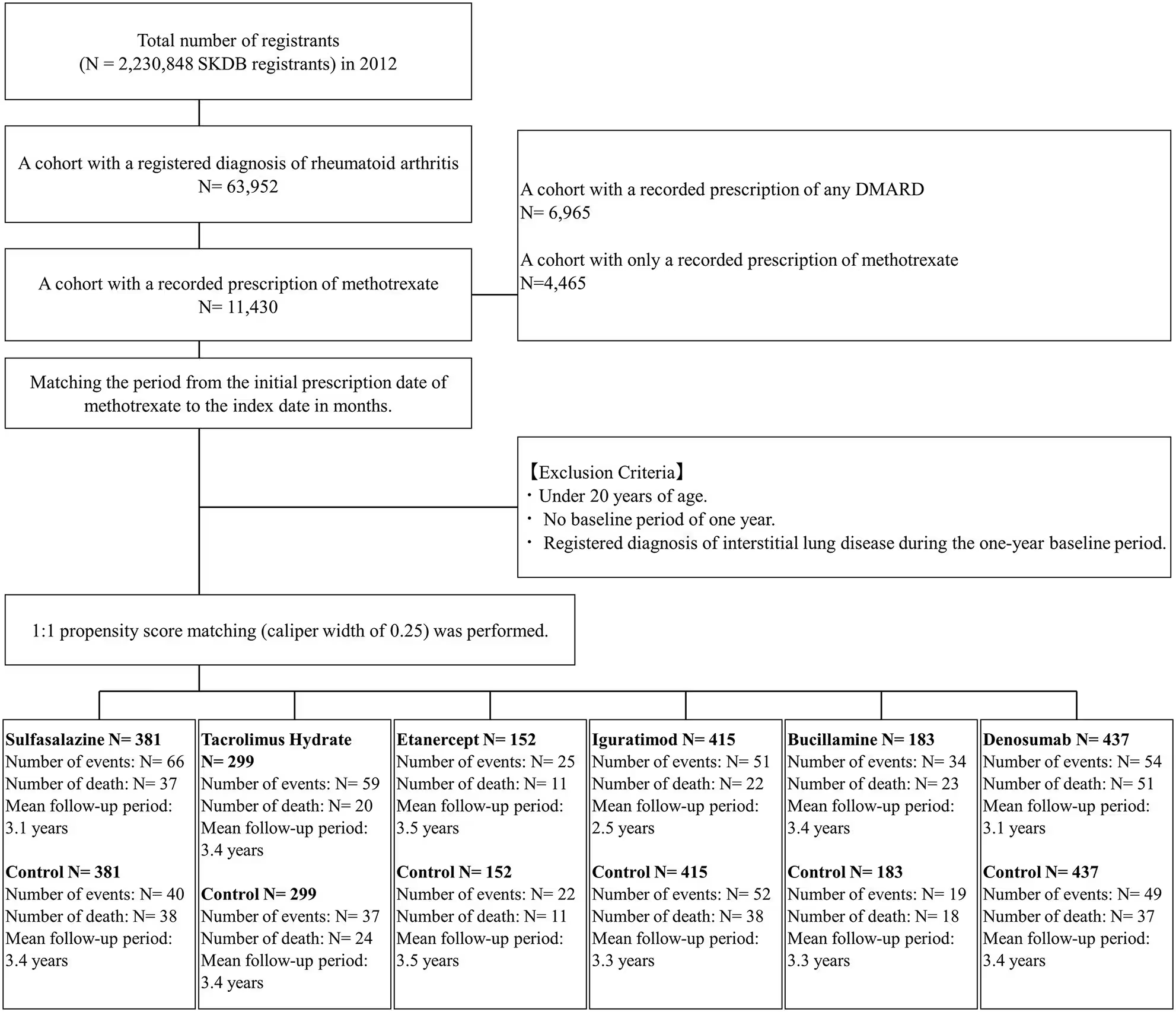
To investigate these long-term risks, a team of researchers led by Daito Funaki at the Shizuoka Graduate University of Public Health analyzed administrative healthcare records covering millions of residents in Japan. The study evaluated data from the Shizuoka Kokuho Database, focusing on adults diagnosed with rheumatoid arthritis who had begun methotrexate therapy. Because patients starting methotrexate naturally differ from those who do not, the team utilized a prevalent new-user design combined with propensity score matching to establish balanced comparison groups. This approach allowed the investigators to track thousands of patients over time while controlling for confounding variables such as age, sex, pre-existing medical conditions, and concurrent medication histories. Full details of the statistical models and database parameters are available in the open-access report published in PLOS One.
Which secondary antirheumatic medications showed elevated lung disease associations?
The retrospective analysis examined the six most commonly prescribed secondary agents added after methotrexate initiation, which included sulfasalazine, tacrolimus hydrate, etanercept, iguratimod, bucillamine, and denosumab. Among these, the addition of sulfasalazine, tacrolimus hydrate, or bucillamine was associated with a statistically significant increase in the cumulative incidence of claims-defined interstitial lung disease during the follow-up period. Specifically, sulfasalazine treatment yielded a one-year cumulative incidence of about eight percent compared to roughly four percent in its matched control group. Similar elevations appeared for tacrolimus hydrate and bucillamine, pointing to distinct patterns following the initiation of these specific compound combinations.
Conversely, patients who added etanercept, iguratimod, or denosumab did not display elevated cumulative incidence rates when compared against their respective control groups. Furthermore, when the researchers restricted their evaluation strictly to diagnoses specifically coded as drug-induced interstitial lung injury, the absolute event counts remained very low across all evaluated medications. This disparity suggests that the broader lung disease events observed in the data may stem from a complex mix of underlying disease severity, patient vulnerabilities, and systemic inflammatory processes rather than direct chemical toxicity from the drugs alone.
What limitations affect the interpretation of these real-world healthcare records?
While the findings provide important real-world safety signals, the authors emphasize that observational claims data cannot establish a direct causal link between specific secondary drugs and lung damage. Because the database relies on monthly administrative billing codes rather than detailed clinical charts, researchers could not independently verify pulmonary imaging findings or assess patient-specific factors like smoking status and precise autoantibody profiles. Additionally, the study design defined exposure groups at the index date without tracking subsequent medication changes, meaning that cumulative drug exposure and dosage variations over time were not fully integrated into the final risk calculations.
The team also noted that supplementary analyses involving oral prednisolone revealed a higher incidence of lung complications among patients receiving glucocorticoids, highlighting the persistent challenge of confounding by indication, where sicker patients inherently receive more intensive drug combinations. Consequently, the authors caution that these findings should be interpreted as exploratory evidence to guide future safety hypotheses rather than definitive proof of pulmonary toxicity. Prospective clinical studies incorporating direct radiological evaluations and continuous monitoring of disease activity will be necessary to better understand how combination therapies influence long-term respiratory health in autoimmune patients.
The research was published in PLOS One on November 24, 2026.
This article has been fact checked for accuracy, with information verified against reputable sources. Learn more about us and our editorial process.
Last reviewed on .
Article history
- Latest version
Reference(s)
- Funaki, Daito., et al. “Add-on DMARDs and interstitial lung disease in methotrexate-treated rheumatoid arthritis: A prevalent new-user design study using a large regional Japanese claims database.” PLOS One, vol. 21, no. 11, November 24, 2026, pp. e0363451 Public Library of Science (PLoS), doi: 10.1371/journal.pone.0363451. <https://doi.org/10.1371/journal.pone.0363451>.
Cite this page:
- Posted by Bilal Abbasi