New Magnetic Nanocomposite Cleans Food Extracts to Track 17 Herbicides at Once
A reusable graphene oxide material simplifies the detection of trace agricultural chemicals in complex fruits and vegetables.
A newly developed magnetic nanocomposite cleaner can strip away stubborn interferences from pigment-rich squash leaves, lipid-rich avocados, and sugar-rich mangoes to track 17 different herbicide residues at once. The reusable material offers a greener way to screen everyday produce for trace agricultural chemicals without generating mountains of laboratory waste.
Agricultural herbicides such as triazines and phenylureas protect crops from weeds and secure food yields, but their residues frequently find their way into surface waters and food plants. Detecting these compounds at trace levels in fresh produce is notoriously difficult because co-extracted plant pigments, natural sugars, and heavy lipids foul analytical instruments and distort measurements. Traditional sample preparation methods often rely on single-use centrifuge sorbents that produce high volumes of chemical waste, prompting researchers to seek faster, more sustainable alternatives.
How Does Magnetic Graphene Oxide Clean Complex Food Extracts?
To tackle this challenge, Gershom Mpela Ntshani and colleagues at the University of South Africa published in Food Analytical Methods a study detailing the creation of a magnetic graphene oxide nanocomposite known as iron oxide coated with amine-functionalized silica and graphene oxide, or Fe3O4@NH2-GO. The research team synthesized the material by combining magnetite nanoparticles with a silica shell and bonding them to oxidized graphite sheets. This unique structure provides a high surface area and active chemical sites that bind selectively to matrix interferences rather than the target herbicides themselves.
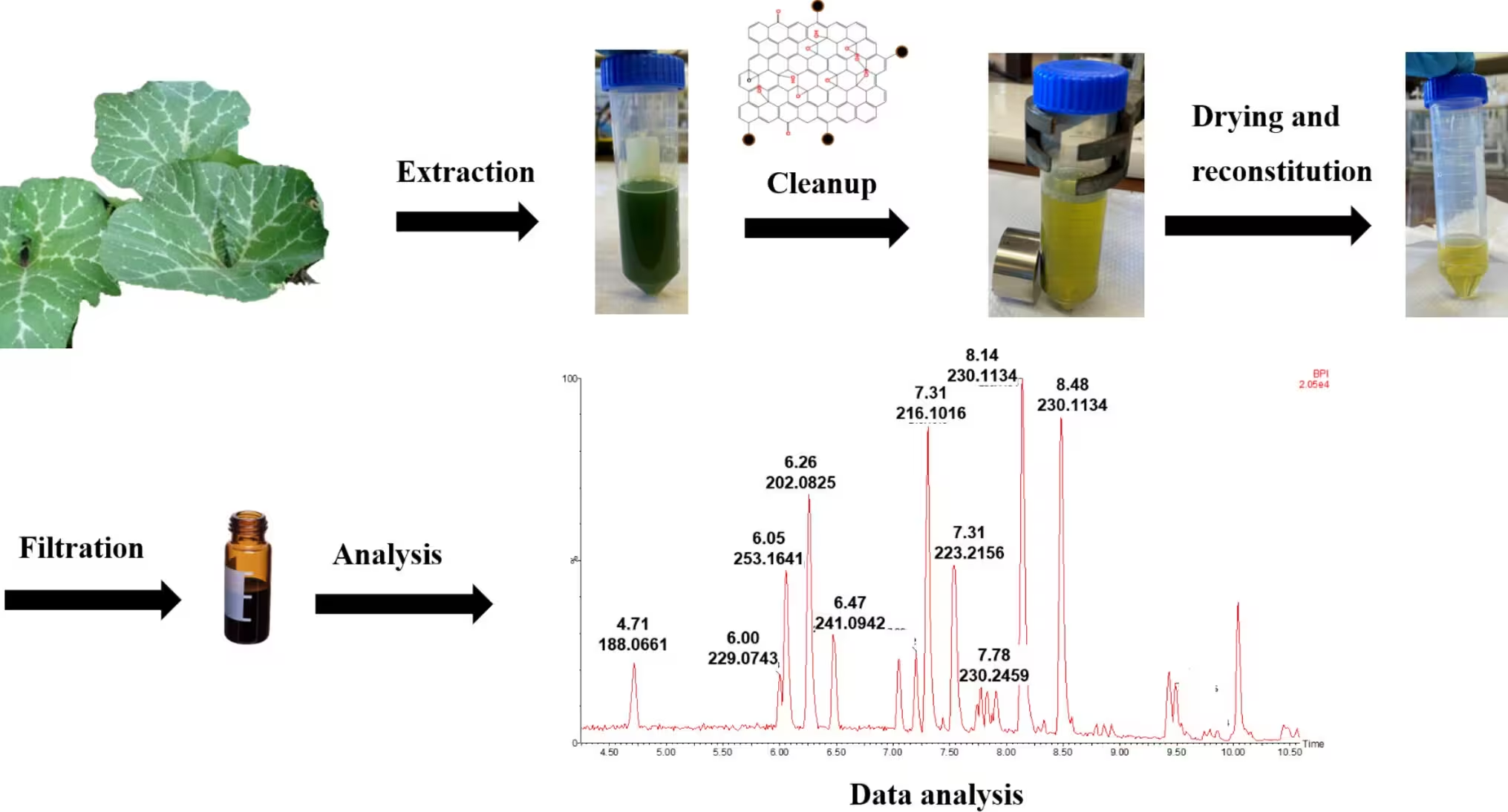
During testing, the researchers extracted herbicide mixtures from homogenized samples of squash leaves, green-skinned avocados, and Hapus mangoes using acetonitrile. They then added fifty milligrams of the magnetic nanocomposite to clean the liquid plant extracts. Because the sorbent contains an inner magnetic core, an external magnet can isolate the cleaning material from the liquid phase in seconds, bypassing tedious centrifugation steps and fragile filtration cartridges.
What Did the Sensitivity and Recovery Tests Reveal?
The research team coupled the dispersive magnetic solid-phase extraction cleanup with ultra-performance liquid chromatography and quadrupole time-of-flight mass spectrometry. This high-resolution setup allowed the scientists to track 17 multiclass herbicides spanning chlorotriazines, phenylureas, and chloroacetamides. Method validation showed strong linearity across all three food matrices, with correlation coefficients consistently exceeding 0.99.
Limits of detection ranged from four-thousandths to six-tenths of a microgram per kilogram, while limits of quantification stretched from thirteen-thousandths to nearly two micrograms per kilogram. These low thresholds easily satisfy stringent regulatory safety limits. When the team analyzed actual grocery and market samples using the optimized technique, none of the 17 target herbicides were detected, indicating that the tested produce remained well within safe agricultural baselines.
Can the Cleaning Sorbent Be Used More Than Once?
One of the most practical advantages demonstrated in the study is the reusability of the magnetic nanocomposite. After each cleanup cycle, the researchers washed the sorbent four times with ethanol and dried it at sixty degrees Celsius. Laboratory tests proved that the Fe3O4@NH2-GO material could be recycled through at least six consecutive extraction runs while retaining stable recovery rates for most of the targeted compounds.
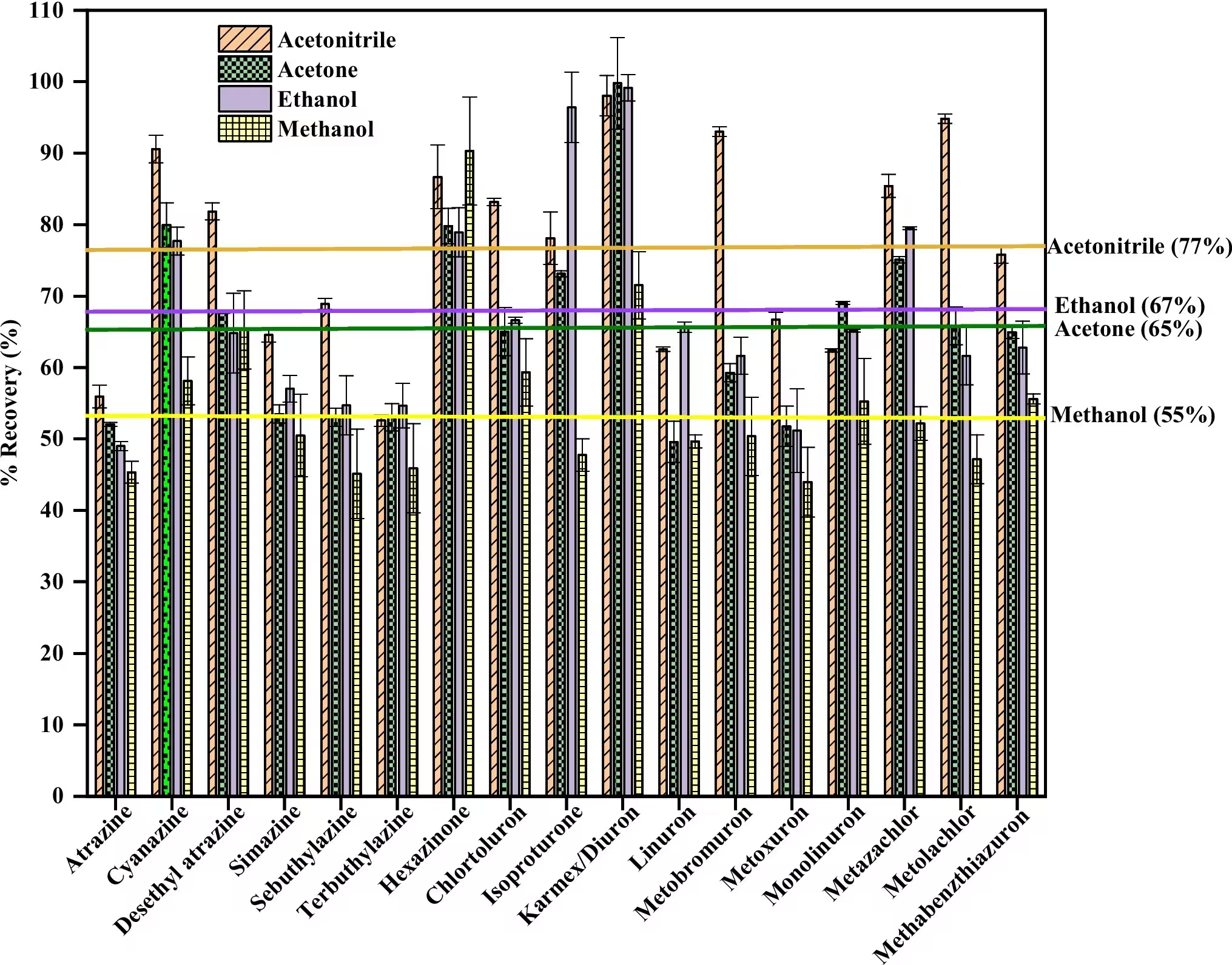
While standard European Committee for Standardization QuEChERS cleanup kits often provided wider linear ranges and slightly more consistent recoveries for specific polar compounds like chlorotriazines, the new magnetic method required smaller sample sizes and significantly reduced sorbent consumption. The authors note that hydrophobic compounds like metolachlor showed lower recoveries in certain matrices due to strong interactions with the nanocomposite surface, indicating that further fine-tuning is necessary for select chemicals. Nevertheless, the magnetic cleanup strategy provides a sustainable, low-waste blueprint for routine food safety monitoring across diverse agricultural commodities.
The research was published in Food Analytical Methods on November 25, 2026.
This article has been fact checked for accuracy, with information verified against reputable sources. Learn more about us and our editorial process.
Last reviewed on .
Article history
- Latest version
Reference(s)
- Ntshani, Gershom Mpela., et al. “Dispersive Magnetic Solid-Phase Cleanup Technique for Analysis of Multiclass Herbicides in Fresh Produce Prior to UPLC-MS Detection.” Food Analytical Methods, vol. 20, no. 1, November 25, 2026 Springer Science and Business Media LLC, doi: 10.1007/s12161-026-03355-7. <https://doi.org/10.1007/s12161-026-03355-7>.
Cite this page:
- Posted by Bilal Abbasi