Magnetic Order Triggers Unexpected Shifts in Crystal Vibrations of Unconventional Magnet
Measurements under high magnetic fields and extreme cold reveal how quantum spin textures rewrite lattice vibrations in manganese telluride.
When an unconventional crystal of manganese telluride cools below ninety degrees Kelvin, its atomic vibrations undergo a sudden and unexpected shift that reveals a deep hidden link between magnetism and crystal structure. Researchers studying this pyrite-type antiferromagnet found that four out of five primary Raman-active lattice vibrations depart entirely from standard thermal contraction models once magnetic order takes hold. The findings, available on the arXiv preprint server, demonstrate how localized symmetry changes can fundamentally rewrite the vibrational behavior of a quantum material.
How Do Magnetic Spins Rewrite Crystal Vibrations?
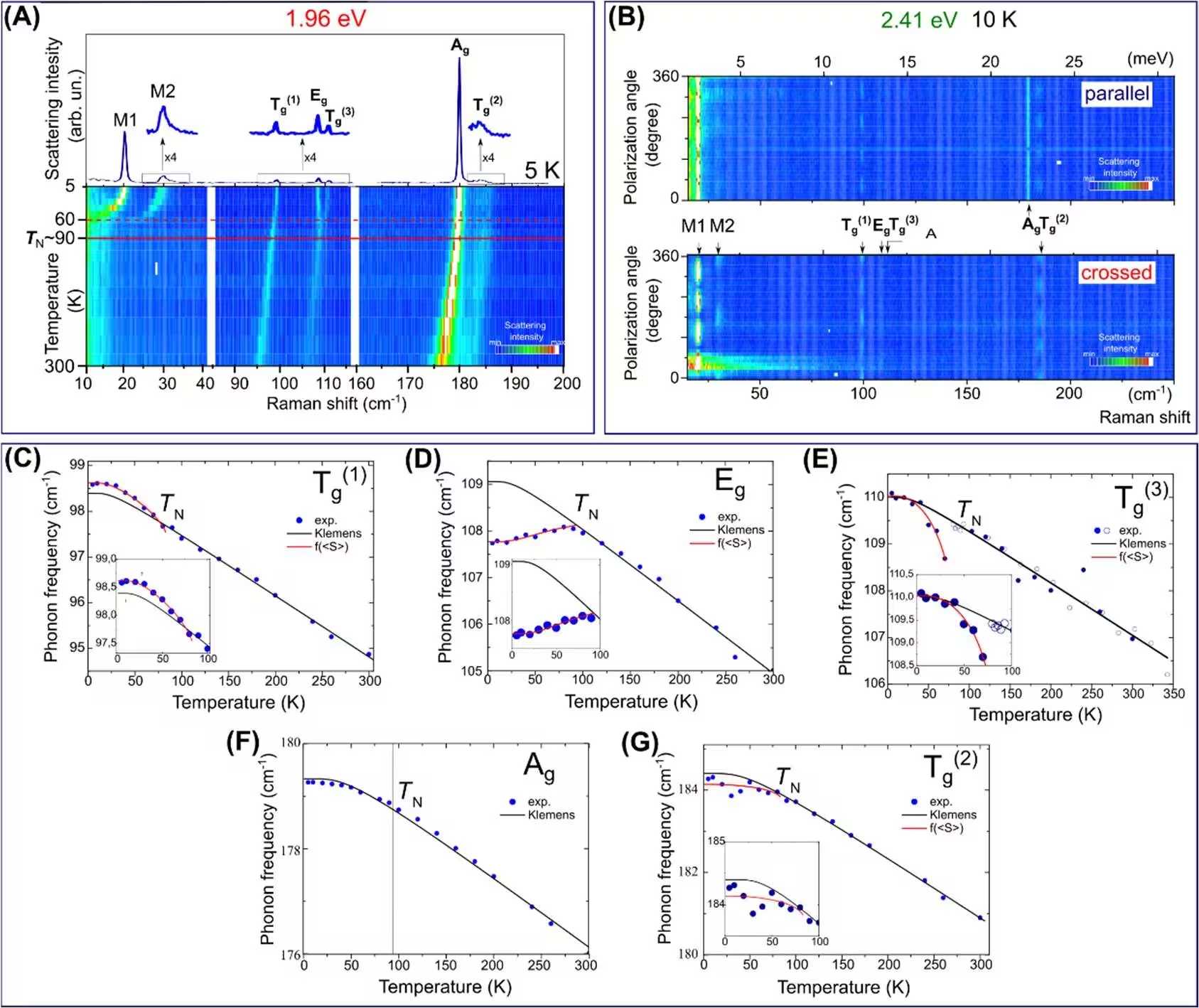
To understand what happens inside manganese telluride, or MnTe2, physicists look at phonons, which are quantized lattice vibrations that normally shift predictably as a material gets colder. In ordinary crystals, cooling causes the lattice to contract smoothly in a process well described by the Klemens model of anharmonic decay. But when non-collinear and non-coplanar spins align below the Néel temperature, four out of five optical phonon modes deviate significantly from this expected baseline.
Led by Taras Palasyuk at the Warsaw University of Technology alongside an international team of collaborators, the researchers used temperature-dependent measurements spanning from five to three hundred Kelvin, linear polarization angles, and external magnetic fields up to sixteen Tesla to probe the material. They discovered that while the fully symmetric Ag phonon mode follows normal thermal expectations, the remaining Eg and Tg modes exhibit distinct hardening, softening, and nonmonotonic behaviors.
What Causes the Abrupt Shifts in Phonon Frequencies?
The most dramatic anomalies appear in neighboring Eg and Tg phonon modes, which sit so close in energy that they blur together at higher temperatures. Below sixty Kelvin, a specific phonon mode known as Tg(3) emerges sharply as a shoulder peak, dropping in energy by about one reciprocal centimeter between eighty and seventy Kelvin before climbing again upon further cooling. Meanwhile, the Eg mode softens linearly, dropping about one point three reciprocal centimeters compared to standard predictions.
The authors account for these anomalies by developing a theoretical model incorporating spin-phonon coupling within a Green’s function formalism. By examining how atomic displacements modulate the superexchange interactions between neighboring manganese ions, the mathematical framework successfully captures the core features of frequency renormalization driven by spin-spin correlations. The work suggests that local structural adjustments, such as subtle shifts in manganese-tellurium bond lengths and tellurium-tellurium dimers, break local site symmetry and permit hybridization between previously isolated vibration modes.
What Happens When External Magnetic Fields Are Applied?
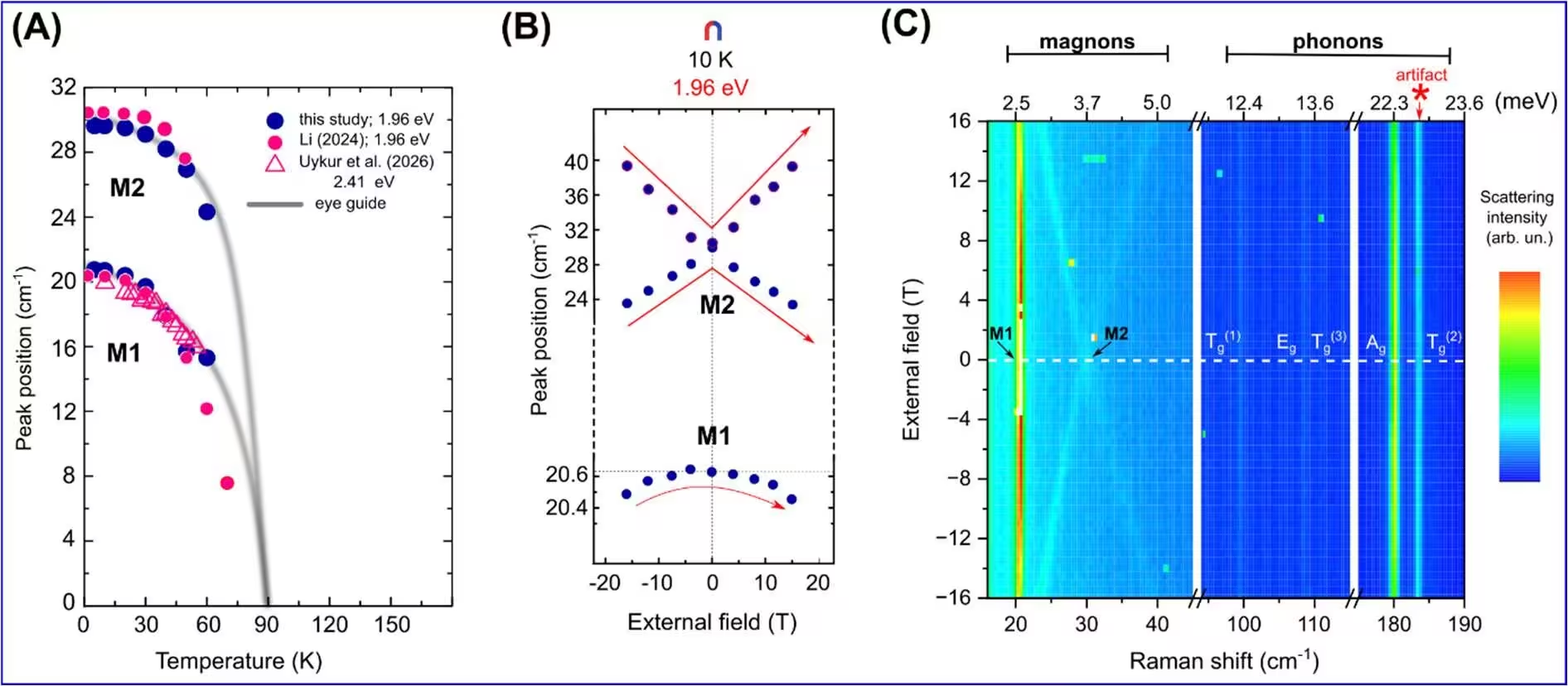
In addition to probing lattice dynamics, the team investigated ultra-low frequency spectral regions where spin-wave excitations, or magnons, reside. Starting at sixty Kelvin, two broad signals designated as M1 and M2 gain intensity and display clear order-parameter evolution. When subjected to external magnetic fields up to sixteen Tesla at ten Kelvin, the M2 signal undergoes clear Zeeman splitting, confirming its magnonic origin.
At the same time, the M1 signal exhibits a subtle but systematic softening of about zero point two reciprocal centimeters under high magnetic fields. The researchers note that these responses, combined with the twofold anisotropy and peak asymmetry observed in certain modes, point toward local time-reversal symmetry breaking in the antiferromagnetic phase. These insights establish a robust foundation for future microscopic investigations into how magnetic textures influence lattice dynamics in unconventional magnets.
The study was posted to the arXiv preprint server on November 24, 2026.
This article has been fact checked for accuracy, with information verified against reputable sources. Learn more about us and our editorial process.
Last reviewed on .
Article history
- Latest version
Reference(s)
- Palasyuk, Taras. “Antiferromagnetic phase of MnTe2: spin-order-induced renormalization of phonon Raman spectrum.” arXiv.org <http://arxiv.org/abs/2611.33156v1>.
Cite this page:
- Posted by Bilal Abbasi