NASA Curiosity Rover Discovers Baffling Honeycomb Pattern Across Martian Surface
NASA’s Curiosity rover has discovered mysterious honeycomb-shaped fractures in Mars’ Valle Grande, offering new clues into the planet’s ancient history.

Mars Rover Uncovers Mysterious Honeycomb Terrain
NASA’s Curiosity rover has stumbled upon a sprawling, geometric landscape in a Martian valley, revealing a dense field of polygonal fractures that stretch as far as its cameras can see. The intricate, honeycomb-like patterns surround a six-meter-tall hill known as Miraflores, providing researchers with a unique opportunity to study small-scale geological features directly from the surface rather than relying on distant orbital imagery.
“We’ve seen a lot of fascinating landscapes through Curiosity’s eyes, but this sea of polygons took our breath away,” said Ashwin Vasavada, the Curiosity project scientist at NASA’s Jet Propulsion Laboratory. He noted that the team is currently conducting a rigorous analysis of the chemical composition and geometry of the fractures to decode the forces that shaped them.
While polygonal terrain is a recurring feature on the Red Planet, the scales of these formations vary significantly. The HiRISE camera aboard the Mars Reconnaissance Orbiter has previously identified massive polygons—some reaching up to 350 meters in diameter—across diverse regions like Hellas Planitia and Noachis Terra. These larger structures are often interpreted as remnants of ancient, water-rich environments. In contrast, the features currently under inspection at Valle Grande are significantly smaller, leaving their precise origin an open question for planetary geologists.
Clues from Ancient Climate Cycles
The discovery invites immediate comparison to earlier findings within Gale Crater. A 2023 study published in Nature identified centimeter-scale polygonal ridges that served as a geological diary of ancient climate shifts. These ridges, characterized by sulfate-rich, Y-shaped junctions, were identified as fossilized mud cracks formed during repeated wet-dry cycles roughly 3.8 to 3.6 billion years ago.
The presence of these patterns suggests that early Mars did not merely experience fleeting pulses of liquid water, but rather sustained, high-frequency environmental cycles. Such conditions are of significant interest to astrobiologists, as consistent wet-dry transitions are thought to facilitate the prebiotic chemical reactions necessary for the development of life.
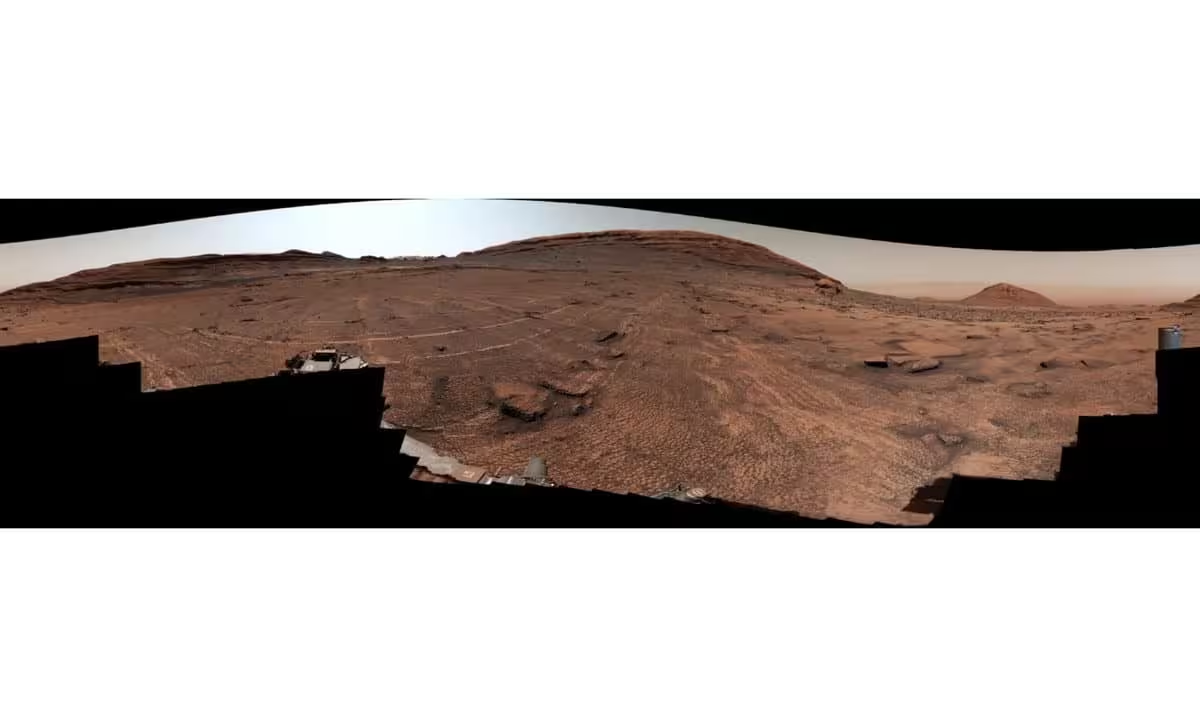
Whether the newly discovered polygons in Valle Grande share this wet-dry origin remains to be seen. Scientists are currently weighing several hypotheses, including freeze-thaw cycles, tectonic stresses, or volcanic activity, as potential drivers for the formation. As Curiosity continues to map the region, the combination of high-resolution geometry and ground-level chemical data is expected to help refine our understanding of how these persistent structures are created on a planet with a long and complex history of geological transformation.
This article has been fact checked for accuracy, with information verified against reputable sources. Learn more about us and our editorial process.
Last reviewed on .
Article history
- Latest version
Reference(s)
- “JPL Science: Ashwin Vasavada.” <https://science.jpl.nasa.gov/people/vasavada/>.
- Rapin, W.. “Sustained wet–dry cycling on early Mars - Nature.”, vol. 620, no. 7973, pp. 299-302. Nature, doi: 10.1038/s41586-023-06220-3. <https://www.nature.com/articles/s41586-023-06220-3>.
Cite this page:
- Posted by Bilal Abbasi