New Simulation Method Cuts Ion Calculation Times Tenfold in Salt Solutions
A dynamic electrostatic feedback protocol bypasses traditional sampling bottlenecks in electrolyte simulations.
Calculating the chemical behavior of individual ions in salt water has long plagued physical chemists, but a new computational protocol cuts simulation times tenfold by harnessing a dynamic electrostatic feedback mechanism. Understanding single-ion properties is vital for mapping biological membrane transport, protein crystallization, and the efficiency of nanoporous supercapacitor electrodes.
Traditional computer simulations of ionic fluids face a major roadblock because they are forced to insert or delete neutral ion pairs simultaneously to prevent artificial electrical charges from destabilizing periodic boundary conditions. To circumvent this limitation, researchers developed alternative techniques such as the single-particle Widom test-particle insertion method. Yet, that approach relies on virtual insertions into unperturbed configurations, suffering from severe sampling bottlenecks in dense environments and requiring separate, computationally expensive calculations for each ionic species.
To solve these bottlenecks, Alexandre P. dos Santos from the Universidade Federal do Rio Grande do Sul and co-authors introduced a Donnan Grand Canonical Monte Carlo simulation method, available on the arXiv preprint server, that utilizes fast three-dimensional Ewald summation. Ewald summation is a mathematical trick used to calculate long-range electrostatic forces in repeating simulation boxes. By introducing an adaptive inner electrostatic potential that penalizes net charge fluctuations, the simulation cell maintains average charge neutrality while allowing single ions to be inserted or deleted independently.
How Does Dynamic Potential Alignment Maintain Neutrality?
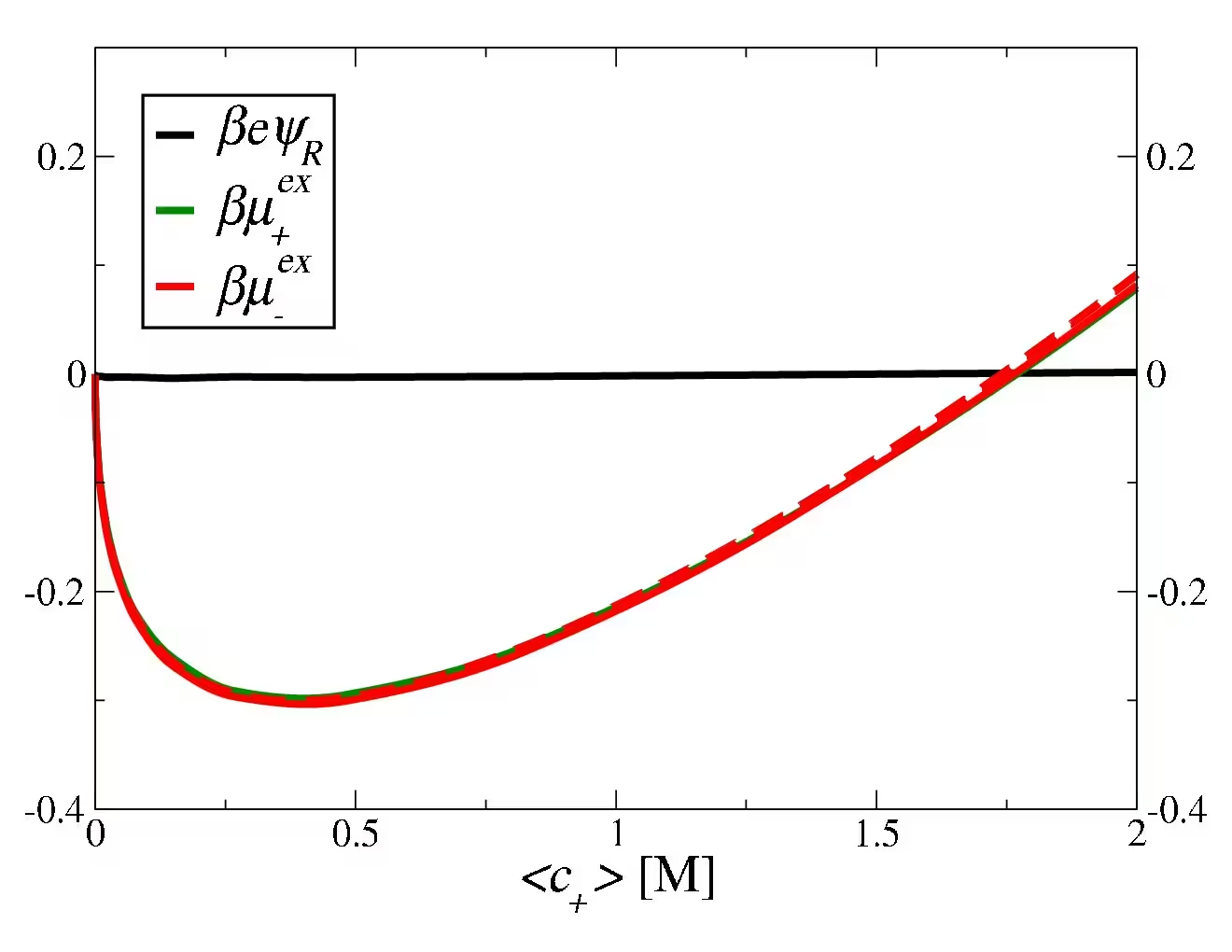
During a simulation run, the system uses a dynamic feedback parameter to counteract instantaneous local charge imbalances. This prevents uncompensated charges from accumulating while preserving thermodynamic consistency with an external reference reservoir. Because both cations and anions are sampled simultaneously during single-ion moves, a single simulation run rapidly yields the complete pair of individual excess chemical potentials corresponding to a specific bulk salt concentration. The authors report that this technique converges about ten times faster than traditional Widom insertion algorithms.
Can Liquid-State Theories Accurately Predict Asymmetric Ions?
To validate the protocol, the research team tested aqueous electrolyte solutions of varying valency stoichiometries, including one-to-one, two-to-one, and three-to-one salts, alongside ionic size asymmetries. They compared their simulation results against the Mean Spherical Approximation, a widely used analytical liquid-state theory. For size-symmetric one-to-one and two-to-one electrolytes, the simulation data showed exceptional agreement with the theoretical benchmark across molar concentrations.
However, the tests revealed the limits of standard linear-response theories when tackling size-asymmetric electrolytes and multivalent ions. When anion radii were increased relative to cations, steric cavity interactions and electrostatic screening became strongly coupled, causing traditional approximations to fail. In these complex regimes, the new simulation protocol maintained smooth performance and rapid statistical convergence without requiring researchers to model entire multi-component electrochemical cells.
The study was posted to the arXiv preprint server on November 23, 2026.
This article has been fact checked for accuracy, with information verified against reputable sources. Learn more about us and our editorial process.
Last reviewed on .
Article history
- Latest version
Reference(s)
- Santos, Alexandre. “Donnan Grand Canonical Monte Carlo Simulations with Fast Ewald Summation for Calculating Individual Ionic Chemical Potentials.” arXiv.org <http://arxiv.org/abs/2611.30961v1>.
Cite this page:
- Posted by Anjali Singh